


















Check Domain
What is Check Domain?
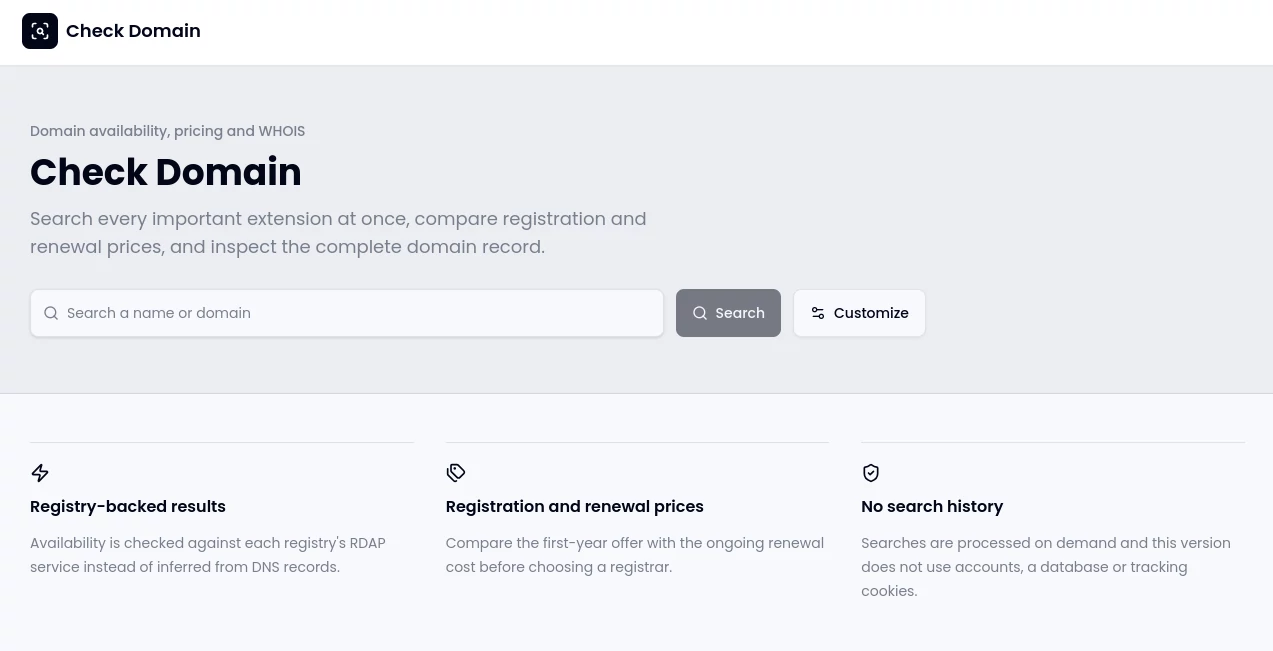
Choosing a domain name is often the first serious decision behind a new website, brand, or online business. A good name needs to be available, affordable beyond the first year, and worth building around. Check Domain brings these considerations together by combining domain availability checks, WHOIS and RDAP information, extension details, and registrar pricing in one place.
Instead of checking one extension at a time and opening several lookup pages, users can start with a brand idea or a complete domain and review multiple extensions together. This makes it particularly useful during the early naming stage, when having a broader view can reveal alternatives that might otherwise be missed.
Key Features
- Multi-extension domain search: Search a name across selected extensions, including popular choices such as .com, .net, .org, .io, and .ai.
- Registry-backed availability: Availability is checked through RDAP services provided by supported registries rather than being inferred only from DNS records.
- WHOIS information: Registered domains can be inspected for available public details such as registrar information, important dates, nameservers, and registry data.
- Registration and renewal prices: First-year registration offers can be compared with ongoing renewal costs, helping users avoid choosing a domain based only on an attractive introductory price.
- Domain status information: Results can distinguish between available, registered, for-sale, or domains that require additional confirmation.
- No account requirement: Searches can be performed without creating an account or maintaining a personal search history.
User Interface
The interface is deliberately focused on the task rather than filled with unnecessary controls. A user can enter a brand name or an existing domain, select the extensions to investigate, and review the returned results.
The result layout is especially useful when comparing several possibilities at once. Availability, domain records, extension information, and pricing are presented as separate pieces of information, making it easier to understand why one domain may be a better choice than another.
For someone brainstorming a new company name, this can save a surprising amount of time. Instead of keeping several browser tabs open and manually comparing results, the important signals are brought into the same research process.
Accuracy & Performance
One of the stronger technical choices is the use of registry-backed RDAP checks for supported extensions. DNS information alone is not always enough to determine whether a domain can actually be registered, so checking against registry services provides a more meaningful availability signal.
Results are processed as the relevant registries respond, allowing users to review extension results without turning the process into a complicated technical lookup. Still, availability should always be confirmed at the registrar during checkout before payment, since domain status can change quickly.
Capabilities
The platform goes beyond a simple available-or-taken answer. Users can investigate registered domains, inspect public WHOIS and RDAP information, review TLD and registry details, examine nameservers, and compare registration costs with renewal prices.
This broader approach is valuable for domain investors, startup founders, developers, agencies, and anyone researching a brand before committing to it. A domain that looks inexpensive at first glance may have a considerably higher renewal price, so seeing both figures can lead to a more informed decision.
Security & Privacy
Privacy is another practical part of the service. The current version does not require user accounts and does not use a database or tracking cookies for maintaining search history. Searches are processed on demand rather than being tied to a personal account.
Users should still remember that WHOIS and RDAP are based on public registry information where available. The information displayed depends on what the relevant registry or registrar makes publicly accessible.
Use Cases
Brand and startup naming: Founders can enter a potential brand name and quickly see which important extensions are available before designing a website or registering a company domain.
Domain purchasing research: Buyers can compare registration and renewal prices rather than judging a domain by its introductory price alone.
Domain portfolio research: Investors can investigate registered names, ownership-related public records, extension details, and registrar information before deciding whether a domain deserves further attention.
Technical investigation: Developers and website owners can inspect RDAP, WHOIS, registry, and nameserver information when investigating an existing domain.
Alternative extension discovery: If a preferred .com name is unavailable, searching several extensions at once can uncover practical alternatives without starting the entire process again.
Pros and Cons
Pros
- Search multiple domain extensions in one workflow.
- Uses registry-backed RDAP availability checks for supported TLDs.
- Provides WHOIS and domain record information where available.
- Shows registration and renewal pricing together.
- Does not require an account to perform searches.
- Useful for both simple domain searches and deeper research.
Cons
- Domain availability is not a permanent reservation and should be confirmed at registrar checkout.
- Public WHOIS and RDAP information can vary depending on the registry and registrar.
- Pricing depends on the available registrar offers and may change over time.
- Users looking for advanced domain portfolio management may need additional services beyond a lookup tool.
Pricing Plans
The service is designed around on-demand domain research and does not require an account to perform a search. The website does not present a conventional subscription plan structure for accessing its lookup interface.
One of the most useful pricing-related features is the ability to compare domain registration and renewal costs. This distinction matters because a low first-year price can sometimes hide a substantially higher recurring cost. Reviewing both figures before registration gives buyers a clearer picture of the long-term expense.
Actual registrar prices can change, so users should treat displayed costs as research information and verify the final amount with the registrar before completing a purchase.
How to Use It
- Enter a brand idea, keyword, or complete domain name into the search field.
- Select the top-level domain extensions you want to investigate.
- Review the availability results as the registry responses arrive.
- Open an available or registered result to inspect additional domain information.
- Check WHOIS or RDAP details when you need ownership, registrar, date, nameserver, or registry context.
- Compare the registration price with the renewal price.
- Before paying, perform the final availability and price confirmation at the registrar's checkout.
Comparison with Similar Tools
Many domain lookup services concentrate primarily on whether a name is available. This approach is useful for a quick check, but it can leave important questions unanswered. A stronger research workflow also considers the extension, registry information, registrar, and future renewal cost.
The main advantage here is the combination of these signals in one search experience. Someone comparing several brand ideas can move from availability to domain records and pricing without switching between unrelated lookup tools.
For a person who simply needs to know whether one .com domain is available, a traditional registrar search may be enough. For broader research, especially when several extensions and long-term costs matter, a more detailed lookup provides considerably more context.
Conclusion
Finding a domain is easy; finding one that makes sense for a real business is a different task. Availability, extension choice, public records, registrar details, and renewal costs can all influence whether a domain is worth choosing.
This service makes that research process more practical by putting these details together rather than treating availability as the only important answer. The ability to compare multiple extensions, inspect registry-backed information, and see registration alongside renewal pricing gives users a better foundation for making a domain decision.
Whether you are naming a startup, launching a personal project, researching a domain portfolio, or investigating an existing website, it offers a straightforward way to gather the information needed before registration.
Frequently Asked Questions (FAQ)
How do I check domain availability?
Enter a brand idea, keyword, or complete domain into the search field and select the extensions you want to investigate. The service checks supported registry services and presents the resulting domain statuses.
Can I check several domain extensions at once?
Yes. You can select multiple top-level domain extensions and review the results together. This is useful when a preferred extension is already registered and you want to explore alternatives.
Is an available domain guaranteed to remain available?
No. Domain availability can change quickly. An availability result should be treated as a research signal, and the final status should be confirmed at the registrar's checkout before completing registration.
What is RDAP?
RDAP, or Registration Data Access Protocol, provides structured information about domain registrations through registry services. Registry-backed RDAP checks can provide a more reliable availability signal than relying only on DNS records.
What information can WHOIS provide?
Depending on the domain and the information made publicly available, a WHOIS record can contain details such as the registrar, registration and expiration dates, nameservers, and other domain record information.
Why should I compare registration and renewal prices?
A registrar may advertise an attractive first-year registration price while charging a different amount for subsequent renewals. Comparing both figures helps you understand the potential long-term cost before committing to a domain.
Do I need to create an account?
No account is required for the current search experience. Users can perform domain research without creating an account or maintaining a saved search history.
Can I use it to investigate an already registered domain?
Yes. Registered domains can be opened to inspect available WHOIS and RDAP information, extension details, registrar information, dates, nameservers, and other public record data.
Does the displayed domain price stay fixed?
No. Registrar pricing can change, and the final cost may differ from an earlier lookup. Always confirm the current price with the registrar before registration.
AI Domain Name Generator , Business .
These classifications represent its core capabilities and areas of application. For related tools, explore the linked categories above.
Check Domain details
Website unavailable — View Alternatives
Pricing
- Freemium
Apps
- Web App
Categories

Check Domain Alternatives Product

wu tang name…

FiveMinChat

Creget

IdeaFast

Receipt AI

Namify
PowerballTax

OnlyTraction

Oasis
