Climer
What is Climer?
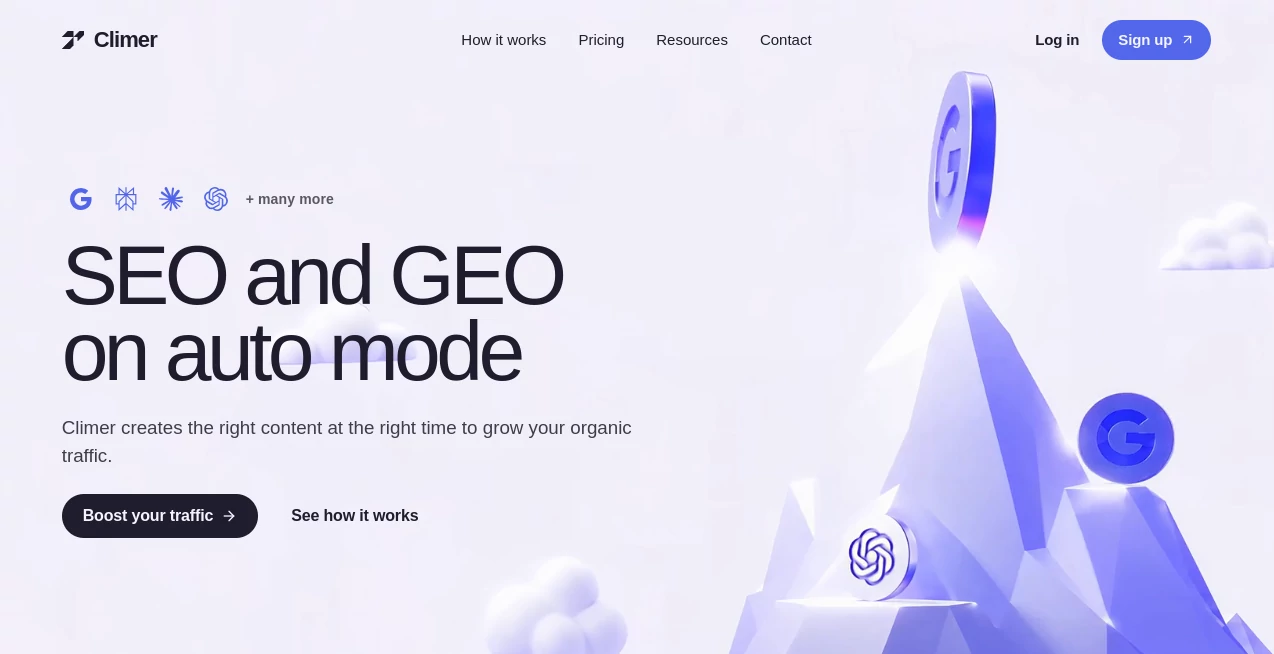
Climer is an AI-powered organic growth platform designed to take much of the guesswork out of SEO and Generative Engine Optimization (GEO). Instead of forcing marketers to jump between separate keyword, content, analytics, and AI visibility tools, it brings these activities into one connected workflow.
The platform focuses on a practical question that every growing website eventually faces: what should we work on next? It connects a website to its existing search performance, identifies opportunities, helps create and improve content, and tracks how those changes affect visibility.
It also looks beyond traditional search. The platform monitors how brands are represented across answer engines and AI assistants such as Google, ChatGPT, Claude, Perplexity, and Gemini. That makes it particularly interesting for businesses that want to improve both conventional search traffic and their presence in AI-generated answers.
Key Features
- Keyword research based on audience demand and competition
- AI-assisted content generation and optimization
- SEO and GEO monitoring
- AI visibility and brand mention tracking
- Google Search Console performance insights
- Internal linking recommendations
- Content quality, readability, and compliance checks
- Content planning and publishing calendar
- Website localization support
- Image support for content workflows
User Interface
The interface is organized around the tasks marketers actually need to manage. Visibility, Content, Calendar, Insights, and Settings provide a straightforward structure rather than burying important information under a long list of disconnected reports.
The visibility area separates traditional search performance from AI-answer performance, making it easier to understand where a website is gaining attention and where it still has room to improve. The content calendar provides another useful layer by showing published, review-ready, upcoming, and planned content in one place.
For someone managing a busy content operation, this approach can be a welcome change. You can move from discovering an opportunity to planning an article and reviewing its performance without constantly switching between different dashboards.
Accuracy & Performance
One of the stronger aspects of the platform is its connection with Google Search Console. Rather than treating content creation as an isolated activity, it uses search performance data to help identify which pages are gaining or losing traffic and where attention may be worthwhile.
The GEO side adds another layer by tracking how a brand appears across AI answer engines. This is useful because traditional ranking positions no longer tell the whole story. A company may rank reasonably well in search while remaining almost invisible when potential customers ask AI assistants for recommendations.
The platform's workflow is built around measured improvements rather than simply publishing large amounts of automatically generated text. Its Growth plan, for example, includes evidence-led writing and substantial optimizations alongside weekly SEO and GEO monitoring.
Capabilities
The platform covers a surprisingly broad section of the organic growth process. It can help discover keywords, evaluate topics, create structured articles, optimize existing pages, identify internal linking opportunities, and monitor changes in search performance.
Its content workflow is particularly useful for teams that want a consistent publishing schedule. The system can find opportunities, create articles, and keep a publishing calendar moving while still allowing content to go through review before publication.
Another notable capability is AI visibility tracking. The platform monitors mentions across several answer engines and helps turn those observations into optimization opportunities. For brands preparing for an increasingly AI-driven search environment, this can make GEO much easier to approach as an ongoing process rather than a one-time experiment.
Security & Privacy
Because the platform connects to website and search-performance data, privacy and access controls are important considerations for any business evaluating it. The service provides dedicated privacy and terms pages, while its workflow is centered around connecting a verified website and working with its content and performance information.
Businesses should review the current privacy policy and terms before connecting production websites, particularly when working with sensitive commercial data or websites managed on behalf of clients.
Use Cases
SEO teams: SEO professionals can use the platform to identify content opportunities, monitor search performance, improve existing pages, and strengthen internal linking.
Content marketers: Teams responsible for publishing regularly can use the content planning and generation workflow to maintain a steady editorial schedule without manually coordinating every step.
SaaS companies: Software companies competing in crowded search markets can use keyword research, content optimization, and AI visibility monitoring to build a broader organic acquisition strategy.
Digital agencies: Agencies managing multiple growth activities can benefit from having research, content, monitoring, and reporting workflows connected rather than spread across several independent applications.
Businesses targeting AI search: Companies concerned about visibility in ChatGPT, Gemini, Claude, Perplexity, and other answer engines can use GEO monitoring to understand whether their brand is being mentioned and where improvement may be possible.
Growing websites: A smaller marketing team can use automation and structured workflows to keep content production moving while retaining human review before publication.
Pros and Cons
- Pros: Combines SEO and GEO workflows in one platform.
- Pros: Connects content decisions with Google Search Console performance data.
- Pros: Includes keyword research, content creation, optimization, and internal linking.
- Pros: Tracks brand visibility across several AI answer engines.
- Pros: Includes a practical publishing calendar and review workflow.
- Pros: Designed around ongoing organic growth rather than isolated keyword reports.
- Cons: The platform is primarily focused on organic growth, so businesses looking for a complete paid advertising suite will still need other tools.
- Cons: Connecting search and website data requires an initial setup and verified website.
- Cons: Businesses with very small content requirements may find a full organic-growth platform more extensive than necessary.
Pricing Plans
The current Growth plan is presented at an equivalent price of $79 per month and includes up to 30 new or optimized articles each month. It supports one verified website and includes weekly SEO and GEO monitoring, portfolio planning, evidence-led writing, substantial optimizations, independent review, and manual publication.
This pricing model is aimed more at businesses and serious content operations than occasional users who only need to generate an article from time to time. Since plans and limits can change, checking the current pricing page before subscribing is recommended.
How to Use the Platform
Getting started follows a relatively logical process. First, connect and verify your website so the platform can understand its pages, content, and search performance.
Next, explore the available visibility and search data to identify areas that need attention. Keyword opportunities can then be evaluated based on demand and competition, helping you decide which subjects are worth covering.
Once a topic has been selected, the content workflow can be used to create a structured article with optimization and quality checks. Internal linking opportunities can also be identified to create stronger connections between relevant pages.
Before publishing, review the generated or optimized content and make any necessary editorial changes. The platform's workflow is designed to support human review, rather than treating automatic publication as the only option.
After publication, return to the performance data to see which pages gained or lost visibility. Over time, this creates a continuous cycle of research, creation, optimization, measurement, and refinement.
Comparison with Similar Tools
Many SEO platforms specialize in one particular part of the process. Some are primarily keyword research applications, others concentrate on content generation, while dedicated analytics products focus on reporting and performance measurement.
The main distinction here is the attempt to connect these activities. Keyword discovery feeds content planning, content creation connects with optimization, published pages can be evaluated through search data, and AI-answer visibility provides another performance signal.
That makes the platform especially appealing to teams that are tired of maintaining several disconnected workflows. It is less about being a replacement for every marketing application and more about bringing the core organic-growth process into a single environment.
For example, a marketer might discover an underdeveloped topic, create an article around it, strengthen its internal links, publish it, and later examine its Google Search Console performance. At the same time, they can investigate whether AI assistants are beginning to mention the brand for relevant questions. That connected workflow is where the platform has its strongest appeal.
Conclusion
For businesses that take organic growth seriously, the biggest challenge is often not producing another article. It is knowing which article to create, which existing page deserves attention, how different pages should connect, and whether the work is actually improving visibility.
This platform addresses that problem by bringing SEO, GEO, content production, optimization, planning, and measurement together. Its integration with Google Search Console and its focus on AI answer visibility make it particularly relevant as search behavior continues to change.
The result is a more connected approach to content marketing. Instead of publishing and hoping for results, teams can work through a repeatable cycle of finding opportunities, making improvements, measuring outcomes, and deciding what deserves attention next.
Frequently Asked Questions (FAQ)
What is this platform used for?
It is designed for SEO and GEO management, including keyword research, content creation, content optimization, internal linking, search performance monitoring, and AI visibility tracking.
Can it track visibility in AI assistants?
Yes. The platform monitors brand mentions across AI answer engines including ChatGPT, Claude, Perplexity, Gemini, and other supported platforms.
Does it work with Google Search Console?
Yes. Google Search Console data is used to monitor search performance and help identify pages and opportunities that deserve attention.
Can it generate SEO content?
Yes. Its content workflow can generate structured, internally linked articles while incorporating formatting and quality checks.
Does it automatically publish articles?
The platform supports a review-oriented workflow. Its Growth plan specifically includes independent review and manual publication, allowing content to be checked before it goes live.
How many articles are included in the Growth plan?
The current Growth plan includes 30 new or optimized articles per month.
Is it useful for GEO as well as traditional SEO?
Yes. GEO is a central part of the platform. It tracks how brands appear in AI-generated answers and uses those observations alongside traditional search data.
Who can benefit most from it?
SEO professionals, content marketers, SaaS companies, agencies, growth teams, and businesses that want to increase organic visibility can all benefit from its connected workflow.
AI SEO Assistant , AI Content Generator , AI Digital Marketing Generator , AI Analytics Assistant .
These classifications represent its core capabilities and areas of application. For related tools, explore the linked categories above.

Climer Alternatives Product

Quikauthor

Ecom Tool AI

PromptBuilder

Diploria AI

CapyQR

URL2Pin

Meev

Lutains

Instaposts.ai