
Cofounder
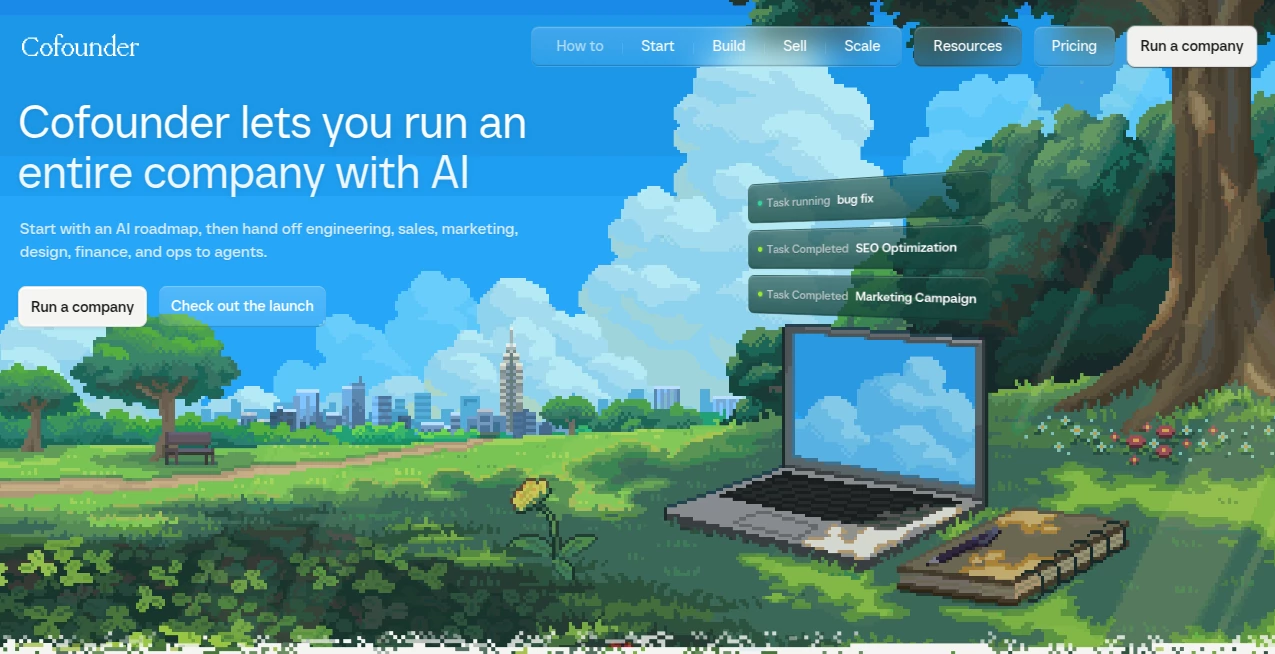
What is Cofounder?
Cofounder is an agent orchestration platform built for founders who want to move from an idea to a functioning business without assembling a large team from day one. Instead of treating AI as a collection of separate assistants, the platform organizes specialized agents across engineering, sales, marketing, design, finance, operations, and customer support.
The approach is particularly interesting for solo founders and small teams. You can start with an AI roadmap, decide what needs to happen next, and let specialized agents work on those tasks while keeping human approval in the loop. The goal is not simply to generate text or code, but to keep real company work moving.
From setting up a codebase and creating a brand presence to researching contacts, running outreach campaigns, managing infrastructure, and supporting customers, the platform brings many startup activities into one operating environment.
Key Features
- AI agents organized around different company functions and departments.
- Company roadmaps that turn startup milestones into concrete tasks.
- Background task execution so multiple jobs can progress at the same time.
- Human approval for actions that require additional oversight.
- Support for custom apps, skills, schedules, MCP connections, APIs, and custom codebases.
- Engineering agents for designing, building, and deploying products.
- Sales and marketing automation covering outreach, content, campaigns, social activity, and analytics.
- Infrastructure and security agents that can monitor live products and help address issues.
- Customer support and payment workflows, including Stripe-related operations.
User Interface
The interface is designed around work rather than a traditional chatbot conversation. Users can view company stages, tasks, agents, and progress from a central workspace. This makes the experience feel closer to managing a small digital organization than chatting with an AI assistant.
The roadmap structure is especially useful when you are starting from scratch. Instead of wondering what to do after creating an initial idea, you can work through stages such as company identity, product development, launch, sales, and growth. Each stage can contain user tasks as well as agent-driven work.
For someone building a startup alone, that structure can make a surprisingly big difference. The platform gives the founder somewhere to look when the usual question of “what should I do next?” comes up.
Accuracy & Performance
Performance depends on the complexity of the task, the AI models involved, and the external services connected to the project. The platform is designed to work with multiple AI models and coordinate agents rather than relying on a single model for every job.
Its strongest advantage is therefore workflow execution rather than a simple benchmark-style answer. An agent can research information, prepare an output, request approval when needed, and continue with the next stage of a task. That makes it more practical for multi-step business work where context needs to be preserved.
Users should still review important outputs before publishing, deploying, contacting customers, or taking financial and operational actions. The human-in-the-loop design is built specifically for this kind of oversight.
Capabilities
The platform covers an unusually broad range of startup activities. On the product side, agents can help set up codebases, design products, build applications, deploy them, and work with infrastructure after launch.
For sales and marketing, it can support contact research, outbound email campaigns, content creation, paid marketing, organic social activity, and analytics. Customer-facing operations can also include support workflows and payment setup.
Another useful capability is extensibility. Businesses can connect custom APIs, MCP tools, skills, applications, or an existing codebase. This gives the system more room to adapt as a company develops its own processes instead of forcing every business into the same workflow.
Security & Privacy
Security is an important consideration when AI agents are connected to company systems, customer information, source code, and operational services. The platform emphasizes human approval for potentially sensitive actions and provides controlled access to the tools and context agents need.
The service also promotes SOC 2 compliant security, while the upcoming Team plan includes SOC 2 as part of its offering. Users connecting business-critical services should nevertheless review the current security and privacy documentation carefully before providing sensitive information.
Use Cases
The clearest use case is launching a software company with a very small team. A founder can begin with an idea, create a roadmap, establish the company's identity, set up a codebase, develop a product, and start working on customer acquisition without immediately hiring specialists for every function.
It can also be useful for validating startup ideas. Instead of spending weeks building a large organization around an untested concept, a founder can use agents to handle early research, product work, branding, outreach, and launch preparation.
Small software teams may find the platform useful for extending their existing capacity. Engineering agents can work on product tasks while sales and marketing agents handle other parts of the business.
Students and first-time founders are another natural audience. The guided startup workflow can provide structure when there is plenty of enthusiasm but little experience with the sequence of tasks required to turn an idea into a real company.
Pros and Cons
Pros
- Combines multiple business functions in one AI agent environment.
- Useful for solo founders and lean startup teams.
- Provides structured roadmaps instead of only conversational assistance.
- Supports multiple AI models and specialized agents.
- Human approval helps keep important actions under founder control.
- Can connect with custom APIs, MCP, skills, and codebases.
- Includes product, sales, marketing, operations, and support workflows.
- Projects can eventually be graduated and ownership transferred to the user.
Cons
- The broad scope may take time to understand for first-time users.
- Usage costs can increase as agent activity and infrastructure usage grow.
- It is primarily designed around company building rather than a single specialized AI task.
- Important business, financial, legal, and deployment decisions still require human review.
- Some advanced team capabilities are not yet generally available.
Pricing Plans
The service currently offers a seven-day free trial with $10 of included usage and access to the Pro experience. This provides an easy way to test the workflow before committing to a paid plan.
The Pro plan starts at $20 per month and includes $20 of monthly usage. It adds access to multiple AI models, domain purchasing and hosting, agent inboxes, managed services, and the ability to graduate projects and claim ownership.
A Team plan is listed at $50 per month with $50 of included usage and is marked as coming soon. It is intended for teams that need features such as multiplayer collaboration, SOC 2, and priority support.
Because pricing is usage-based, the advertised subscription price is not necessarily the final monthly cost for a growing business. Additional usage can cover resources such as agents, AI model usage, compute, database usage, customer support, advertising spend, and data purchasing.
How to Use the Platform
- Start with a company idea or an existing project that you want to develop.
- Use the startup roadmap to identify the next important milestones.
- Provide the relevant company context so agents understand the business and its goals.
- Choose the tasks you want specialized agents to handle.
- Connect the services, applications, APIs, or codebase required for the work.
- Allow agents to work on tasks in the background while monitoring their progress.
- Review outputs and approve actions that require human confirmation.
- Continue through product development, sales, marketing, and operational stages as the company grows.
Comparison with Similar Tools
Traditional AI assistants are generally excellent at helping with individual tasks such as writing, coding, brainstorming, research, or analysis. AI coding platforms can go further by creating applications from natural-language instructions. Business automation platforms, meanwhile, are often focused on connecting existing applications through predefined workflows.
This platform takes a broader approach. Its main distinction is the attempt to coordinate specialized agents around an entire company rather than focusing on one department or one type of output.
That makes it a better fit for a founder who wants an AI operating layer for a business than for someone who simply needs a standalone writing assistant or code generator. The trade-off is that its wider scope also means users need to spend some time understanding how agents, approvals, connected services, and usage work together.
Conclusion
For founders who are tired of stitching together dozens of disconnected tools, this platform offers a compelling alternative. Its biggest strength is the way it treats AI agents as members of a broader operating system, with different agents handling different areas of company building.
The combination of roadmaps, specialized agents, background tasks, human approvals, integrations, and managed infrastructure makes it particularly appealing for solo entrepreneurs and small software teams. It does not eliminate the need for a capable founder, but it can reduce a considerable amount of operational overhead.
If the goal is to test an idea, build a product, find customers, and gradually turn a small operation into a functioning company, this is one of the more ambitious approaches to AI-powered company building worth exploring.
Frequently Asked Questions (FAQ)
Who is the platform best suited for?
It is primarily aimed at early-stage software companies, solo founders, entrepreneurs, and small teams that want to build and operate a company with extensive AI assistance.
Can it help build a software product?
Yes. Engineering agents can help design, build, and deploy products, while infrastructure and security agents can assist with monitoring and operational tasks after launch.
Can it help with sales and marketing?
Yes. Supported workflows include contact research, outbound email campaigns, content creation, paid marketing, organic social activity, and analytics.
Does it require human approval?
Not every task requires manual approval, but the platform uses a human-in-the-loop approach for actions that may be potentially dangerous or require explicit authorization.
Can I connect my own codebase?
Yes. Existing codebases can be connected, although the cleanest experience is generally achieved when a project is set up with the platform from the beginning.
Can I take ownership of my project later?
Yes. Pro and Team users can graduate their projects and claim ownership of the relevant GitHub, Supabase, Vercel, and related projects managed through the platform.
Is there a free option?
There is a seven-day free trial with $10 of included usage and access to the Pro experience. Paid plans then use a subscription combined with included usage.
Can I use my own API key or existing AI subscription?
Currently, bringing your own API key, Codex subscription, or Claude Code subscription is not supported.
What makes it different from a normal AI assistant?
A normal AI assistant generally responds to individual prompts. This platform is designed around coordinated agents, company roadmaps, persistent context, connected tools, approvals, and multi-step business workflows.
AI Workflow Management , AI Project Management , AI Sales Assistant , AI Developer Tools .
These classifications represent its core capabilities and areas of application. For related tools, explore the linked categories above.

Cofounder Alternatives Product

onuml

AgentOne

Geekflare AI

Standard Com…

Workik

Wisegrid

AIOutreach

VisualGPT

Tate-A-Tate