
Comprendo
What is Comprendo?
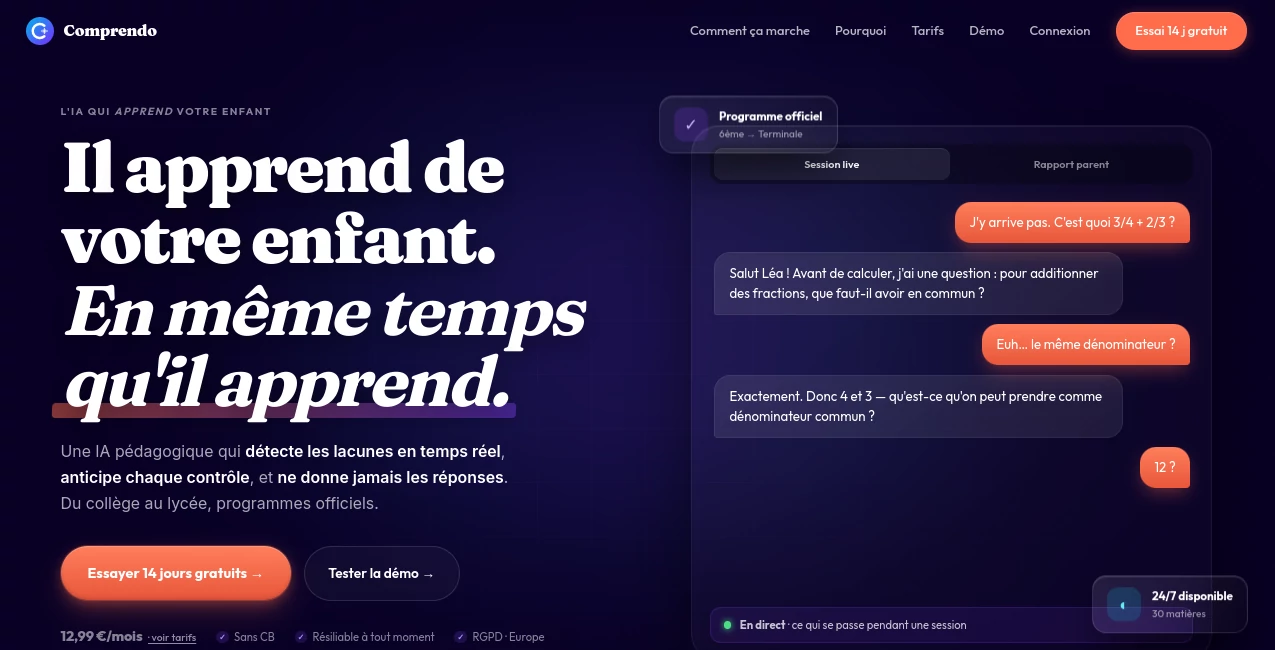
Homework can quickly turn into frustration, especially when a student gets stuck on one question and simply wants someone to provide the answer. This educational AI takes a different approach. Instead of completing an exercise for the learner, it guides students through carefully chosen questions so they can reach the solution themselves.
Designed for students from middle school through high school, the platform follows official French education programs and covers around 30 subjects. It is available around the clock, making it useful not only during planned study sessions but also during those familiar late-evening homework moments when help is needed immediately.
One of its most interesting ideas is that learning does not disappear when a session ends. The system keeps track of mastered concepts, weaker areas, and topics that need to be revisited, allowing future practice to become more relevant to the individual student.
Key Features
- Socratic AI tutoring: Students receive guiding questions instead of ready-made answers, encouraging genuine reasoning and understanding.
- Long-term learning memory: Progress is tracked over time rather than being treated as a collection of disconnected conversations.
- Personalized revision: Revision materials adapt to previously identified weaknesses.
- Homework assistance: Students can type a question or submit a photo of an exercise and receive step-by-step guidance.
- Test preparation: Entering an upcoming test creates a dedicated preparation workspace with priorities, exercises, and revision material.
- Flash quizzes: Targeted multiple-choice questions provide quick practice and immediate feedback.
- Parent reports: Parents can receive weekly information about study time, subjects, weaknesses, and progress without having to supervise every session.
- Official exam preparation: The platform includes official Brevet and Baccalauréat material from 2021–2025, along with timed mock exams and detailed corrections.
User Interface
The experience is deliberately simple. Students begin with an overview of their subjects and chapters, ask a question or upload a picture of an exercise, and then work through the guidance provided by the tutor.
The interface also separates preparation for individual tests into dedicated workspaces. This is a practical touch: instead of creating a generic revision list, students can focus on the exact material they need before a particular exam.
Revision sheets, quizzes, progress information, and upcoming assessments are organized around the student's learning journey. For a teenager who does not want another complicated educational dashboard, that simplicity can make a meaningful difference.
Accuracy & Performance
The platform is built around official French school curricula from 6ème through Terminale. Its exam preparation includes official source material, including Brevet and Bac subjects from recent years, while its test-preparation system adjusts exercises according to the concepts that require attention.
Another notable detail is the use of an Elo-style mastery score for individual concepts. Each exercise can influence the estimated level of mastery, while topics that have not been reviewed gradually become candidates for revision again.
Flash quizzes are also designed to work without relying on an LLM for every interaction, allowing targeted questions to be delivered immediately. Together, these mechanisms make the experience feel more like structured tutoring than an ordinary question-and-answer chatbot.
Capabilities
The platform goes beyond answering homework questions. Students can prepare for upcoming tests, generate personalized revision sheets from course material, practice weak concepts, and work through exam-style exercises.
A particularly useful capability is root-gap detection. When several weaknesses are connected, the system attempts to identify the underlying prerequisite rather than repeatedly treating each mistake as an isolated problem. For example, a student struggling with a later mathematics topic may actually need to revisit a more basic concept first.
Exam preparation is another strong area. Students can work with official Brevet and Bac subjects, timed mock examinations, chapter-based revision sheets, and practice designed around the national curriculum. Support is also available for areas such as the Grand Oral and Parcoursup preparation.
Security & Privacy
Because the service is designed for children and teenagers, privacy is particularly important. The platform states that it follows GDPR requirements, uses parental consent, and keeps data hosted in Europe. It also provides options for exporting or deleting personal data.
For parents, this creates a useful balance between visibility and privacy. Weekly reports can show what has been studied and where difficulties remain without requiring parents to monitor every individual question or conversation.
Use Cases
Daily homework: A student can upload a difficult exercise and work through guiding questions instead of copying a finished solution.
Preparing for a test: Entering the subject and test date creates a focused workspace that prioritizes the concepts most worth reviewing.
Last-minute revision: Flash quizzes and targeted exercises are useful when only a short amount of time is available before an assessment.
Long-term learning: The mastery system helps identify topics that were once understood but may have become weaker after a period without practice.
Brevet and Bac preparation: Students can practice using official exam material, timed mock exams, detailed corrections, and curriculum-aligned revision resources.
Parental follow-up: Parents can use weekly reports to understand study habits and identify subjects that may require additional attention.
Pros and Cons
Pros
- Encourages students to reason rather than copy answers.
- Available 24/7 for homework and revision.
- Supports middle-school and high-school subjects.
- Personalizes revision around detected weaknesses.
- Includes long-term mastery tracking.
- Offers dedicated preparation for upcoming tests.
- Includes official Brevet and Bac preparation resources.
- Provides weekly progress reports for parents.
- Offers a 14-day trial without requiring a credit card.
Cons
- The service is primarily designed around the French education system.
- Students who expect instant answers may initially find the guided approach slower.
- The mobile applications are announced for a later launch rather than being the primary experience today.
- The strongest benefits come from consistent use rather than occasional question answering.
Pricing Plans
There are two main ways to try the service. The free discovery option lasts 14 days and includes one child, up to 10 messages per day, and five exercises per day across middle-school and high-school subjects. No credit card is required for the trial.
The paid family plan costs €12.99 per month and is cancellable at any time. It includes all subjects, persistent unlimited memory, weekly parent reports, and priority support. The plan can be used for one to four children, making it particularly interesting for families with several students.
For parents comparing the cost with traditional private tutoring, the monthly subscription is positioned as a considerably less expensive way to provide regular academic support across multiple subjects.
How to Use Comprendo
Getting started is straightforward. First, create an account and choose the student's educational level. From there, the student can select a subject or chapter and ask a question directly.
For homework, a student can type the problem or upload a photo of the exercise. Rather than receiving the finished answer, the tutor asks questions that gradually lead toward the correct reasoning.
For an upcoming test, enter the subject and examination date. The system can then organize a dedicated preparation plan, prioritize important concepts, provide targeted quizzes, and highlight areas that still need work.
Over time, completed exercises and revision sessions contribute to the student's mastery profile. This means future practice can focus more heavily on concepts that remain fragile.
Comparison with Similar Tools
General-purpose AI assistants are excellent at producing explanations and answers quickly, but that is not always the best learning experience for a student. A learner who can simply copy a solution may finish homework without actually understanding the underlying concept.
Traditional online courses have the opposite limitation: their content is usually structured in advance and does not automatically adapt to every student's weaknesses.
Private tutors provide highly personalized support, but they are limited by schedules, availability, and considerably higher costs. The approach here sits between these options: it offers continuous availability while attempting to preserve the questioning and reasoning style of a personal tutor.
The distinction is especially clear in test preparation. Rather than simply generating another explanation, the platform can organize preparation around a specific upcoming assessment, identify weaker concepts, and use targeted exercises to reinforce them.
Conclusion
For students, the most valuable part of this educational AI may be what it deliberately refuses to do: hand over the answer. Its teaching method is built around helping learners discover the solution through questions, which makes it better suited to developing understanding than simply completing homework.
The combination of personalized revision, long-term mastery tracking, test-specific preparation, official exam resources, and parent reporting gives it a more structured role than a conventional chatbot.
It will not replace every teacher or private tutor, and students who want instant solutions may need some time to adjust to the method. But for families looking for affordable, always-available academic support that encourages independent thinking, it is a compelling option worth trying.
Frequently Asked Questions (FAQ)
Does the AI give students the answers?
No. Its core teaching method is based on guiding students with questions rather than providing a ready-to-copy solution. The goal is to help the learner understand how to reach the answer independently.
Which students can use the platform?
It is designed for students from 6ème through Terminale and follows the official French education programs across middle-school and high-school subjects.
Can students upload a photo of an exercise?
Yes. Students can submit a photograph of an exercise and receive guided assistance based on the problem.
Can it help prepare for the Brevet and Bac?
Yes. The service includes official Brevet and Bac subjects from 2021–2025, detailed corrections, timed mock exams, and chapter-based revision resources.
How does the long-term memory work?
Exercises and interactions contribute to a mastery score for individual concepts. Concepts that have not been reviewed can gradually lose priority, while related weaknesses can be connected to identify underlying gaps.
Can parents monitor progress?
Yes. Weekly reports provide information about study time, subjects, identified weaknesses, and progress without requiring parents to follow every study session.
Is there a free trial?
Yes. The discovery plan provides 14 days of access with daily limits on messages and exercises. A credit card is not required.
How much does the paid plan cost?
The family subscription costs €12.99 per month and can be cancelled at any time. It includes all subjects, persistent memory, weekly parent reports, and priority support.
Is the service GDPR compliant?
The platform states that it follows GDPR requirements, requires parental consent, and hosts data in Europe. It also provides options for data export and deletion.
Are mobile apps available?
iOS and Android applications are planned for launch around the 2026 back-to-school period, with features such as mobile revision, parent notifications, and an offline mode.
Education , AI Education Assistant , AI Homework Helper , AI Coaching .
These classifications represent its core capabilities and areas of application. For related tools, explore the linked categories above.

Comprendo Alternatives Product

Sourcetable

GradeProAI

core level

Youshow IELTS

Wondika

TranscribeYT

Lexi4

GameGen

MediTailor -…