


















Cortea
What is Cortea?
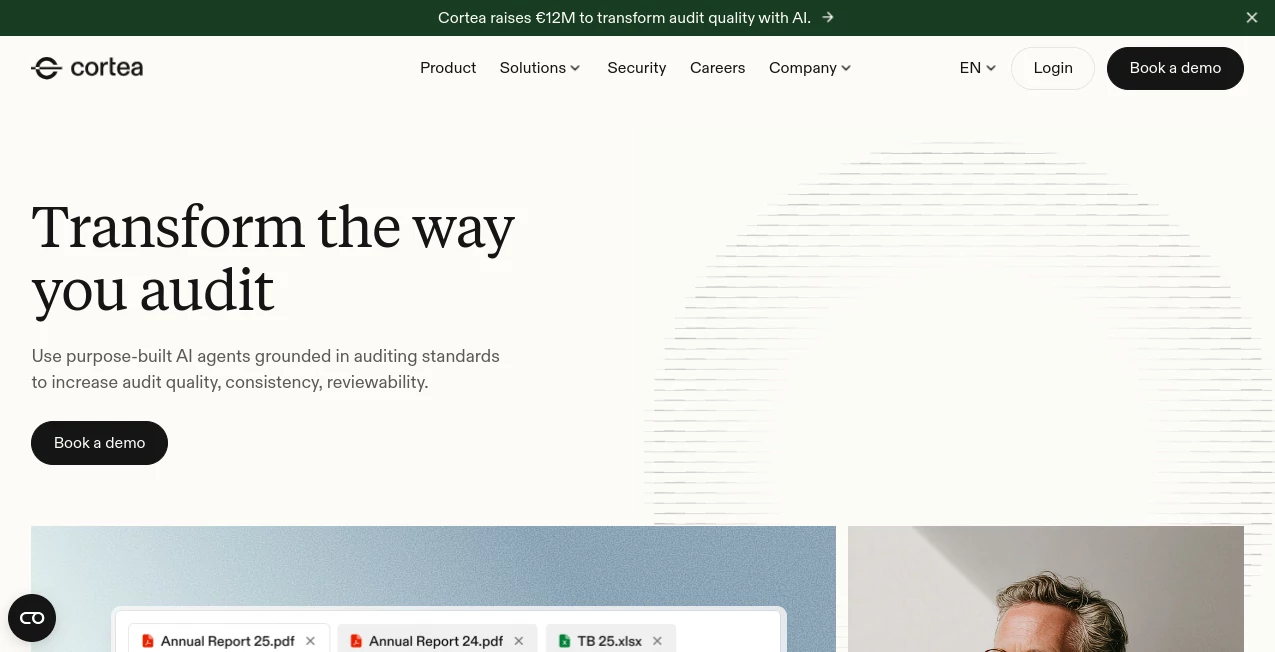
Cortea is an AI-powered audit platform built for professional audit firms that want to reduce repetitive work without giving up the professional judgment that makes an audit reliable. Instead of treating AI as a general-purpose assistant, the platform is designed around audit workflows, established methodologies, and the practical requirements of financial and IT audit teams.
The idea is straightforward: let AI handle the checking, comparison, analysis, and preparation work that can consume valuable hours, while auditors remain responsible for reviewing conclusions and making final decisions. This approach makes the technology particularly interesting for firms dealing with large volumes of evidence, complex financial information, and demanding documentation requirements.
Key Features
- AI-powered quality agents for reviewing audit files and supporting documentation.
- Risk analysis and audit planning aligned with established auditing methodologies.
- Automated disclosure and compliance checks covering IFRS, UK GAAP, and Companies Act requirements.
- Financial data validation against source documents with an audit trail.
- Evidence testing that allows teams to review documents and samples against defined criteria.
- File request management for tracking submissions and engagement documentation.
- Audit team collaboration with task assignment and milestone tracking.
- Support for financial audits, IT audits, advisory work, and internal audit processes.
User Interface
The interface is designed around the way audit teams already work rather than forcing users into an unfamiliar AI-first workflow. Teams can work with audit files, source documents, evidence, requests, and review procedures in a structured environment.
One useful aspect is the ability to start an analysis from a specific task, such as creating a risk analysis or reviewing supporting material. This keeps the AI interaction practical. An auditor does not need to write elaborate prompts just to get useful work started.
Accuracy & Performance
Accuracy is particularly important in audit software because a fast answer is of little value if the reasoning behind it cannot be reviewed. The platform is designed around established audit methodologies and standards, with outputs intended to be traceable back to the documents and information used during analysis.
Its quality agents can cross-check financial statements, disclosures, audit reports, figures, assertions, and supporting documentation to identify inconsistencies, missing information, and potential compliance issues. The goal is not simply to produce an answer quickly, but to make review work more consistent and easier to manage.
Capabilities
The platform covers several stages of the audit process. Teams can use AI for risk identification and planning, evidence testing, financial data validation, disclosure reviews, and quality-control procedures. It can also help organize file requests and keep engagement tasks moving.
For IT audit teams, the system can assist with reviewing system documentation, controls, and supporting evidence. Internal audit departments can use it for recurring procedures and risk monitoring, while advisory teams can apply the technology to research, analysis, and client deliverables.
A strong point is the distinction between assistance and decision-making. The system can flag issues, prepare analysis, and draft findings, but the auditor remains responsible for reviewing, approving, and signing the work.
Security & Privacy
Security is clearly a central consideration for an audit platform because client files can contain highly confidential financial and business information. The platform states that it is built around enterprise security expectations and supports ISO 27001 and SOC 2 Type II standards.
It is also designed with UK GDPR and EU GDPR requirements in mind. Client and engagement data is kept separated, with access controls based on need-to-know principles. Another important point for professional firms is that client data is not used to train AI models.
These controls make the platform more suitable for professional environments where confidentiality, professional secrecy, and clear data boundaries are not optional extras.
Use Cases
Financial audit: Audit teams can use the platform for evidence review, financial data validation, disclosure checks, risk analysis, and repetitive testing procedures.
IT audit: Teams reviewing controls and system documentation can use AI assistance to examine evidence and maintain consistent, traceable results.
Internal audit: Organizations can automate recurring procedures, monitor risk areas, and maintain documentation that can withstand internal or external review.
Advisory: Professional teams can speed up research and analysis while keeping experienced professionals involved in the final interpretation and client-facing work.
For example, an audit team dealing with hundreds of supporting documents could use AI to identify unusual inconsistencies or missing information before a senior auditor begins the final review. That does not replace the auditor; it gives the auditor a cleaner starting point.
Pros and Cons
Pros
- Purpose-built for professional audit workflows.
- Designed around auditing standards and firm methodologies.
- Supports financial, IT, internal audit, and advisory use cases.
- Provides traceability and keeps auditors involved in final decisions.
- Automates repetitive evidence, disclosure, and data-review tasks.
- Strong focus on confidentiality and professional secrecy.
- Client data is not used to train AI models.
Cons
- It is primarily aimed at professional audit firms rather than casual users.
- The platform may require organizational onboarding and workflow integration.
- Pricing is not presented as a standard self-service subscription on the public website.
- Teams looking for a general-purpose AI assistant may find its specialized focus more restrictive than a broad AI platform.
Pricing Plans
Pricing is not publicly listed as a fixed monthly or annual plan on the website. Instead, interested organizations are directed toward a product demonstration and a business conversation.
This pricing approach makes sense for enterprise audit software, where the number of users, engagements, workflow requirements, and organizational needs can vary significantly between firms. Teams interested in adopting the platform should request a demo to discuss their requirements and obtain the appropriate commercial details.
How to Use the Platform
- Request a product demonstration and discuss your firm's audit workflow.
- Identify the areas where automation could provide the greatest benefit, such as evidence testing, risk analysis, or disclosure review.
- Provide the relevant audit documents, source information, or engagement material within the supported workflow.
- Use the AI agents to analyze information, identify inconsistencies, and prepare findings or review material.
- Review the generated results and supporting context as part of the normal audit process.
- Approve, modify, or reject findings according to professional judgment and firm methodology.
- Keep the final audit decision and sign-off with the responsible auditor.
Comparison with Similar Tools
Many AI products focus on general document analysis, accounting assistance, or business productivity. This platform takes a narrower and more specialized route by concentrating on audit quality and professional review workflows.
That distinction matters. A general AI assistant may be useful for summarizing a document, but an audit-focused system needs to consider evidence, methodology, compliance requirements, traceability, reviewability, and professional responsibility at the same time.
For an audit firm searching for broad office automation, a general productivity platform may offer more flexibility. For a professional team looking specifically to introduce AI into audit procedures while maintaining auditor oversight, a purpose-built solution can be a much closer fit.
Conclusion
AI is becoming increasingly useful in professional audit work, but the most valuable systems are not necessarily the ones that try to replace the professional. The stronger approach is often to remove repetitive checking and preparation work while giving experienced auditors better information to review.
That is where this platform stands out. Its combination of audit-focused AI agents, standards-based workflows, traceable analysis, collaboration features, and strong confidentiality controls makes it a compelling option for modern audit firms.
For organizations dealing with growing evidence volumes and increasingly demanding reporting requirements, reducing manual review without sacrificing professional judgment can make a meaningful difference. A demonstration is the best next step for firms that want to see how the platform fits into their existing audit process.
Frequently Asked Questions (FAQ)
What is Cortea used for?
It is designed to help professional audit teams automate and improve tasks such as risk analysis, evidence testing, financial data validation, disclosure checking, audit file review, and quality-control procedures.
Is it suitable for financial audits?
Yes. Financial audit is one of its primary use cases, including evidence review, financial figure validation, disclosure checks, and risk-based audit planning.
Can IT auditors use the platform?
Yes. The platform also supports IT audit workflows involving system documentation, controls, and supporting evidence.
Does the AI replace the auditor?
No. The system is designed to support auditors by flagging, analyzing, and drafting information. The auditor remains responsible for reviewing, approving, and signing the final work.
Is client data used to train AI models?
No. The platform states that client and engagement data is not used to train AI models.
Does it support audit standards?
Yes. Its workflows are built around established audit methodologies and standards, including references to ISA (UK) 315, FRC guidance, IFRS, UK GAAP, and Companies Act disclosure requirements.
Is pricing publicly available?
No fixed public pricing plans are presented on the website. Organizations can request a demonstration to discuss their requirements and pricing.
AI Documents Assistant , AI Accounting Assistant , AI Research Tool .
These classifications represent its core capabilities and areas of application. For related tools, explore the linked categories above.

Cortea Alternatives Product

JFIF to JPG …

Grow A Garde…

Lessie AI

Elicit

UPDF AI

Website Traf…

ChatView-AI …

Create Filla…

PrompTessor
