


















Crucible
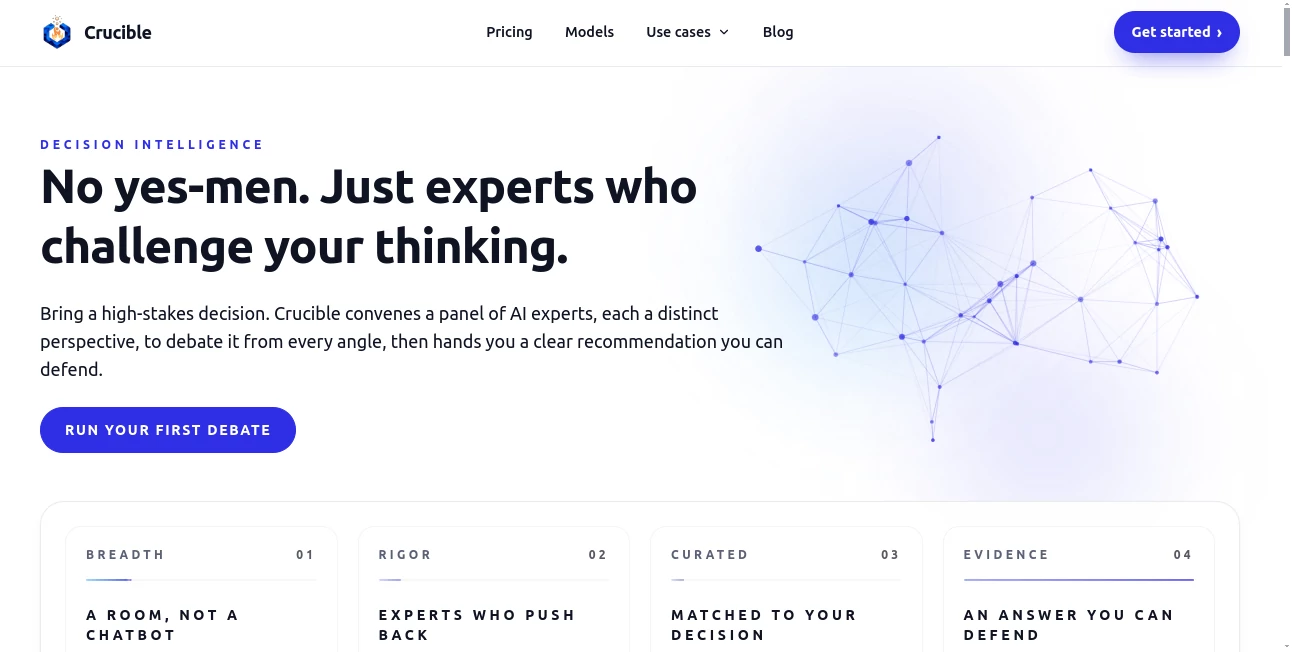
What is Crucible?
Building AI applications is no longer just about getting a model to respond. The real challenge lies in understanding how it behaves under different conditions, how reliable its outputs are, and how it performs when scaled. This is where a modern experimentation and evaluation environment becomes essential.
This platform is designed to help developers, researchers, and product teams systematically test and refine AI-driven systems. Instead of relying on guesswork or isolated prompts, it offers a structured environment where AI behavior can be measured, compared, and improved over time.
What makes it particularly valuable is its focus on clarity. It turns complex AI evaluation workflows into something approachable, even for teams that are not deeply specialized in machine learning.
Key Features
User Interface
The interface is intentionally minimal and focused, allowing users to concentrate on experiments rather than configuration overhead. Workflows are organized in a way that feels natural, making it easy to run multiple tests and review results side by side.
Accuracy & Performance
It enables consistent evaluation of AI outputs across different scenarios. By standardizing test conditions, teams can better understand performance differences between models, prompts, or system configurations.
Capabilities
The platform supports structured experimentation, allowing users to run repeatable AI tests, compare variations, and analyze outcomes. It is especially useful for teams working on LLM-based applications, agents, and conversational systems.
Security & Privacy
Security is handled with a focus on protecting experimental data and model interactions. Sensitive inputs and outputs remain contained within the user’s workspace, ensuring controlled access during development and testing phases.
Use Cases
- Testing and comparing large language model behaviors
- Evaluating prompt engineering strategies
- Building and refining AI agents and workflows
- Quality assurance for AI-powered applications
- Research experiments in AI behavior and performance
Pros and Cons
Pros
- Structured environment for AI evaluation
- Helps reduce uncertainty in model performance
- Suitable for both technical and semi-technical users
- Improves reproducibility of AI experiments
Cons
- May require initial learning for non-technical users
- Best value is realized in teams rather than solo experimentation
Pricing Plans
Pricing is typically structured to support different levels of usage, from individual experimentation to enterprise-scale AI testing. Users can start small and expand as their needs grow, especially when working with larger teams or complex AI workflows.
How to Use This Platform
Getting started begins with creating a workspace and defining your first experiment. Users can input prompts, configure different model settings, and run side-by-side comparisons. Results are then analyzed to identify patterns, weaknesses, and opportunities for improvement.
Over time, teams can build a library of experiments, making it easier to track progress and maintain consistency across AI development cycles.
Comparison with Similar Tools
Compared to basic prompt testing tools, this platform offers a more structured and scalable approach. While many tools focus only on single prompt outputs, this system emphasizes repeatability, evaluation frameworks, and deeper analysis.
It stands out for teams that need more than quick testing—they need a controlled environment for long-term AI improvement.
Conclusion
As AI systems become more integrated into real-world products, the need for reliable evaluation grows stronger. This platform provides a practical way to bring structure into that process. It helps teams move from intuition-based testing to a more disciplined, measurable approach to AI development.
The result is not just better models, but better understanding of how those models behave in real-world conditions.
Frequently Asked Questions (FAQ)
What is this platform mainly used for?
It is used for evaluating, testing, and improving AI models and applications in a structured environment.
Do I need advanced technical skills to use it?
Basic familiarity with AI concepts helps, but the interface is designed to be accessible to a wide range of users.
Can it be used for team projects?
Yes, it is especially effective for teams working on collaborative AI development and testing workflows.
Is it suitable for production-level AI systems?
It is primarily designed for experimentation and evaluation, but the insights gained can directly improve production systems.
What makes it different from simple prompt testers?
It focuses on repeatable experiments, structured evaluation, and comparative analysis rather than single-output testing.
Code & IT , AI Research Tool , Large Language Models (LLMs) , AI Developer Tools .
These classifications represent its core capabilities and areas of application. For related tools, explore the linked categories above.

Crucible Alternatives Product

ModelsLab

Devplan

LocalRAG!

Standard Com…

AI Job Risk …

Fig0

Website Traf…

Vibe Code Pi…

AgentOne
