














AI Job Risk Check
Verified Blue CheckMark
Verified Blue CheckMark products are featured above free or unverified listings.
This badge indicates authenticity and builds trust, giving your product higher visibility across the platform.
Upgrade to get verified
Verified Blue CheckMark products are featured above free or unverified listings. This badge indicates authenticity and builds trust, giving your product higher visibility across the platform.
Upgrade to get verified
What is AI Job Risk Check?
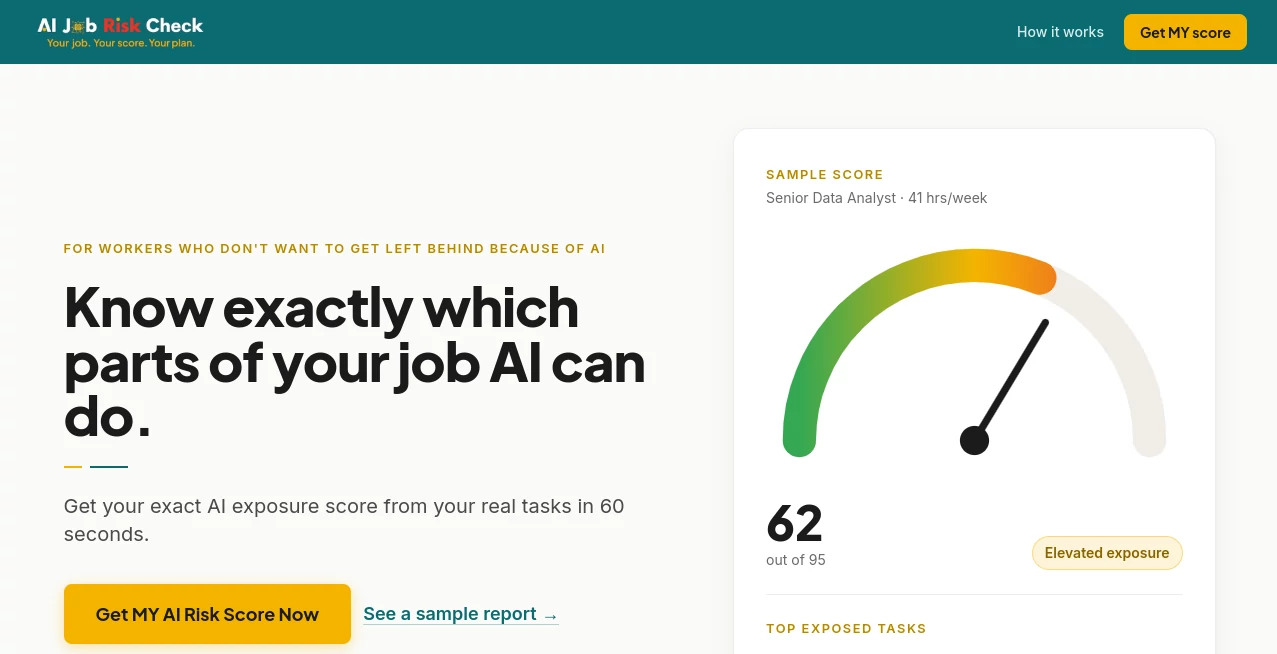
AI is changing the way people work, but the question is rarely as simple as whether a particular job will disappear. In most cases, the more useful question is which parts of that job are already being affected by AI. AI Job Risk Check takes this task-level approach and gives professionals a clearer picture of where they currently stand.
Instead of judging someone only by their job title, the assessment looks at the actual tasks they perform and how much time they spend on them. This distinction makes the experience much more personal. Two people with the same title can receive very different results because their daily responsibilities may look nothing alike.
The assessment takes about 60 seconds and does not require an account, email address, or credit card. Users enter their job title, review relevant tasks, indicate how much of their time goes toward each one, and receive a free AI Job Risk Score. The result is intended as a practical starting point for thinking about career development rather than a prediction of job loss.
Key Features
- Free AI exposure score from 0 to 100
- Task-level assessment instead of relying only on job titles
- Time-weighted scoring based on how much of the workday each task represents
- Task-by-task exposure analysis in the full report
- Personalized career action plan
- Three-year AI exposure outlook
- Research-informed scoring methodology
- O*NET occupational data from the U.S. Department of Labor
- AI exposure research based on published academic work
- Optional one-to-one coaching for putting the recommended plan into practice
- No signup required for the free assessment
User Interface
The experience is deliberately straightforward. There is no lengthy onboarding process or complicated dashboard to learn before seeing a result. The assessment starts with a job title and then moves into the tasks associated with that occupation.
Users rate how much time they spend on the listed activities, which keeps the process connected to their actual working routine. The interface also explains what the score represents instead of treating the final number as a mysterious prediction. For someone who simply wants a quick first look at their AI exposure, the short assessment is particularly convenient.
Accuracy & Performance
The strength of the assessment comes from its methodology rather than from presenting a generic percentage for an occupation. Tasks are mapped to O*NET occupational information and evaluated using published research on AI exposure and AI task capabilities.
The scoring system weights each task according to the amount of time the user spends on it. A task that takes up most of a person's week therefore has more influence on the final result than something performed only occasionally.
The methodology draws on the Eloundou et al. framework published in Science and research from METR on AI task time horizons. The score is capped at 95, reflecting the fact that current occupations still involve human input rather than assuming complete automation.
Capabilities
The free assessment provides a personal score and a detailed look at at least one task so users can understand how the calculation works. The paid report goes further by breaking down the tasks that contribute most to AI exposure and connecting those findings with the user's role.
The resulting profile is designed to answer a practical question: what should I pay attention to next? Rather than simply suggesting that someone "learn AI," the action plan can focus on specific activities within their existing work and identify areas where adapting early may be useful.
Another useful feature is the forward-looking component. Instead of promising an exact prediction for the next few years, the assessment uses the available research to indicate whether exposure for particular tasks is likely to be rising, steady, or already near its current ceiling.
Security & Privacy
The assessment is designed to require very little personal information. A résumé and detailed employment history are not required to receive the basic result, and the free score can be obtained without creating an account.
The service also states that its assessment is secured with SSL and that payments are handled through Stripe. Because the score is intended as an informed snapshot rather than professional career advice, users should treat the result as one useful source of information alongside their own experience, skills, employer situation, and industry knowledge.
Use Cases
- Employees: Understand which parts of a current role may be most exposed to AI.
- Career changers: Compare the AI exposure of different types of work before investing in a new direction.
- Professionals: Identify repetitive or highly automatable tasks that may deserve attention.
- Managers: Think more clearly about how AI could change the work performed by a team.
- Students: Explore how AI may affect potential career paths and the skills associated with them.
- Freelancers: Examine which services they provide may become easier for clients to automate.
- Career coaches: Use task-level exposure as a conversation starter when helping clients plan their next steps.
Pros and Cons
Pros
- Free initial assessment
- Fast assessment that takes about one minute
- No signup required for the free score
- Looks at tasks rather than relying solely on job titles
- Accounts for the amount of time spent on different tasks
- Uses recognizable public occupational and research sources
- Provides a personalized action plan with the full report
- Offers optional coaching for users who want additional support
Cons
- The score cannot predict whether a particular person will lose their job.
- O*NET occupations are standardized, so they may not perfectly describe every individual's responsibilities.
- AI capabilities and workplace adoption change quickly, meaning results can become outdated over time.
- The full report and coaching features require payment.
- The assessment does not know every factor affecting an individual's job security, such as employer strategy, seniority, relationships, or specialized experience.
Pricing Plans
The basic AI Job Risk Score is free. Users can complete the assessment in roughly 60 seconds without signing up, providing an easy way to see how much of their current work may be exposed to AI.
The full report, profile, personalized plan, and first month of coaching are currently offered for a one-time payment of $29.99. After the included month, users can choose whether to continue with coaching for $12.99 per month. The coaching is optional and is not automatically billed.
This pricing structure makes the free assessment a useful entry point for people who are curious about their position, while the paid option is better suited to someone who wants a more detailed breakdown and hands-on support.
How to Use It
- Enter your current job title.
- Select the occupation that most closely matches your work.
- Review the tasks associated with that occupation.
- Rate how much of your working time goes toward each task.
- Answer the additional question about whether you perform the work yourself or manage people who perform it.
- Receive your free AI Job Risk Score.
- Review the tasks contributing most strongly to your result.
- Unlock the full report if you want the detailed profile and personalized action plan.
- Use the recommended plan to decide which skills, tasks, or career opportunities deserve attention.
Comparison with Similar Tools
Many AI career-risk calculators begin with an occupation and assign it a broad exposure level. That approach can be useful for getting a general idea, but it can miss a major difference between people who share the same job title.
This assessment takes a more granular route by asking how a person actually spends their working time. Consider two software engineers: one may spend most of the day writing routine code, while another may spend much of the week designing systems, mentoring colleagues, and making architectural decisions. Their exposure to current AI capabilities is unlikely to be identical.
The published scoring formula is another point of distinction. Instead of presenting a black-box number, the methodology explains how task exposure and time weighting contribute to the final score. The service also goes beyond the assessment itself by offering a personalized plan and optional coaching.
That makes it more useful for someone who is not simply looking for a frightening headline about AI replacing jobs, but wants a clearer idea of what to do next.
Conclusion
AI is unlikely to affect every part of every job in the same way. Some tasks may become easier, some may change substantially, and others may continue to depend heavily on human judgment and context. Looking at the work one task at a time provides a much more useful perspective than treating a job title as a complete picture.
This assessment offers a quick and accessible way to explore that perspective. The free score requires almost no commitment, while the full report adds task-level analysis and a practical career plan. For professionals who have been wondering how exposed their everyday work really is, it can turn a vague concern about AI into something more concrete and actionable.
The most valuable takeaway is not a single number. It is knowing which parts of your work deserve attention and having a clearer starting point for adapting before change forces the issue.
Frequently Asked Questions (FAQ)
What is an AI Job Risk Score?
It is a score from 0 to 100 that estimates how much of a person's specific work is exposed to AI capabilities based on the tasks they perform and the amount of time they spend on those tasks.
Is the AI Job Risk Score free?
Yes. The basic score is free, takes about 60 seconds, and does not require an account, email address, or credit card.
Does a high score mean AI will take my job?
No. A high score indicates greater exposure of the tasks in a role to current AI capabilities. It does not predict that a particular person will be laid off or that an entire occupation will disappear.
How is the score calculated?
The assessment maps work activities to occupational tasks and evaluates their AI exposure. The amount of time a user spends on each task is used as a weight, so frequently performed tasks have a greater influence on the final result.
What research is used?
The methodology uses O*NET occupational data from the U.S. Department of Labor along with published AI exposure research, including the Eloundou et al. framework and METR research on AI task time horizons.
How long does the assessment take?
The basic assessment takes about 60 seconds. Users enter their job information, rate their tasks, and receive their initial score without creating an account.
What does the paid report include?
The full option includes a more detailed task-by-task report, a personalized profile, an action plan, and the first month of coaching.
Is coaching mandatory?
No. Coaching is optional. After the included first month, users can decide whether they want to continue with additional coaching.
Can the result change over time?
Yes. AI capabilities, workplace adoption, and a person's responsibilities can all change. The assessment is best viewed as a snapshot that can be revisited as the working environment evolves.