Doodara
What is Doodara?
Creating a children's picture book traditionally takes time, writing ability, illustration skills, and plenty of patience. Doodara brings those pieces together in one simple creative experience, allowing parents, teachers, and creators to turn an idea into a personalized illustrated storybook in just a few minutes.
The process is designed to feel approachable rather than technical. You can describe a character, choose an artistic style, select a story theme, and let AI build the narrative and illustrations page by page. A particularly useful feature is character consistency, which helps the same character maintain a recognizable appearance throughout the book.
With more than 2,400 picture books created, 16 art styles, over 20 story templates, and five book formats, the platform offers plenty of room for experimenting with different stories and visual directions.
Key Features
- AI-generated children's picture books created from an idea, character, or photo.
- 16 artistic styles, including watercolor, crayon, pencil, anime, 3D rounded, collage, oil painting, and pixel art.
- More than 20 story templates covering themes such as school, emotions, adventure, and everyday experiences.
- Character consistency across pages to reduce unwanted changes in appearance.
- AI-generated story outlines, page scripts, and illustrations.
- Interactive flipbook previews for reading and sharing.
- PDF export for users who want to print their finished books.
- Multiple layouts including square, landscape, portrait, and spread formats.
- Support for creating books in 10 languages.
User Interface
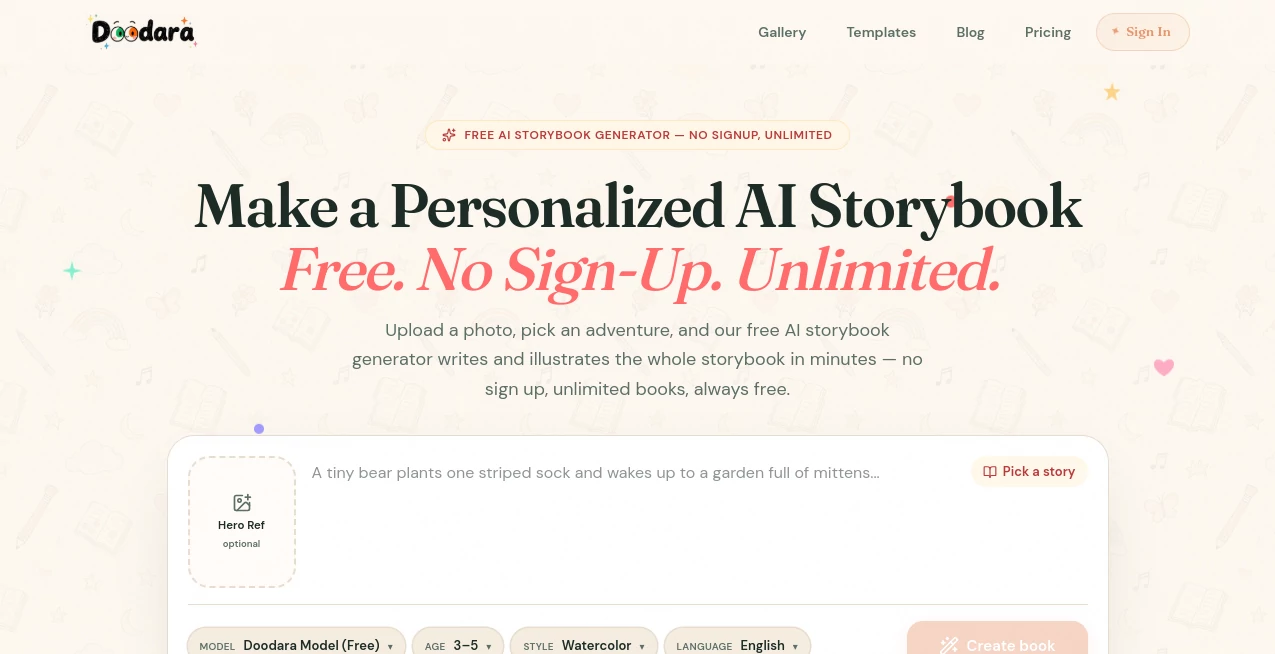
The interface keeps the creative process straightforward. Instead of presenting users with a complicated collection of design controls, it guides them through the essential decisions: character, art style, story, and language.
That simplicity is especially helpful for parents and teachers who may have a story idea but no experience with illustration software. Someone creating a bedtime story, for example, can choose a theme such as fear of the dark, define the main character, and let the system handle much of the production work.
Accuracy & Performance
The strongest part of the experience is the way writing and visual generation work together. The system produces the story outline and page scripts before generating the illustrations, while its character consistency feature is designed to keep the protagonist recognizable from one page to the next.
Generation is intended to take only a few minutes. Users can review and edit pages as the book develops, which gives the process more control than simply accepting one finished AI-generated image.
Capabilities
This is more than a basic story generator. It combines storytelling, illustration, character creation, page composition, and book presentation into a single workflow. Users can create a character portrait, choose from more than 20 story templates or write their own idea, select one of 16 visual styles, and generate a complete illustrated book.
The finished result can be viewed as an interactive flipbook, shared through a link, or exported as a PDF. The different book formats also make the same story suitable for different reading and presentation contexts.
Security & Privacy
Privacy matters when a service is designed for family-oriented content and may involve personal photographs. Users should review the platform's current privacy policy and terms before uploading personal images, particularly when creating stories featuring children.
The service also allows people to begin creating without signing up, while an account becomes useful when users want to save, share, or print their books.
Use Cases
Parents can use it to create personalized bedtime stories in which their child becomes the main character. A story about a first day at school, a family adventure, or overcoming a fear can become much more engaging when the child recognizes themselves in the illustrations.
Teachers can also use personalized books for classroom activities. A custom story can introduce a lesson, encourage reading, explore emotions, or help younger students connect with a subject through characters and visual storytelling.
It can also work well for gifts. A personalized story featuring a child, sibling, grandparent, or fictional character can become a memorable keepsake rather than another generic digital story.
Pros and Cons
Pros
- Simple workflow suitable for non-designers.
- Free plan available.
- No sign-up is required to begin creating.
- 16 different visual styles.
- More than 20 story templates.
- Character consistency across pages.
- Interactive flipbook preview.
- PDF export and print-oriented formats.
- Supports 10 story languages.
Cons
- The free plan has a limited monthly credit allowance.
- More extensive book creation requires a paid plan.
- AI-generated stories and illustrations may still need human editing for the best result.
- Users seeking advanced manual illustration controls may find the simplified workflow limiting.
Pricing Plans
The platform offers a Free plan at $0 per month with 10 credits, all 16 art styles, book formats and sizes, spread-page support, and story templates. The free tier is intended for roughly one picture book per month.
The Pro plan costs $19.90 per month and includes 200 credits, approximately 20 picture books per month, batch illustration generation, and unlimited IP characters. An annual subscription is listed at $238.80 per year.
The Premium plan costs $59.90 per month and provides 1,000 credits, approximately 100 picture books per month, faster generation, early access to new features, and priority support. The annual price is listed as $718.80.
Credit usage is straightforward: a page illustration, character portrait, setting image, or cover image consumes one credit, while story outlines, page scripts, and AI suggestions do not consume credits.
How to Use the Tool
- Start by describing or creating the main character and choose an artistic style.
- Select a story theme from the available templates or provide your own idea.
- Choose the desired language and book format.
- Let the AI generate the story outline, scripts, and page illustrations.
- Review the generated pages and make edits where necessary.
- Preview the finished book using the interactive flipbook.
- Share the story through a link or export it as a PDF for printing.
Comparison with Similar Tools
Many AI writing applications can produce children's stories, while image generators can create attractive illustrations. The difference here is the complete book-oriented workflow. Instead of moving between separate writing and image-generation applications, users can develop the story and its artwork within the same creative process.
The emphasis on consistent characters is another practical advantage. When making a multi-page children's book, having a recognizable protagonist throughout the story is far more useful than generating a collection of unrelated illustrations.
The inclusion of templates, multiple art styles, flipbook previews, PDF export, and print-ready formats also makes the experience closer to producing an actual picture book rather than simply generating a collection of AI images.
Conclusion
For parents, teachers, and creators who want to turn a simple idea into a personalized children's book, this is an appealing combination of storytelling and visual creation. The workflow removes much of the technical work normally associated with writing and illustrating a book, while still giving users choices over characters, themes, styles, languages, and formats.
The free plan makes it easy to experiment before committing to a subscription, and the broader plans are aimed at people who want to create books more frequently. Whether the goal is a bedtime story, classroom activity, personalized gift, or simply a fun creative project, the platform provides a practical route from an idea to a finished picture book.
Frequently Asked Questions (FAQ)
Is it free to create an AI storybook?
Yes. A free plan is available with 10 credits per month. The service also allows users to begin creating without signing up.
How many art styles are available?
There are 16 art styles, including watercolor, crayon, pencil, anime, 3D rounded, collage, oil painting, pixel art, and several other artistic approaches.
Can I use my own story idea?
Yes. Users can choose from more than 20 templates or provide their own story concept instead of relying entirely on a predefined theme.
Can the same character appear throughout the book?
Yes. The platform includes character consistency technology designed to maintain the character's appearance across different pages.
Can I download the finished storybook?
Yes. Finished books can be exported as PDF files, making them suitable for saving or printing.
Does it support languages other than English?
Yes. Storybooks can be created in 10 languages, including English, Spanish, French, German, Portuguese, Italian, Japanese, Korean, Chinese, and Arabic.
Can I print a personalized book?
Yes. The platform provides print-ready formats and also offers an option to order a printed copy through its service.
Who can benefit from an AI storybook maker?
Parents, teachers, children, writers, and creative users can all use it. It is particularly useful for personalized bedtime stories, classroom projects, family gifts, and creative storytelling.
AI Book Writing , AI Illustration Generator , AI Story Writing .
These classifications represent its core capabilities and areas of application. For related tools, explore the linked categories above.

Doodara Alternatives Product
Automateed
Luma AI
Neural Novel…

Krea 2 Turbo
Leonardo.ai
BookAI.chat
ISEKAI ZERO

AI Fanfic Ge…

AI Story Gen…