


















Epub Translator
What is Epub Translator?
Epub Translator is an online EPUB translation tool designed for readers who want to work with complete ebooks rather than copying and pasting individual paragraphs into a general translator. It allows users to upload a DRM-free EPUB file, select a target language, and translate readable content across the entire book while keeping chapters, images, formatting, and reading order together.
The service is particularly useful when you have found an interesting novel, nonfiction book, research source, or learning material that is not available in your preferred language. Instead of rebuilding the book after translating separate sections, the original EPUB structure remains part of the workflow. Users can also read the original book in the browser before deciding whether translation is necessary.
Key Features
- Complete EPUB book translation rather than paragraph-by-paragraph translation.
- Support for 20 target languages, including English, Spanish, French, German, Japanese, Chinese, Arabic, Korean, Portuguese, and more.
- Preservation of chapters, images, formatting, and reading order.
- Translated and bilingual EPUB files included with completed translations.
- Built-in browser reading for the original and translated editions.
- Translation cost calculated according to the readable character count.
- Free credits are available for users to try the translation service.
- No software installation is required because the complete workflow runs in a web browser.
User Interface
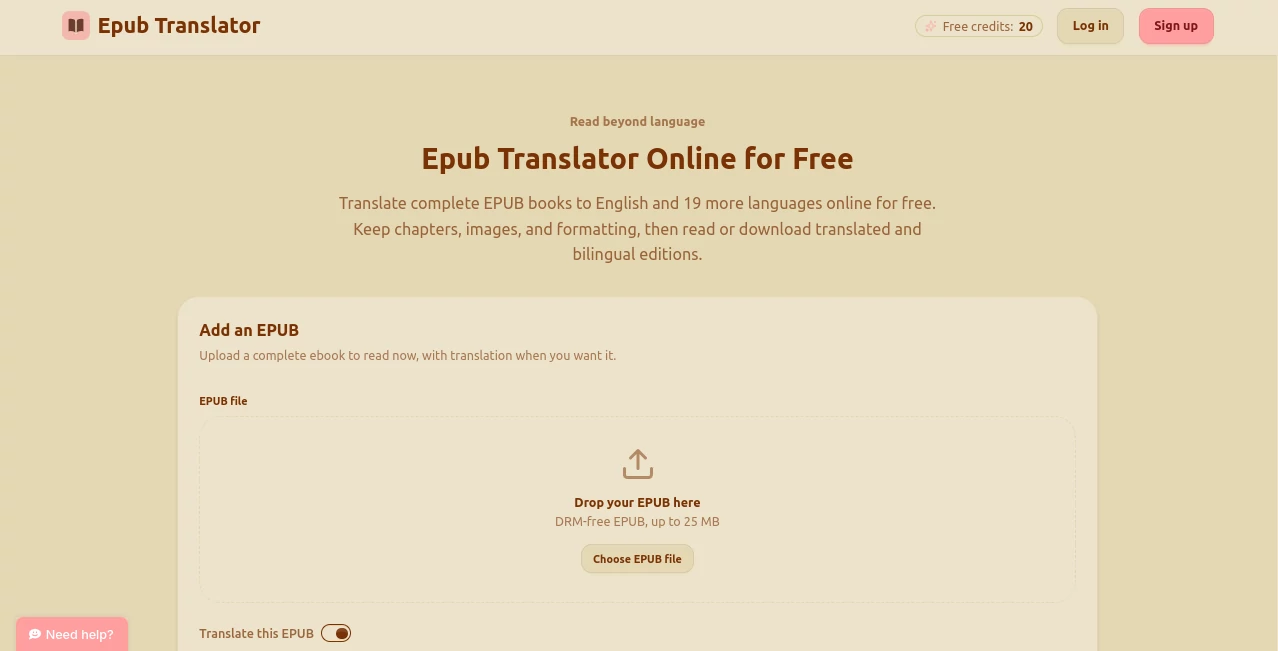
The interface is built around a simple upload-and-translate workflow. Users can drop a DRM-free EPUB file into the upload area or select one from their device. Once the book is prepared, it can be opened in the built-in reader, making it possible to inspect the original content before starting a translation.
The translation controls are straightforward: choose the target language, review the readable character count and credit requirement, then start the job. During processing, users can follow the translation progress and switch between Original, Translated, and Bilingual reading modes when the corresponding versions are available.
Accuracy & Performance
Translating an entire ebook is a different challenge from translating a short message. A book contains chapter boundaries, headings, notes, images, and a much larger amount of text. The platform approaches this as a complete-book translation job, processing readable content across the chapters rather than requiring users to submit each section individually.
Performance also depends on the size and readable character count of the EPUB. Before translation begins, the service displays the character count and the required credit price, giving users a clearer idea of what the job will involve instead of leaving the cost completely unknown.
Capabilities
The strongest part of the service is its focus on the EPUB format itself. It is not simply a text box where you paste a chapter and receive translated paragraphs. The goal is to return an ebook that remains useful as an ebook.
After translation, users receive two versions: a translated EPUB containing the target-language text and a bilingual EPUB that keeps the original and translated content together. The bilingual option can be especially practical for language learners, researchers, and readers who want to check a translation against the source.
The supported target languages currently include Arabic, Simplified Chinese, Traditional Chinese, Dutch, English, French, German, Hindi, Indonesian, Italian, Japanese, Korean, Polish, Brazilian Portuguese, Russian, Spanish, Thai, Turkish, Ukrainian, and Vietnamese.
Security & Privacy
Because users are uploading complete ebook files, privacy is an important consideration. The service is designed around DRM-free EPUB files and provides access to its terms of service and privacy policy. Users should still make sure they have the appropriate rights to upload and translate a particular book, especially when working with copyrighted material.
Another useful aspect is that users can open and read the original EPUB in the browser before committing to a translation. This gives readers an opportunity to check the file and decide whether translating the complete book is actually worthwhile.
Use Cases
- Reading foreign-language books: Translate novels and nonfiction books that are difficult to read in their original language.
- Language learning: Use the bilingual edition to compare original passages with their translations while studying vocabulary and sentence structure.
- Academic and personal research: Work through foreign-language books and long-form sources without manually copying every chapter into another translator.
- International readers: Make ebooks from different markets more accessible without rebuilding the book manually.
- Travel and cultural reading: Explore books written in languages you do not normally read.
- Offline reading: Download the completed EPUB editions and continue reading in a preferred ebook application.
Pros and Cons
Pros
- Designed specifically for complete EPUB books.
- Preserves chapters, images, formatting, and reading order.
- Provides both translated and bilingual EPUB outputs.
- Supports 20 target languages.
- Offers free credits for trying the service.
- Works directly from a browser without installing software.
- Uses a pay-per-credit approach rather than requiring a recurring subscription.
Cons
- Only DRM-free EPUB files can be uploaded.
- The translation cost varies according to the amount of readable text.
- Users who need very specialized literary or technical translation may still want to review important passages manually.
- The service is focused on EPUB rather than providing a broad document-translation workflow for many unrelated file formats.
Pricing Plans
The service uses credits rather than a traditional recurring subscription. Free credits are available, allowing users to try EPUB translation before purchasing additional capacity.
Paid credits are permanently valid. The current credit options include 10 credits for $4.99, 20 credits for $8.99, and 50 credits for $17.99. The effective price per credit becomes lower with the larger packages.
The exact number of credits required for a translation depends on the readable character count of the uploaded book. Before starting a paid translation, users can review the calculated cost. Completed translations include both the translated and bilingual EPUB versions.
How to Use Epub Translator
Start by selecting a DRM-free EPUB file from your computer or device. Files can be uploaded directly through the browser, with the current upload limit set at 25 MB.
Once the book has been prepared, open it in the built-in reader if you want to inspect the original content first. When you are ready to translate, select one of the available target languages and review the readable character count and required credits.
Start the translation and follow its progress. When processing is complete, you can read the translated version online or download both the standard translated EPUB and the bilingual EPUB. The downloaded files can then be used with compatible ebook readers on desktop, tablet, or mobile devices.
Comparison with Similar Tools
General-purpose translation services are excellent for short passages, messages, and individual pieces of text, but they are not always designed around the structure of an ebook. Copying an entire book chapter by chapter can also become tedious, especially when the original formatting needs to be reconstructed afterward.
This service takes a more specialized approach. Instead of treating an EPUB as a collection of unrelated paragraphs, it works with the complete ebook and aims to preserve its chapter structure, images, formatting, and reading order. That makes it a more natural choice for someone whose starting point is already an EPUB file.
The bilingual output is another useful distinction. A reader studying Spanish, Japanese, French, or another supported language can keep the original and translated content together instead of maintaining two completely separate files.
Conclusion
For readers who regularly encounter EPUB books in languages they do not understand, this service solves a very specific and frustrating problem: translating the book without turning it into a pile of disconnected text.
The combination of complete-book processing, preserved structure, browser reading, 20 target languages, and translated plus bilingual downloads makes it particularly appealing for readers, students, researchers, and language learners. The credit system is also straightforward, with the required amount shown according to the book's readable content.
If your goal is simply to translate a sentence, a general translator may be enough. But when the starting point is a complete EPUB and you want to keep reading it as an ebook afterward, a dedicated EPUB translation workflow can save a considerable amount of manual work.
Frequently Asked Questions (FAQ)
Is Epub Translator free?
Yes. Users receive free credits for EPUB translation, and reading original EPUB files in the browser is available for free. Additional translation capacity can be purchased through credit packages.
Can I translate an entire EPUB book?
Yes. The service is designed to process readable text across a complete EPUB rather than requiring users to copy and submit individual chapters.
Does it preserve the original book structure?
Yes. Chapters, images, formatting, and reading order are kept together in the translated EPUB output.
What is a bilingual EPUB?
A bilingual EPUB contains the original and translated content together. It can be useful for language learning, proofreading, research, and comparing a translation with the source text.
How many languages are supported?
There are currently 20 target languages, including English, Spanish, French, German, Japanese, Chinese, Arabic, Korean, Italian, Portuguese, Russian, Turkish, Ukrainian, Vietnamese, and others.
Can I read my original EPUB before translating it?
Yes. The original book can be opened in the built-in browser reader after it has been prepared, allowing you to read it before starting a translation.
Can I download the translated book?
Yes. Completed translations provide both a standard translated EPUB and a bilingual EPUB for download.
How much does an EPUB translation cost?
The required credit amount depends on the readable character count of the book. The calculated price is displayed before the translation starts.
Do I need to install software?
No. The upload, reading, translation, and download workflow is available through a web browser.
What type of EPUB files can I upload?
The service accepts DRM-free EPUB files, with the current upload interface specifying a maximum file size of 25 MB.
Can I use the translated EPUB in another ebook reader?
Yes. The completed EPUB files can be downloaded and used with compatible ebook-reading applications on supported devices.
AI Translate , AI General Writing , AI Writing Assistants .
These classifications represent its core capabilities and areas of application. For related tools, explore the linked categories above.
Epub Translator details
Website unavailable — View Alternatives
Pricing
- Freemium
Apps
- Web App
Categories

Epub Translator Alternatives Product

DocReplacer

Simplified

TopPDF

EditForge

AHelp

TimedSubs

CursiveKit

Cataseo AI

Ornold
