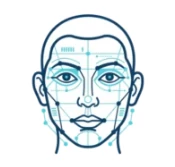
Face Features Detector
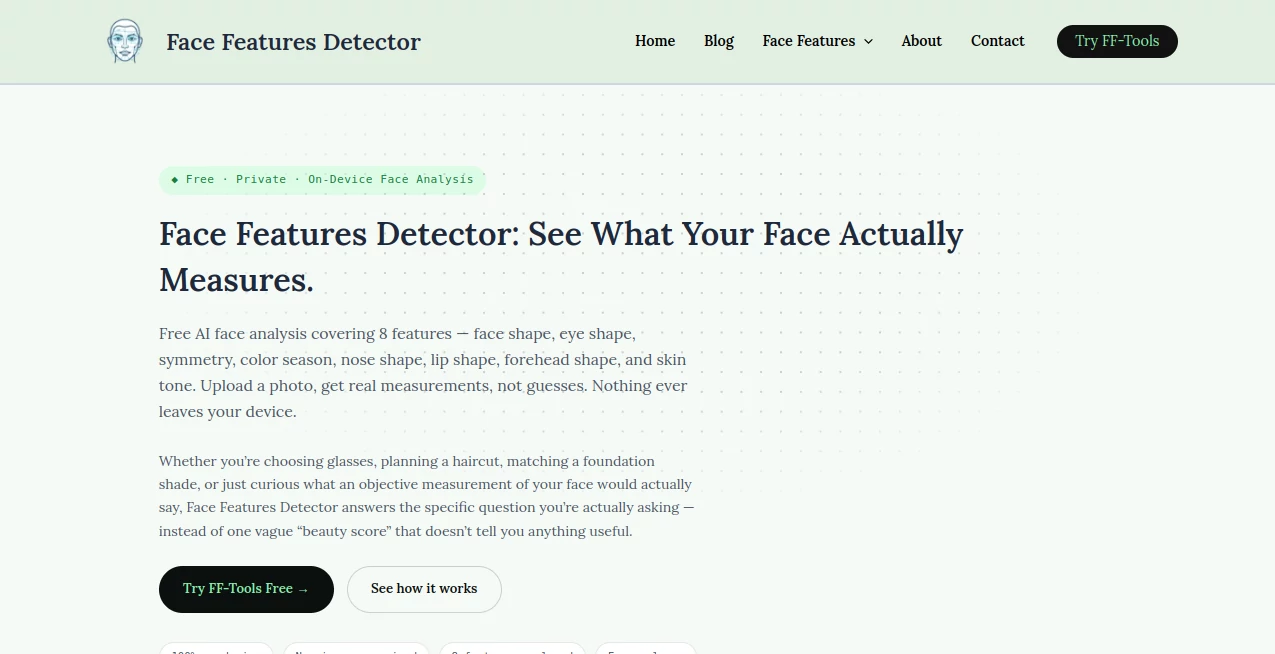
What is Face Features Detector?
Face Features Detector is a free AI face analysis platform designed for people who want more than a generic beauty score. Instead of reducing a face to one broad rating, it examines individual characteristics such as face shape, eye shape, symmetry, color season, nose shape, lip shape, forehead shape, and skin tone.
The idea is refreshingly practical: upload a photo, choose the feature you want to understand, and receive a measurement-based result with the information behind it. That makes the platform useful for everyday decisions, from choosing glasses and planning a haircut to finding a more suitable foundation shade or simply learning more about your own facial features.
Another major advantage is privacy. The analysis is designed to run directly on the user's device, meaning photos are not sent to a remote server for processing. There is also no account or sign-up requirement, so visitors can try the tools without creating an account first.
Key Features
- Analysis of eight distinct facial features
- Face shape classification based on facial proportions
- Eye shape analysis using visible facial characteristics
- Face symmetry scoring across key facial landmarks
- Seasonal color analysis and undertone detection
- Nose shape analysis using facial proportions and profile information
- Lip shape classification
- Forehead shape measurements
- Skin tone and undertone analysis
- On-device facial landmark processing
- No account or sign-up required
- Free access to the available analysis tools
- Support for uploaded photographs and mobile camera capture
User Interface
The experience is built around a simple three-step process: upload or capture a photograph, select the type of analysis you want, and review the result. There is no complicated setup or software installation standing between the visitor and the analysis.
The focused structure also makes the interface easier to understand. Rather than presenting a crowded dashboard with dozens of unrelated measurements, each tool concentrates on a particular facial characteristic. Someone interested in finding their face shape can go directly to that analysis without having to work through an unnecessary full-face assessment.
The platform also works in a mobile browser, which is particularly convenient because a phone camera can be used directly when taking a suitable photograph.
Accuracy & Performance
The analysis uses facial landmark detection to identify reference points on the face and calculate proportions, angles, and relationships between those points. This approach provides a more consistent starting point than trying to judge facial proportions by looking in a mirror.
The quality of the photograph still matters. A clear, front-facing image with even natural lighting and a relaxed expression generally provides a better basis for analysis. Pulling hair away from the forehead can also help when the result depends on the outline of the face.
One thoughtful aspect of the system is that it does not pretend every facial characteristic fits perfectly into a single category. Results can include confidence information when measurements fall close to the boundary between classifications. That is a more realistic way to approach facial analysis than presenting every result as an absolute fact.
Capabilities
The platform covers eight main areas of facial analysis. Face shape can be classified into categories such as oval, round, square, heart, diamond, oblong, and triangle by examining facial proportions. Eye analysis considers characteristics such as crease visibility, corner angle, and the amount of visible sclera.
For people interested in personal styling, the color analysis and skin tone tools can be especially useful. They examine coloring and undertones to provide a starting point for wardrobe, makeup, and foundation decisions.
The toolkit also includes nose and lip shape analysis, forehead measurements, symmetry scoring, an AI age calculator, and a face shape quiz. These additional options make the platform useful for both measurement-based analysis and casual exploration.
Security & Privacy
Privacy is one of the strongest aspects of the platform. Facial analysis is performed on the user's device through the browser rather than requiring the photograph to be uploaded to a remote processing server. According to the platform, photographs are not uploaded, stored, or shared as part of the analysis process.
This matters because facial photographs are personal data that many users understandably prefer to keep under their own control. The on-device approach removes the need to send an image elsewhere simply to obtain a facial measurement.
Use Cases
There are plenty of practical situations where a quick facial measurement can be useful. Someone shopping for glasses can use face and eye shape information as a starting point when comparing frame styles. A person considering a new haircut can use facial proportions to explore cuts that may complement their features.
Beauty and makeup decisions are another natural fit. Skin tone, undertone, and seasonal color information can help narrow down foundation shades, clothing colors, and makeup palettes.
Stylists, makeup artists, and content creators can also use the results as an objective starting point during consultations. It should not replace professional judgment, but having consistent measurements can make a discussion more concrete.
And sometimes there is no practical reason at all. Curiosity is a perfectly good reason to analyze your face, especially when the process is free and does not require an account.
Pros and Cons
Pros
- Free to use without an account
- Eight separate facial analysis categories
- Processes photographs on the device
- No app download is required
- Provides measurements rather than relying only on broad labels
- Useful for styling, makeup, shopping, and personal curiosity
- Works on mobile browsers
- Confidence information helps communicate uncertainty
Cons
- Results depend heavily on photograph quality
- Some facial characteristics can be difficult to classify when they sit between categories
- Facial landmark analysis measures visible geometry and cannot perfectly represent every aspect of facial appearance
- Professional styling decisions should still include human judgment and personal preference
Pricing Plans
The platform is free to use. There is no account requirement, subscription, or payment step needed to access the facial analysis tools. Users can run analyses with different photographs without being asked to purchase a plan.
This free model also makes experimentation easier. For example, a user can compare results from a well-lit photograph with another image taken under different conditions and see how changes in the photo affect the measurements.
How to Use the Face Analysis Platform
- Choose the facial feature you want to analyze.
- Upload a clear photograph or use your device's camera.
- For the best results, use even natural lighting and a front-facing image.
- Keep your expression relaxed and avoid heavy filters.
- Keep hair away from the face when the outline or forehead needs to be measured.
- For nose analysis that requires profile information, provide the appropriate side-view photograph.
- Allow the on-device analysis to process the image.
- Review the classification, measurements, confidence information, and guidance provided with the result.
Comparison with Similar Tools
Many online face analysis products approach the subject as a single attractiveness or beauty-rating exercise. That can be entertaining, but it is not particularly helpful when the user has a specific question such as which face shape they have or why a particular foundation shade does not look right.
This platform takes a more focused approach by separating facial analysis into individual tools. Instead of hiding everything behind one overall number, it explains the measurements associated with a particular feature. The distinction is important because face shape, eye shape, skin undertone, and symmetry answer very different questions.
The privacy model also sets it apart from services that require photographs to be uploaded to a server. Keeping the analysis inside the browser gives users a stronger level of control over their personal photographs while still providing an accessible AI-assisted experience.
Conclusion
For anyone looking for a practical way to understand their facial features, this platform offers a useful alternative to vague beauty-rating tools. Its biggest strengths are the focused analysis, measurement-based approach, straightforward interface, and emphasis on on-device privacy.
It is particularly useful when the result needs to lead to a real decision. Choosing glasses, exploring hairstyles, understanding skin undertones, or building a personal color palette all become easier when there is a measurable starting point rather than a subjective guess.
The results should still be treated as estimates rather than absolute judgments, especially when a photograph has poor lighting or a feature falls between classifications. Used in that way, the platform is a convenient and accessible tool for turning a simple photograph into useful information about facial proportions and appearance.
Frequently Asked Questions (FAQ)
Is the face analysis free?
Yes. The available facial analysis tools can be used for free without creating an account or entering payment information.
Does the analysis require an app?
No. The tools work directly in a web browser, including on mobile devices. Users can upload an existing photograph or use their phone's camera.
Does my photo get uploaded to a server?
The analysis is designed to run on the user's device. The platform states that photographs are not uploaded, stored, or shared for the facial analysis process.
How can I get better results?
Use a clear, front-facing photograph with even natural lighting and a neutral expression. Keeping hair away from the face can also improve measurements that depend on the facial outline.
Can it identify my face shape?
Yes. The face shape analysis considers proportions involving areas such as the forehead, cheekbones, jaw, and overall face length before assigning a face shape category.
Can it analyze eye shape?
Yes. The eye analysis considers visible characteristics such as eyelid crease, eye corners, and sclera to distinguish between different eye shape categories.
Can it help with makeup choices?
Yes. Skin tone, undertone, and color analysis can provide useful information when choosing foundation shades, makeup colors, or complementary wardrobe palettes.
Can professionals use the results?
Stylists, makeup artists, and content creators can use the measurements as an objective starting point during consultations. The results are best treated as supporting information rather than a replacement for professional expertise.
Does it work on smartphones?
Yes. The tools are accessible through a mobile browser and can use a phone's camera, so there is no separate application to install.
AI Image Recognition , AI Selfie & Portrait , AI Photography .
These classifications represent its core capabilities and areas of application. For related tools, explore the linked categories above.
Face Features Detector details
Website unavailable — View Alternatives
Pricing
- Free
Apps
- Web App
Categories

Face Features Detector Alternatives Product

Ultralytics

Unblur Image

insMind

Luma AI

Image Descri…

Better Datin…
FaceSage

AvatarCraft …

FacialHarmon…