
Foliora
What is Foliora?
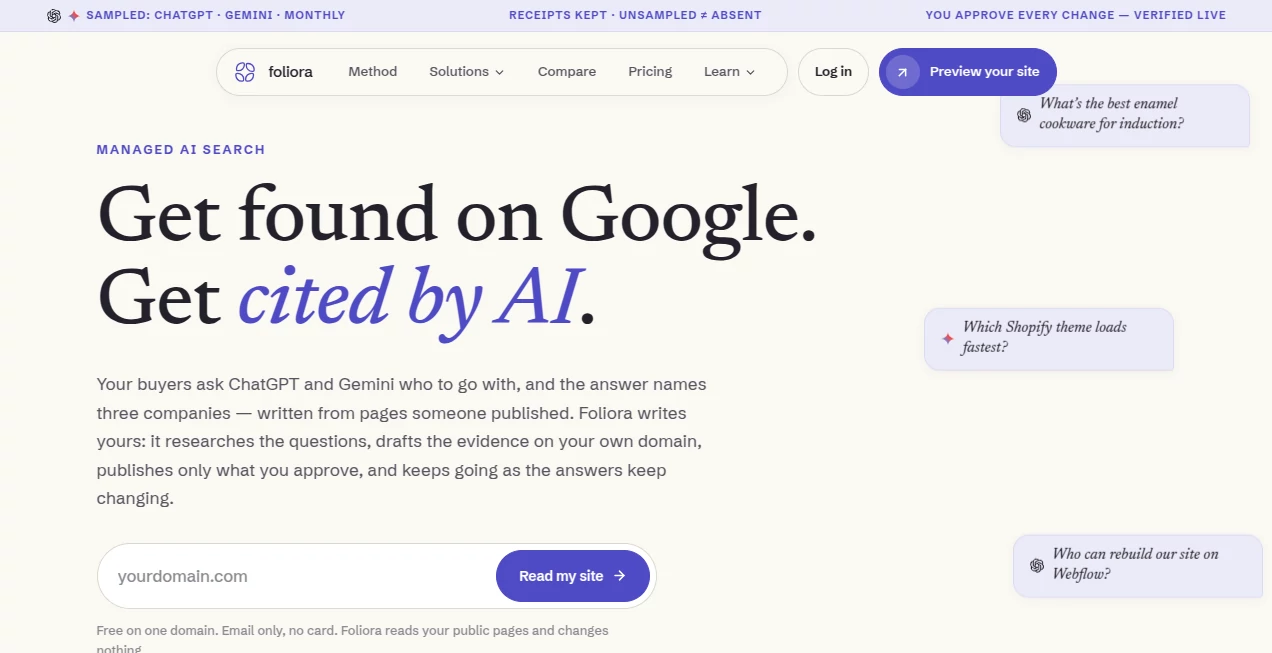
Foliora is a managed AI search platform designed for businesses that want their websites to be discovered in traditional search and mentioned by AI assistants. Instead of stopping at a report or visibility score, it connects research, content improvements, approval, publishing, and verification into one continuous workflow.
The idea behind the platform is simple but increasingly important. Buyers now ask tools such as ChatGPT and Gemini for recommendations before they ever visit a company website. If a business is missing from those answers, a strong Google ranking alone may not be enough. The platform focuses on improving the public information that search engines and AI systems can actually read, understand, and cite.
One particularly useful aspect is that the work is based on the company's existing website, products, documentation, pricing, and other public evidence. This makes the recommendations more practical than generic AI-generated SEO suggestions. Instead of producing another long list of tasks, the system identifies pages that should answer important buyer questions and proposes specific changes.
Key Features
- Managed SEO, GEO, and AEO workflows in one platform.
- Buyer-question research based on what a website actually sells.
- Weekly website crawling with pages clustered by template.
- Measurement of buyer questions across ChatGPT and Gemini.
- Evidence-backed content and technical recommendations.
- Exact proposed changes for titles, descriptions, headings, passages, FAQs, structured data, internal links, and redirects.
- Approval-based publishing rather than uncontrolled automatic changes.
- Publishing support for Shopify, WordPress, Webflow, and GitHub pull requests.
- Live verification after approved changes are published.
- Stored records of AI responses, questions, dates, and cited sources.
User Interface
The interface is built around the idea of moving from observation to action. Rather than forcing users to interpret dozens of disconnected dashboards, the workflow centers on the website, buyer questions, findings, proposed changes, and approval process.
This approach should feel especially useful to marketers and business owners who want to know what needs attention without becoming full-time SEO analysts. The platform also makes the approval stage explicit, so users can review what is being changed before anything reaches their live website.
The overall experience is better suited to people who prefer a guided workflow over a collection of isolated SEO utilities. A business owner could review a proposed page change, approve it, and then check the live result instead of manually moving between research, content, publishing, and monitoring tools.
Accuracy & Performance
The platform takes an evidence-first approach to measurement. AI answers are sampled from ChatGPT and Gemini, while the questions can remain fixed between measurement cycles. This makes changes over time easier to interpret because the comparison is based on the same buyer questions rather than constantly changing prompts.
Another thoughtful detail is the treatment of failed AI samples. A failed sample is recorded as unsampled rather than being presented as proof that a company was not mentioned. That distinction matters when using AI visibility data to make business decisions.
Website analysis also goes beyond surface-level content. The system can inspect technical elements such as canonical URLs, redirects, rendering, metadata, structured data, internal links, and the difference between indexation and discovery.
Capabilities
The strongest capability is the complete research-to-verification loop. The system identifies commercially relevant questions, examines the website and competing sources, determines which page should address an opportunity, and drafts a specific improvement.
For example, if an AI assistant repeatedly recommends competitors when a customer asks a product-related question, the platform can identify a suitable page and propose clearer evidence or answer-focused content for that page. The objective is not to manipulate the AI model itself. Instead, it improves the public information available to search systems and assistants.
It can also work with websites containing large numbers of similar pages. Pages can be clustered by template, allowing one approved improvement to potentially address a broader group of pages built in the same way. This can make the workflow considerably more efficient for catalogs, SaaS websites, ecommerce stores, and content-heavy businesses.
Security & Privacy
Control over publishing is one of the platform's notable design choices. Changes do not simply appear on a website without approval. Each proposed change must be reviewed before publication, and the system re-reads the remote resource before writing so that an outdated version is not accidentally overwritten.
The platform also keeps a record of approved changes and verifies the live result afterward. According to its stated workflow, the approved version is checked against the published result, creating a clearer audit trail than a simple notification saying that an API request succeeded.
There are also defined boundaries around what it writes. Customer or order data is outside the publishing boundary, while the workflow concentrates on public website resources such as content, metadata, structured information, and approved redirects.
Use Cases
This platform is particularly relevant for businesses whose customers use search engines and AI assistants during the buying process. A SaaS company, for example, can monitor questions around its product category and discover where competitors are being cited instead.
Ecommerce businesses can use the workflow to improve product and category information, while agencies can use it to manage SEO and AI visibility work across client websites. It also supports businesses using Shopify, WordPress, Webflow, or code-managed websites connected through GitHub.
Startups may find the approach useful because it connects SEO improvements with actual buyer questions rather than encouraging them to publish large amounts of generic content. For established businesses, the historical measurement can help reveal whether visibility changes over time instead of relying on a single snapshot.
Another practical use is AI brand monitoring. Rather than merely checking what an assistant says about a company, the workflow connects an unfavorable or missing mention to a potential improvement on the company's own website.
Pros and Cons
- Pros: Combines SEO, GEO, and AEO work into a single workflow.
- Pros: Focuses on actual buyer questions rather than arbitrary prompts.
- Pros: Provides specific proposed changes instead of only reporting problems.
- Pros: Requires approval before publishing.
- Pros: Verifies published changes on the live website.
- Pros: Supports Shopify, WordPress, Webflow, and GitHub-based workflows.
- Pros: Keeps historical AI question and citation records for comparison.
- Cons: The base subscription is designed around one website.
- Cons: Some larger websites may need additional page, question, site, or change capacity.
- Cons: AI visibility is inherently variable, so measurement should be viewed as an ongoing signal rather than a guaranteed ranking result.
Pricing Plans
The base subscription starts at $29.99 per month and includes one website, up to 250 crawled pages, 25 buyer questions measured monthly, weekly website crawling, monthly ChatGPT and Gemini sampling, and three approved changes per billing period.
Businesses can expand the plan through fixed monthly add-ons. Additional websites cost $24 per site per month, weekly AI measurement for a selected site costs $19 per month, an additional 25 buyer questions costs $12 per month, three additional approved changes cost $12 per month, and each additional 1,000 crawl pages costs $8 per month.
A free preview is also available for one domain. The preview reads a limited selection of public pages and provides a score, findings, and several opportunities without requiring a card or making changes to the website.
The pricing model is appealing for smaller companies because it avoids the much larger retainers often associated with managed SEO services. At the same time, larger sites can increase capacity as their needs grow rather than immediately committing to a large package.
How to Use It
Start by entering the public domain you want to analyze. The initial preview examines a selection of publicly available pages without connecting to the site's publishing system or modifying anything.
After connecting a website, the platform analyzes its content and structure, identifies buyer questions, and examines how AI assistants respond to those questions. The resulting opportunities are then organized around the pages and changes most likely to address the identified gaps.
Review the proposed change before approving it. Depending on the connected platform, an approved update can be published through Shopify, WordPress, Webflow, or a GitHub pull request. Manual application of the approved difference is also possible.
After publication, the live page is re-read and checked against the approved change. The same buyer questions can then be asked again in later measurement cycles, allowing businesses to see whether their visibility and citations have changed over time.
Comparison with Similar Tools
Many SEO and AI visibility products focus primarily on monitoring. They provide rankings, visibility scores, keyword positions, or AI responses and leave the actual improvement work to the user. Traditional agencies can take the opposite approach by providing hands-on work, but their monthly retainers can be substantially higher.
This platform sits between those approaches. Its distinctive feature is the connection between measurement and implementation. Instead of simply saying that a company was not mentioned in an AI response, it attempts to identify why the website was not a strong source and proposes a concrete change that the owner can approve.
The historical approach is another meaningful difference. Keeping the same buyer-question panel and asking it again over time provides a more useful trend than repeatedly changing the questions and comparing unrelated results. For businesses experimenting with AI search visibility, that continuity can make the data easier to understand.
It is not a replacement for every SEO platform. Businesses that need extensive backlink databases, traditional rank-tracking features, deep keyword research, or large-scale technical auditing may still use dedicated SEO software alongside it. Its strength is the operational connection between website evidence, AI visibility, proposed improvements, publishing, and verification.
Conclusion
Foliora takes a practical approach to the changing search landscape. Instead of treating AI visibility as another dashboard to watch, it connects what buyers ask with the information published on a company's own website.
The combination of buyer-question research, SEO and AEO improvements, controlled publishing, and post-launch verification makes the platform particularly interesting for businesses that want measurable work rather than another monthly report. Its approval-first model also gives website owners a useful level of control over what changes actually go live.
At $29.99 per month for the base plan, it is positioned as an accessible option for businesses that want to experiment with AI search optimization without immediately hiring a high-cost agency. The biggest value comes from its continuous workflow: discover an opportunity, improve the source, publish the approved change, and ask again to see what happened.
Frequently Asked Questions (FAQ)
What does the platform do?
It researches buyer questions, checks how search engines and AI assistants respond, identifies gaps in a website's public information, drafts improvements, and can publish and verify approved changes.
Does it work with ChatGPT and Gemini?
Yes. The platform samples responses from ChatGPT and Gemini and can measure a defined set of buyer questions over recurring cycles.
Can it automatically change my website?
No. Proposed changes require user approval before publishing. The system is designed around an approval-first workflow.
Which website platforms are supported?
Publishing workflows support Shopify, WordPress, Webflow, and GitHub pull requests. Users can also apply an approved change manually.
What is included in the $29.99 plan?
The base plan includes one site, 250 crawled pages, 25 buyer questions measured monthly, weekly crawling, monthly ChatGPT and Gemini sampling, and three approved changes per billing period.
Is there a free trial or preview?
There is a free website preview that analyzes a selection of public pages and provides findings without requiring a card or making changes to the website.
Can it help with AI search visibility?
Yes. The workflow is specifically designed around SEO, generative engine optimization, and answer engine optimization, with an emphasis on making website information easier for AI assistants to retrieve and cite.
Is it suitable for startups?
Yes. Its focus on buyer questions and existing website evidence can be useful for startups that want to improve organic and AI visibility without building a large content operation.
Does it guarantee that AI assistants will recommend my business?
No. AI-generated answers can change independently, and no platform can guarantee a specific citation or recommendation. The value comes from measuring real responses, improving the underlying sources, and tracking the results over time.
AI SEO Assistant , AI Analytics Assistant .
These classifications represent its core capabilities and areas of application. For related tools, explore the linked categories above.

Foliora Alternatives Product

SEOAuthori

CrawlReady
ClearWork

Free Marketi…

Atracker

Marketbetter…

Aura++

Lebesgue: AI…

Crawlly AI