
Furriq
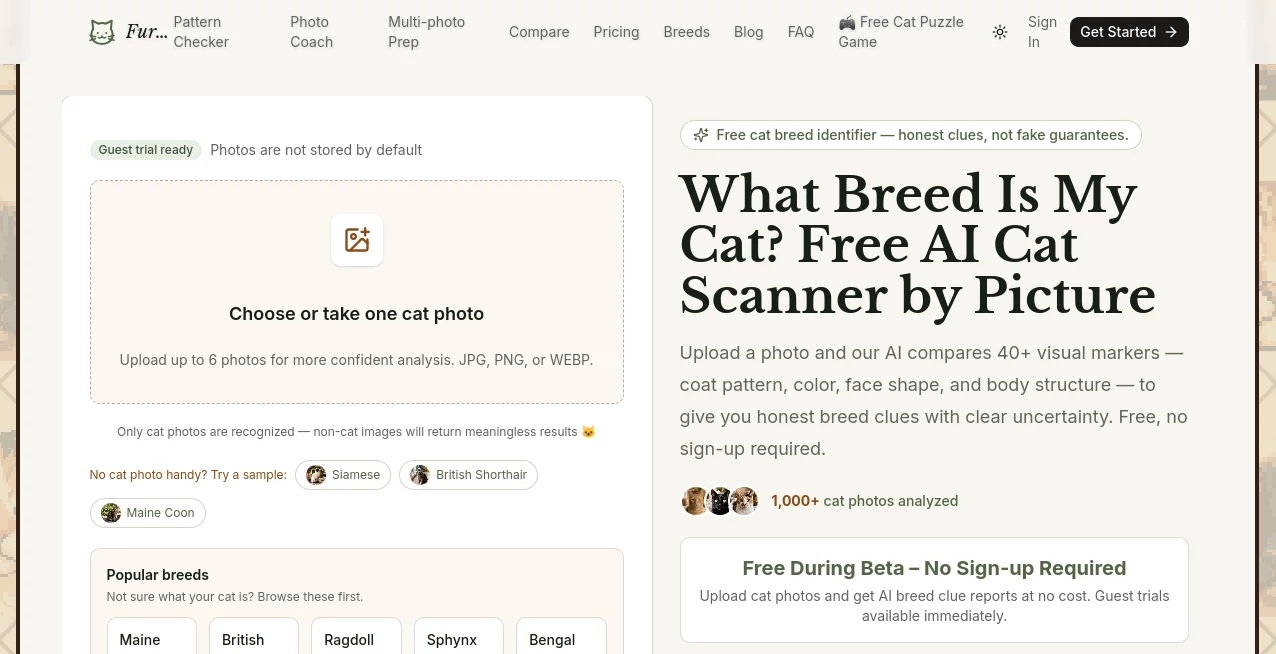
What is Furriq?
Finding out what breed a cat might be can be surprisingly difficult, especially when the cat is a rescue, a mixed breed, or simply does not have pedigree papers. A photograph can reveal plenty of useful clues, though, and that is where this free AI-powered cat breed identifier takes a practical approach.
Instead of presenting a single breed as an unquestionable answer, the tool examines visible characteristics such as coat pattern, color, face shape, ear structure, and body type. It compares more than 40 visual markers and returns likely breed matches together with confidence information. This makes it useful for cat owners who are curious about their pet's appearance without confusing a visual estimate with genetic proof.
The service is currently available during beta at no cost, with guest access that does not require an account. Users can upload a clear cat photograph and receive a breed clue report in a matter of moments.
Key Features
- AI-powered cat breed identification from photographs
- Analysis of more than 40 visible markers
- Recognition across 61 covered cat breeds
- Analysis of coat pattern, color, facial structure, ears, and body characteristics
- Results presented as likely breed clues rather than guaranteed ancestry
- Support for JPG, PNG, and WEBP images
- Ability to upload up to six photos for a more confident analysis
- Built-in photo quality checking before server processing
- Pattern checking for characteristics such as tabby, tuxedo, calico, tortoiseshell, and pointed coats
- Free access during the current beta period
- No sign-up required for guest trial usage
User Interface
The interface is refreshingly straightforward. The main action is immediately obvious: choose or take a cat photo and start the analysis. There is no complicated setup or lengthy questionnaire standing between the user and the result.
For people who are trying an image-based breed identifier for the first time, this simplicity matters. The service also provides sample cat images, making it possible to understand how the process works even when there is no suitable photo available at the moment.
Additional tools, including a pattern checker, photo preparation features, multi-photo analysis, and breed comparison resources, make the experience feel more like a small cat identification toolkit than a single-purpose upload box.
Accuracy & Performance
One of the more sensible aspects of the service is the way it handles accuracy. A photograph can show physical characteristics, but it cannot reveal a cat's complete genetic history. The system therefore treats its output as a collection of likely clues rather than a definitive pedigree result.
The analysis considers factors such as coat pattern, color distribution, face shape, ear shape, and body structure. A report can provide several likely breed matches and explain the traits that contributed to those suggestions.
Photo quality also plays an important role. The browser performs a local check of factors such as brightness, sharpness, and image size before the image is processed. A clear, well-lit photograph with the cat visible from a useful angle is naturally more helpful than a dark or blurry snapshot.
Capabilities
The core capability is visual breed estimation, but the surrounding features add useful context. Users can explore breed information, compare popular breeds, examine coat patterns, and learn which physical traits are actually meaningful when identifying a cat.
The system currently covers 61 breeds, including recognizable names such as Siamese, British Shorthair, Maine Coon, Ragdoll, Bengal, Persian, Sphynx, Abyssinian, Russian Blue, and Norwegian Forest Cat.
Another useful detail is the distinction between coat pattern and breed. For example, being a tabby does not automatically make a cat a particular breed. The service encourages users to consider body proportions, muzzle shape, ears, coat length, and tail characteristics rather than relying on one obvious visual feature.
Security & Privacy
Privacy is an important part of the product's design. Uploaded original images are not stored by default, and the site's privacy information states that user data is not sold.
The local photo-quality check also happens in the browser before server processing. According to the current product information, the generation process records metadata and setup state rather than retaining the original uploaded image, with no image retention.
These choices make the service particularly appealing to users who want to experiment with an image-based AI tool without creating a permanent collection of their pet photographs online.
Use Cases
The most obvious use case is simple curiosity. You may have adopted a cat from a shelter and wondered whether its appearance resembles a Maine Coon, Siamese, British Shorthair, Bengal, or another breed. Uploading a photo can provide an interesting starting point for further research.
It can also be useful for rescue organizations and shelters. Understanding likely breed influences can help volunteers write more informative adoption descriptions or give potential adopters additional context about a cat's appearance.
Cat enthusiasts can use the tool as an educational resource as well. Instead of simply receiving a breed name, users can explore why certain physical characteristics resemble particular breeds and learn why mixed-breed cats are often harder to classify.
For example, someone with an orange tabby might initially expect the pattern alone to identify the breed. The tool's approach encourages a closer look at other characteristics, which can turn a quick identification attempt into a more useful learning experience.
Pros and Cons
Pros
- Free during the beta period
- No account required for guest trials
- Analyzes more than 40 visual characteristics
- Covers 61 cat breeds
- Can work with multiple photos
- Provides confidence and uncertainty rather than pretending every result is certain
- Original photos are not stored by default
- Includes useful educational breed and coat-pattern information
- Helpful for cat owners, enthusiasts, shelters, and rescue organizations
Cons
- A photograph cannot establish genetic ancestry or pedigree
- Results can be less useful when the image is dark, blurry, or poorly framed
- Mixed-breed cats can be difficult to classify from appearance alone
- The service is focused specifically on cats rather than general animal identification
- The current free availability is tied to the beta period
Pricing Plans
The service is currently free for all users during its beta period. Guests receive two free trial attempts, while setup-related checks do not consume those attempts.
The team plans to retain a free tier after the beta period, allowing casual users to continue identifying cats without paying. Future paid options may be aimed at higher-volume users such as breeders, shelters, and veterinary clinics, potentially including faster processing, batch uploads, and more detailed lineage-oriented reports.
Animal shelters, rescue groups, and adoption agencies are also expected to retain free access. This makes the product particularly interesting for organizations that need to work with a large number of cats without adding another software expense to their operations.
How to Use the Tool
Start by selecting a clear photograph of the cat you want to analyze. JPG, PNG, and WEBP images are supported, and multiple photos can be uploaded when additional visual information may help.
For the strongest result, use a well-lit image where the cat's face, body, ears, and coat are reasonably visible. Avoid heavily blurred images or photographs where the cat is mostly hidden.
Once the image is prepared, start the analysis. The AI examines the visible characteristics and generates a report containing likely breed matches, relevant traits, and uncertainty information.
Finally, treat the report as a starting point for investigation rather than a formal breed certificate. Comparing the suggested breeds and reading their characteristics can often be just as interesting as seeing the initial result.
Comparison with Similar Tools
Many photo-based breed identifiers focus on giving the user a single breed label as quickly as possible. This approach can be entertaining, but it can also create a misleading sense of certainty, particularly with mixed-breed cats.
This service takes a more careful route by explaining that visible resemblance is not the same thing as ancestry. Instead of presenting a photograph as if it contained genetic information, it focuses on observable characteristics and uses uncertainty as part of the result.
The multi-photo functionality is another useful distinction. When one photograph does not clearly show the cat's features, several images can provide additional visual context. The accompanying breed guides and pattern resources also give users somewhere to go after receiving their initial result.
For casual users who simply want a quick guess, many alternatives may appear similar. For someone who prefers an explanation of what the photograph can actually reveal, the more transparent approach is a meaningful advantage.
Conclusion
For cat owners wondering what makes their pet look like a particular breed, this AI cat identifier offers an easy and approachable way to investigate the question. Its strongest quality is not simply the ability to produce breed suggestions, but the way it communicates the limitations of photo-based identification.
The combination of visual trait analysis, multiple-photo support, breed resources, privacy-conscious defaults, and free beta access makes it worth trying. It is especially useful for rescue cats and mixed breeds where a traditional pedigree is unavailable and curiosity is often the main motivation.
Most importantly, the results are presented as clues rather than promises. That distinction keeps the experience useful and realistic: a photograph can tell you a lot about how a cat looks, even if it cannot tell you everything about where that cat came from.
Frequently Asked Questions (FAQ)
Can a photo really identify my cat's breed?
A photo can provide useful visual clues about possible breed influences, but it cannot prove genetic ancestry. The results should be considered estimates based on visible characteristics rather than DNA-level identification.
How many cat breeds are covered?
The service currently lists 61 covered breeds, including popular breeds such as Siamese, Maine Coon, Persian, Ragdoll, Bengal, British Shorthair, and Sphynx.
What characteristics does the AI analyze?
The analysis considers more than 40 visual markers, including coat pattern, color, facial structure, ear shape, and body structure.
Can I upload more than one photo?
Yes. Users can upload up to six photographs, which can provide additional visual information and potentially produce more confident breed clues.
Is a tabby cat a specific breed?
No. Tabby describes a coat pattern rather than a single breed. Many different breeds and domestic cats can have tabby markings, so other physical characteristics need to be considered as well.
Are my cat photos stored?
Original uploaded images are not stored by default. The site's current privacy information states that the generation process records metadata and setup information rather than retaining the original image.
Is the result the same as a DNA test?
No. A visual AI analysis and a DNA test answer different questions. The image-based result identifies visual similarities and possible breed influences, while genetic testing can provide information that cannot be determined from appearance alone.
Is the tool free?
Yes. It is currently free for all users during the beta period, with guest access available without requiring an account.
Can shelters use the service?
Yes. The service is designed to remain free for animal shelters, rescue groups, and adoption agencies, with the team also offering to support organizations that need bulk access.
Should I use the result for veterinary decisions?
No. The result is intended for visual breed clues and education. It should not be treated as veterinary, medical, breeder-certification, or DNA advice.
AI Image Recognition , AI Life Assistant .
These classifications represent its core capabilities and areas of application. For related tools, explore the linked categories above.

Furriq Alternatives Product

What The Food

ImgUnblur

TWT Chat

AI Meal Plan…

Hairstyle An…

Face Symmetr…

GetFIT App

Reverse Imag…

PlateLens