Gadaa Ask
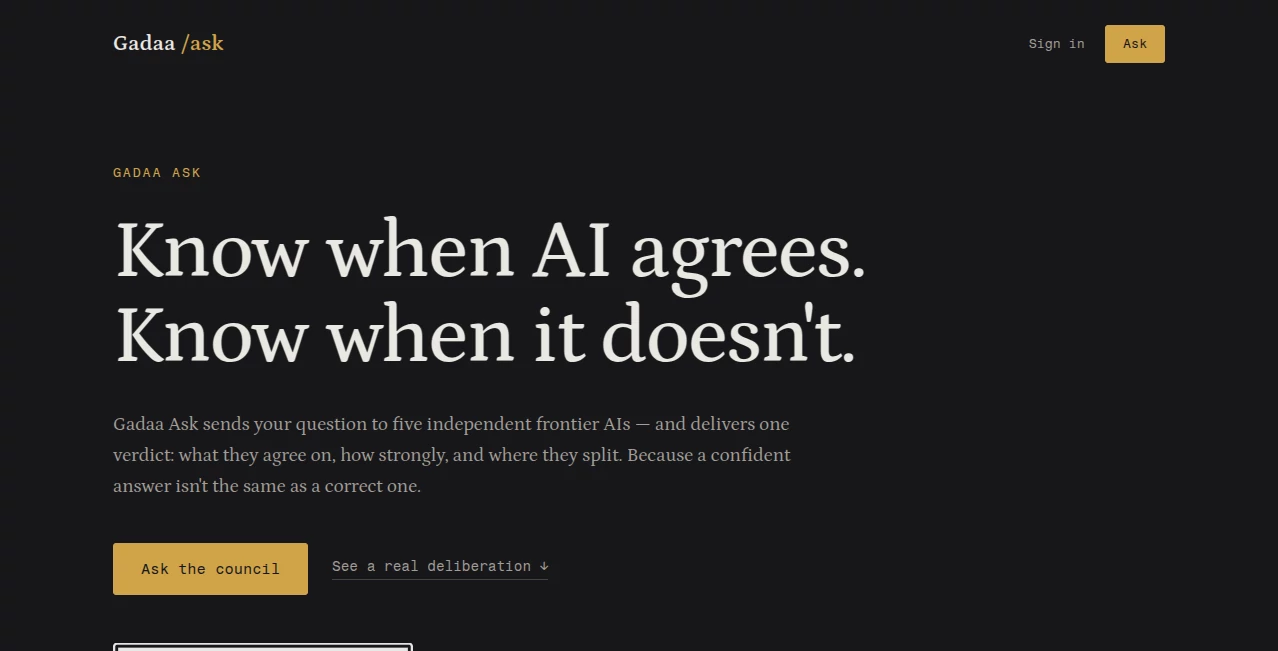
What is Gadaa Ask?
Gadaa AI presents itself as a modern artificial intelligence platform built around the idea of bringing intelligence and technology together in one place. Its central message, “Intelligence in Convergence,” points to a broader approach than a single-purpose AI utility. Rather than focusing on one narrow task, the platform is positioned around the convergence of intelligent capabilities and practical digital experiences.
That concept is particularly appealing for users who are exploring AI as part of their everyday digital workflow. Instead of treating artificial intelligence as something reserved for technical users, the experience aims to make intelligent technology more approachable and useful for a wider audience.
For someone discovering new AI services, the most interesting part is the platform's focus on bringing different aspects of AI together. This makes it worth exploring for users who want a straightforward starting point rather than jumping between numerous disconnected services.
Key Features
- AI-focused platform built around the concept of converging intelligent capabilities.
- A modern web-based experience designed for users exploring AI-powered services.
- Simple access to an AI-oriented environment without requiring a complicated technical setup.
- A flexible concept that can support different AI-driven workflows and use cases.
- Focused on making artificial intelligence more accessible to everyday users.
User Interface
The website takes a clean, focused approach that puts the AI experience at the center. The presentation avoids overwhelming visitors with unnecessary visual elements, which is useful when the main objective is to understand and interact with an intelligent platform.
A straightforward interface can make a meaningful difference with AI products. Users often want to get to the useful part quickly, and a less cluttered environment helps reduce the learning curve. The overall presentation feels more like an entry point into an AI ecosystem than a traditional software dashboard packed with settings.
Accuracy & Performance
Performance is an important consideration for any AI service, particularly when users expect quick responses and dependable results. The platform's web experience is designed to provide a direct path into its AI environment, although specific public benchmarks for response speed or model accuracy are not currently available.
For practical use, users should judge results according to the task at hand. AI output can vary depending on the underlying models, input quality, and complexity of a request, so reviewing important information before relying on it remains a sensible practice.
Capabilities
The strength of the platform lies in its broader AI-oriented concept. The convergence approach makes it suitable for users who are interested in exploring artificial intelligence without committing themselves to a highly specialized tool from the beginning.
It can serve as an entry point for experimenting with AI-assisted workflows, discovering how intelligent technology can fit into everyday digital activities, and evaluating whether an AI-centered environment matches a particular workflow.
This approach is especially useful for curious users. Someone who is still figuring out which AI capabilities are actually valuable to them may prefer an environment that encourages exploration rather than requiring a specific use case from the first click.
Security & Privacy
Security and privacy are important considerations whenever users interact with an online AI service. At the time of writing, detailed public documentation covering data retention, model training policies, encryption practices, or third-party data sharing was not readily available from the public website.
Users working with confidential documents, private business information, personal data, or proprietary material should therefore review the platform's current privacy and data-handling policies before submitting sensitive information.
Use Cases
The platform can be interesting for several types of users. AI newcomers can use it as a place to explore the possibilities of artificial intelligence without immediately committing to a highly specialized application. Students and independent learners may also find value in experimenting with AI-assisted workflows and discovering new ways to approach digital tasks.
For professionals, the broader concept can be useful during the evaluation stage of an AI workflow. For example, a user researching AI solutions for content, research, communication, or general productivity can begin by exploring the available experience before deciding whether a specialized tool is necessary.
Developers and technology enthusiasts may also appreciate the concept from a different perspective: it provides another example of how AI products are moving toward more integrated experiences rather than isolated single-function utilities.
Pros and Cons
Pros
- Clear AI-focused positioning.
- Modern and approachable web experience.
- Convergence-based concept encourages exploration.
- Suitable as an entry point for users discovering AI.
- Does not require users to begin with a highly specialized workflow.
Cons
- Detailed public information about individual AI capabilities is limited.
- Public performance benchmarks are not readily available.
- Detailed pricing information is not clearly exposed on the public-facing site.
- Users handling sensitive information should review current privacy documentation before use.
Pricing Plans
Detailed pricing information was not publicly available from the accessible version of the website at the time of review. This means it would be inappropriate to assign specific subscription prices or plan limits without confirmation.
Potential users should check the current platform experience for the latest availability, plan structure, and any usage restrictions before making a purchasing decision. Pricing and access conditions can also change as an AI platform develops.
How to Use Gadaa AI
Getting started is designed to be straightforward. Begin by visiting the platform and entering its AI environment. From there, explore the available functionality and identify the type of task you want to accomplish.
A good approach is to begin with a simple request rather than immediately testing a complicated workflow. This gives you a quick impression of how the system responds and whether its capabilities match your expectations.
Once you understand the available experience, you can move toward more specific workflows and evaluate how well the platform fits your personal, educational, or professional needs.
Comparison with Similar Tools
Unlike narrowly focused AI products that concentrate on one function, the main appeal here is the idea of convergence. Specialized tools can be excellent when a user already knows exactly what they need, such as a dedicated writing assistant, image generator, translator, or coding platform.
A broader AI environment can be more attractive during the discovery phase. Instead of starting with a predefined workflow, users can explore the technology first and determine which capabilities are genuinely useful to them.
This makes the platform less about replacing every specialized AI application and more about offering an alternative way to approach AI: start with the intelligent environment, explore its possibilities, and then decide which workflows deserve a more specialized solution.
Conclusion
Gadaa AI takes an interesting approach to the growing AI landscape by centering its identity around intelligence in convergence. The concept is appealing because AI users increasingly need more than isolated tools; they want technology that can fit naturally into the way they already work, learn, and create.
The platform is particularly worth exploring for people who are curious about AI but do not yet have a single, narrowly defined requirement. Its clean presentation and broad positioning provide a natural starting point for experimentation.
As the service develops and more information becomes publicly available, its capabilities, pricing, and practical applications will become easier to evaluate in greater depth. For now, its strongest proposition is the opportunity to explore a more unified AI experience rather than approaching artificial intelligence as a collection of disconnected utilities.
Frequently Asked Questions (FAQ)
What is Gadaa AI?
It is an AI-focused platform built around the concept of bringing intelligent capabilities together under the idea of “Intelligence in Convergence.”
Who can use the platform?
It can be explored by AI newcomers, students, professionals, creators, and technology enthusiasts looking for a broader AI-oriented experience.
Is it suitable for beginners?
The straightforward web experience makes it approachable for people who are beginning to explore AI, although the best experience will depend on the capabilities currently available through the platform.
Does it provide multiple AI capabilities?
The platform is positioned around the convergence of AI capabilities, although specific functionality may evolve as the service develops.
Is pricing information available?
Detailed public pricing information was not available from the accessible website during this review. Users should check the current service for the latest plans and access conditions.
Should I upload sensitive information?
Users should review the latest privacy and data-handling policies before submitting confidential, personal, or proprietary information to any online AI service.
Can it replace specialized AI tools?
That depends on the user's workflow and the capabilities currently offered. Specialized applications may remain preferable for highly specific tasks, while a broader AI environment can be useful for exploration and general workflows.
AI Translate , AI Education Assistant .
These classifications represent its core capabilities and areas of application. For related tools, explore the linked categories above.

Gadaa Ask Alternatives Product

LongTerMemory

morse code t…

UPDF AI

Instantly Id…

YT Video Sum…

TranscribeYT
Transpic

EZ Grader

Elispeak