
















Gandr
What is Gandr?
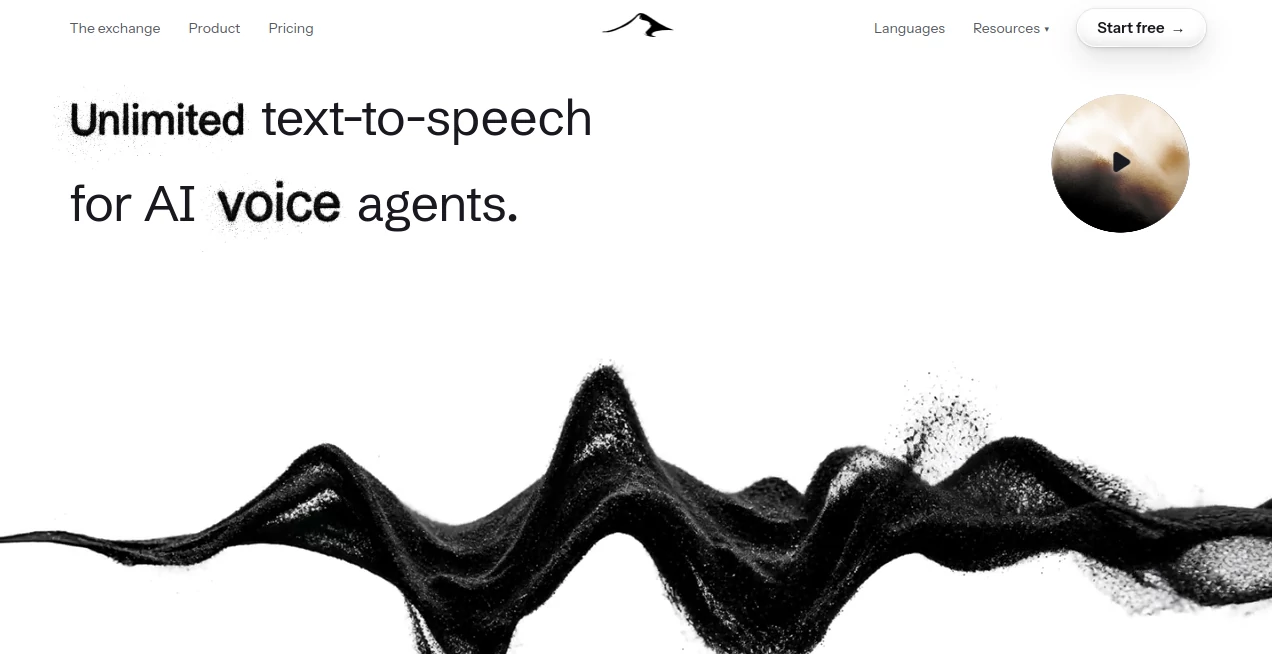
Gandr is a text-to-speech platform designed for AI voice agents that need to respond quickly, sound natural, and operate at scale. Instead of treating speech generation as a simple audio conversion task, the platform is built around the demands of live voice conversations, where even a short delay can make an automated caller feel slow or disconnected.
Its production API delivers first audio in around 107 milliseconds, with the reported 95th percentile at 108 milliseconds for a single stream. That kind of response time makes it particularly interesting for customer support agents, appointment systems, sales assistants, live translation applications, and other voice experiences where conversation needs to move naturally.
Another notable feature is instant voice cloning. A short reference recording can be used to create a working voice without waiting for a training process or paying a separate fee for each voice. The cloned identity is designed to remain consistent across the platform's supported languages.
For developers building voice products, the combination of low latency, streaming support, voice cloning, and infrastructure-oriented pricing makes this a practical option worth testing. It is especially well suited to teams that expect their voice applications to handle substantial call volume.
Key Features
- Low-latency text-to-speech with first audio reported at 107 milliseconds.
- Instant voice cloning from a short reference recording.
- Support for 23 languages from a single cloned voice.
- Streaming through SSE for real-time applications.
- WebSocket support for conversational voice experiences.
- Raw audio byte output for flexible integration.
- Three serving tiers for different deployment requirements.
- Pricing based on concurrent lines rather than characters.
- No additional cost when speech volume increases within the selected line capacity.
- Automatic provenance watermarking on generated audio.
- API authentication through an API key or Bearer authorization.
- Compatibility with popular voice infrastructure and agent stacks.
User Interface
The web console keeps the testing process straightforward. Developers can enter a line of dialogue, select a language and voice, and listen to the generated result directly in the interface. The experience is useful for comparing voices and hearing how a script behaves before connecting it to a production application.
The console also presents practical examples rather than relying only on technical specifications. Different voice scenarios demonstrate how the system can sound in customer support, storytelling, logistics, and other conversational situations. For a developer evaluating a speech engine, being able to hear the result immediately can save considerable time.
Accuracy & Performance
Performance is one of the strongest parts of the offering. The published production measurements report approximately 107 milliseconds to first audio at the median and 108 milliseconds at the 95th percentile for a single stream. The figures are based on server time to first audio rather than simply measuring time to first byte.
Low latency matters more in interactive speech than it does in ordinary audio generation. If an agent pauses for too long before responding, users can interrupt it, repeat themselves, or assume the system has stopped listening. The reported response time is therefore particularly relevant for applications where conversations happen in real time.
The service also handles capacity differently from a traditional stalled request. When capacity is reached, the API can return a retryable busy response, allowing clients to retry instead of waiting indefinitely for a connection to recover.
Capabilities
The platform is built around several integration methods, including one-shot audio generation, streaming speech, and conversational WebSocket connections. This gives developers room to choose an architecture based on the type of application they are building.
Voice cloning is another major capability. A reference clip of roughly ten seconds can be used to create a voice, with the system designed to preserve the speaker's identity across 23 supported languages. This can be useful for brands that want a consistent voice across multilingual assistants without recording separate voices for every market.
The API also accepts familiar authentication methods and provides usage information for monitoring consumption. Requests can contain up to 2,000 characters, while reference audio clips have their own size limitations.
Security & Privacy
For applications dealing with generated voice content, provenance can be just as important as generation quality. Generated samples include an inaudible provenance watermark applied during generation. This provides a way to establish where a generated clip originated if the audio later appears somewhere it should not.
The platform also states that it does not train on customer data. Developers should still review the current privacy documentation and terms before processing sensitive recordings, personal information, or regulated data in a production environment.
Use Cases
- AI Customer Support: Create responsive voice agents that can answer questions and handle conversations without long pauses.
- Voice Assistants: Add natural speech output to AI assistants that need to communicate through phone or voice interfaces.
- Outbound Sales: Power automated sales agents that can speak with prospects in real time.
- Appointment Reminders: Build automated calling systems for reminders, confirmations, and scheduling workflows.
- Live Translation: Use multilingual voice generation for applications that need to communicate across language barriers.
- IVR Replacement: Replace rigid menu-based phone systems with more conversational voice experiences.
- AI Receptionists: Create voice-based front desks capable of handling incoming calls and routing conversations.
- Voice Prototyping: Test scripts and conversational experiences before integrating speech into a larger product.
- Interactive Storytelling: Give characters and digital experiences a consistent, recognizable voice.
Pros and Cons
- Pros: Very low reported latency, instant voice cloning, 23-language support, streaming APIs, WebSocket support, developer-focused infrastructure, and provenance watermarking.
- Pros: The concurrent-line pricing model can become attractive for high-volume applications because costs do not rise simply because agents speak more minutes.
- Pros: The console makes it easy to test voices and scripts before beginning a full integration.
- Cons: The product is primarily aimed at developers and teams building voice applications rather than casual users looking for a simple standalone voice generator.
- Cons: The pricing model may require some calculation for smaller projects where usage is relatively light and conventional metered pricing could be cheaper.
- Cons: Production integrations require technical work with APIs, authentication, audio formats, and real-time communication protocols.
Pricing Plans
The pricing model is designed around concurrent voice lines rather than charging for every character or minute of generated speech. This approach is particularly interesting for businesses running voice agents at high volume because increased conversation length does not automatically increase the speech-generation bill in the same way as conventional per-minute services.
The published pricing example compares a 20-line flat plan with conventional metered speech. At 438,000 minutes of speech, the example shows a $3,000 monthly cost for 20 unmetered lines compared with $21,900 at a $0.05-per-minute rate. The company notes that metered pricing can still be less expensive when traffic is light, so the best option depends on actual usage.
Because pricing and availability can change, businesses should confirm the current plan and rate for their required number of concurrent lines before making a production decision.
How to Use the Tool
- Create an account or request access through the product website.
- Prepare a script that you want the voice system to speak.
- Choose an existing voice or provide a suitable reference recording for voice cloning.
- Select the language required by your application.
- Test the generated speech through the web console.
- Connect the API to your application using the available authentication method.
- Choose one-shot, SSE streaming, or WebSocket communication depending on your application.
- Monitor usage and concurrency as your application moves toward production.
Comparison with Similar Tools
Many text-to-speech services are designed around converting text into downloadable audio. This platform takes a somewhat different approach by focusing heavily on the requirements of live AI voice agents. Latency, streaming, concurrent connections, voice cloning, and integration with existing voice stacks are central to the product.
For a developer building a podcast narration workflow or occasional voiceover, a conventional TTS service may be simpler. For a company operating phone-based AI agents, however, the infrastructure-oriented approach can be considerably more relevant.
The pricing philosophy is another important distinction. Instead of making every additional minute directly increase the speech bill, the service uses concurrent lines as the main unit. That can make financial forecasting easier for high-volume voice applications, although low-volume projects should compare the numbers carefully.
Conclusion
For teams building serious voice applications, this platform offers a compelling combination of speed, voice cloning, multilingual generation, and developer-oriented infrastructure. The reported 107-millisecond first-audio response is especially attractive for conversational systems where delays can quickly make an interaction feel unnatural.
Its strongest appeal is not simply producing convincing speech. It is the attempt to provide the speech layer that AI agents need when they are expected to operate continuously, handle many simultaneous conversations, and integrate with an existing voice stack.
Developers working on customer support, sales agents, receptionists, appointment systems, live translation, or other real-time voice products should consider testing it with an actual production script. Hearing the response speed and voice quality with a realistic workload is likely to be more informative than comparing specifications alone.
Frequently Asked Questions (FAQ)
What is this platform used for?
It provides text-to-speech infrastructure for AI voice agents, including real-time speech generation, voice cloning, streaming, and multilingual voice output.
How fast is the text-to-speech API?
The published production measurements report 107 milliseconds to first audio at the median and 108 milliseconds at the 95th percentile for a single stream.
How many languages are supported?
The platform currently states that one cloned voice can be used across 23 languages, allowing developers to maintain a consistent voice identity across multilingual applications.
Can I clone a voice?
Yes. A short reference recording of approximately ten seconds can be used to create a working voice clone without a separate training process.
Does it support real-time streaming?
Yes. The API supports streaming through SSE as well as conversational connections through WebSocket, making it suitable for interactive voice applications.
How is pricing calculated?
The service uses concurrent lines as its primary pricing unit rather than charging based on characters. This can be useful for applications with high speech volume, although lower-volume users should compare the economics with metered alternatives.
Is it suitable for developers?
Yes. The product is strongly developer-oriented, with API access, multiple integration methods, authentication options, usage monitoring, and support for common voice-agent infrastructure.
Does the platform watermark generated audio?
Generated samples include an inaudible provenance watermark that is applied during generation across the available serving tiers.