


















Autonoma
What is Autonoma?
Modern software teams move quickly, but maintaining reliable end-to-end testing often becomes a frustrating bottleneck. Manual test creation takes time, test suites become outdated, and small interface changes can trigger unnecessary failures. This platform approaches the problem differently by allowing intelligent AI agents to explore applications like real users, automatically discovering user flows, validating functionality, and identifying regressions before they reach production.
Instead of asking developers to spend hours writing and maintaining test scripts, it generates comprehensive testing plans from the existing codebase and continuously verifies applications using real browsers and devices. This dramatically reduces maintenance while helping engineering teams release updates with greater confidence and fewer production issues.
Whether a company is building SaaS products, enterprise software, e-commerce platforms, or mobile applications, the solution provides an efficient way to automate quality assurance without adding unnecessary complexity to the development workflow.
Key Features
User Interface
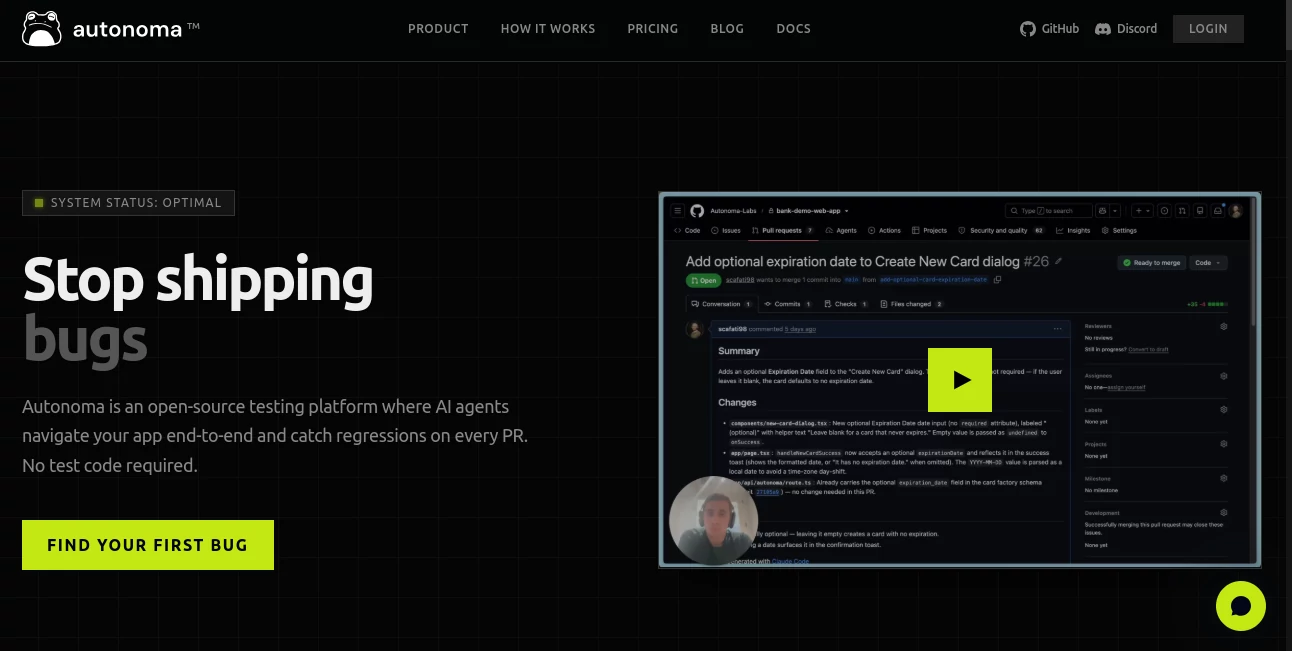
The dashboard is clean, developer-focused, and designed to fit naturally into modern engineering workflows. Test execution, detected issues, pull request status, and generated reports are presented in a straightforward manner, making it easy for developers to understand exactly what happened during every test run.
Accuracy & Performance
Rather than relying on fragile selectors alone, AI agents interact with applications in a way that closely resembles real user behavior. They navigate pages, complete forms, validate workflows, and detect unexpected changes across the application. This approach improves reliability while reducing the maintenance burden typically associated with traditional automated testing.
Capabilities
- AI-generated end-to-end test planning
- Automatic regression detection on pull requests
- Testing with real browsers and devices
- Support for web and mobile applications
- GitHub integration for continuous testing
- Real data creation and teardown through SDK integration
- Self-hosted deployment option
- Cloud-based execution with scalable infrastructure
- Parallel test execution
- Open-source platform for greater flexibility
Security & Privacy
Security is clearly a major priority. The platform supports enterprise-grade protection through encrypted communication, secure infrastructure, Single Sign-On integration, and deployment inside private cloud environments. Organizations that require additional control can self-host the entire testing environment, keeping application data and credentials within their own infrastructure. The company also highlights compliance-focused practices such as isolated execution environments and modern encryption standards.
Use Cases
- Continuous integration testing for software teams
- Regression testing before every deployment
- Quality assurance for SaaS products
- Testing customer onboarding workflows
- E-commerce checkout validation
- Enterprise application testing
- Cross-browser verification
- Mobile application testing
- Startups seeking automated QA without dedicated testing teams
- Engineering organizations adopting AI-driven development workflows
Pros and Cons
- Pros
- No manual test scripting required for most workflows.
- Open-source architecture provides flexibility and transparency.
- Supports both cloud and self-hosted deployments.
- Integrates naturally into existing CI/CD pipelines.
- Uses real browsers for realistic testing scenarios.
- Designed to reduce test maintenance as applications evolve.
- Cons
- Repository access is required to generate automated tests.
- Initial setup involves connecting project infrastructure and test data.
- Organizations with highly customized workflows may need additional configuration.
Pricing Plans
The platform offers a generous free starting option with usage credits, allowing development teams to evaluate automated testing before committing to larger workloads. A pay-as-you-go cloud model is available for scaling projects, while the complete self-hosted edition can be deployed without ongoing platform usage costs. This flexible pricing structure makes the service suitable for both startups and large engineering organizations.
How to Use Autonoma
Begin by connecting your project and allowing the platform to analyze the application's structure. It automatically generates a testing strategy based on pages, user flows, and possible edge cases. After connecting your application's data factories through the provided SDK, automated agents execute realistic browser interactions, validate workflows, and report any regressions directly inside your pull requests. Once configured, testing continues automatically with every code change, providing continuous confidence throughout the development lifecycle.
Comparison with Similar Tools
Traditional testing frameworks often require developers to manually write, update, and maintain extensive test suites. Recorder-based automation tools can simplify the initial setup but frequently become fragile when user interfaces change. This solution stands apart by allowing AI agents to understand application behavior, generate testing scenarios automatically, and continuously adapt to evolving software. The combination of open-source flexibility, real browser execution, scalable infrastructure, and automated maintenance creates a compelling alternative for modern engineering teams focused on rapid software delivery.
Conclusion
Reliable software testing should accelerate development instead of slowing it down. This platform introduces a modern AI-driven approach that minimizes manual effort while increasing confidence in every release. Its combination of automated planning, intelligent browser interaction, enterprise-grade security, flexible deployment options, and seamless CI integration makes it an excellent choice for teams that want to ship faster without compromising quality. For organizations embracing AI-assisted software development, it represents a practical evolution of end-to-end testing.
Frequently Asked Questions (FAQ)
Can it generate tests automatically?
Yes. AI agents analyze the application and create comprehensive end-to-end testing plans without requiring developers to manually write every test.
Does it support self-hosting?
Yes. Organizations can deploy the platform within their own infrastructure for greater control, security, and compliance.
Can it work with CI/CD pipelines?
Yes. It integrates with modern development workflows and automatically validates pull requests before deployment.
Does it test real user interactions?
Yes. The platform performs testing using real browsers and realistic user actions rather than relying solely on static scripts.
Who benefits most from this solution?
Software engineering teams, startups, SaaS companies, enterprise development organizations, and DevOps teams looking to automate regression testing and improve software quality.
AI DevOps Assistant , AI Code Assistant , AI Testing & QA , AI Developer Tools .
These classifications represent its core capabilities and areas of application. For related tools, explore the linked categories above.

Autonoma Alternatives Product

Firefox

VercelAPP

freellm

CodeSpy AI

Project Genie

CodeProt

Website Clon…

Claude and C…

Lovable APP