


















Ellie
What is Ellie?
For many people, reaching a weight-loss goal is only half the journey. The more difficult question can come afterward: how do you maintain the progress when a GLP-1 medication is reduced, stopped, or simply no longer part of the plan?
Ellie is designed as a week-by-week companion for people navigating life during or after GLP-1 treatment. Instead of focusing on a single weigh-in, it looks at trends, appetite changes, nutrition, activity, and the periods when weight regain may become more likely.
The approach is refreshingly practical. Users establish a weight threshold they do not want to cross, then receive guidance around what may happen during different stages of maintenance. The app is built around published research and clearly positions itself as an educational companion rather than a replacement for medical care.
Key Features
- Week-by-week planning for maintaining weight during or after GLP-1 treatment
- Seven-day weight trends instead of reacting to individual weigh-ins
- Food Noise SOS for moments when cravings or persistent thoughts about food become difficult
- Protein and strength targets designed to support muscle maintenance
- Support for different medication situations without recommending doses
- A personal threshold designed to help identify weight drift early
- A concise export that can be taken to a prescriber
- Free calculators and educational guides covering topics such as protein, maintenance calories, medication washout, and tapering
User Interface
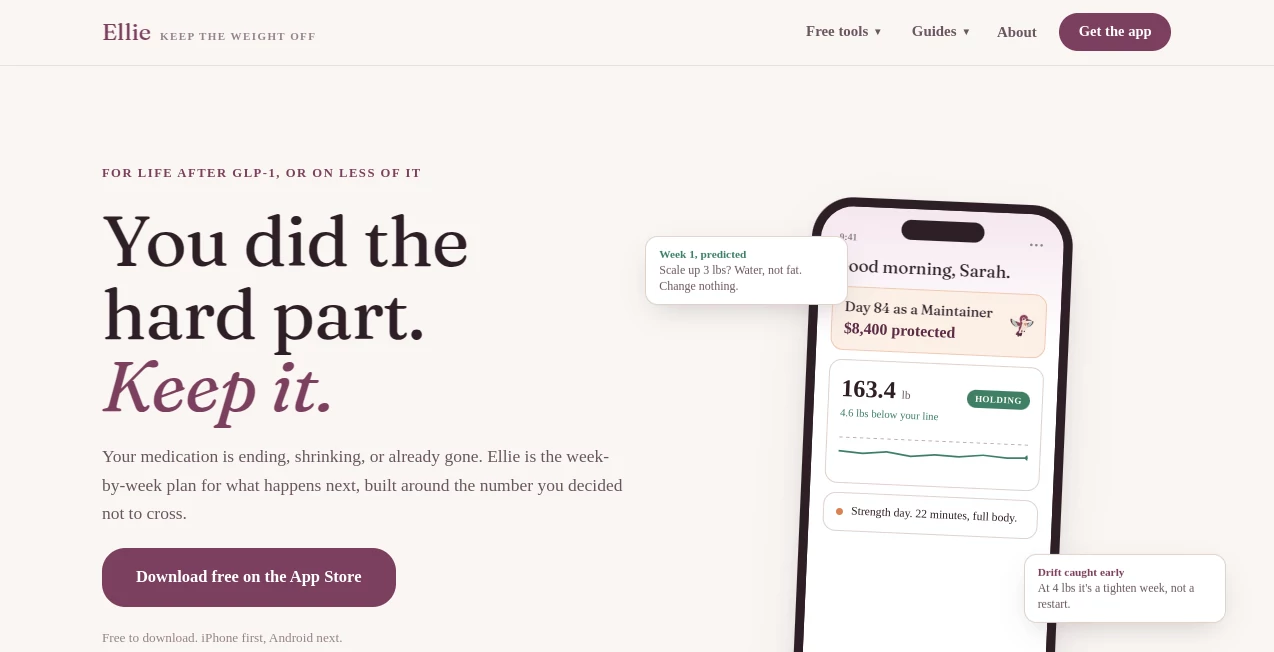
The interface is built around simple daily actions rather than complicated dashboards. A typical view can show the user's current weight, distance from their chosen threshold, maintenance day, strength activity, and the current stage of the plan.
This makes the experience feel more like a personal checklist than a traditional health-tracking application. The design also uses short explanations and clear prompts, which can be particularly useful when someone simply wants to know what to pay attention to today.
Accuracy & Performance
The product takes a research-led approach to its educational content. Its website references studies and real-world clinical data when explaining weight regain, appetite changes, and maintenance challenges. It also states that claims in its free educational resources are sourced and graded.
Importantly, the application does not present itself as a system that can determine the correct medication regimen. It records the plan established by the user and their prescriber instead of making dosing recommendations. That distinction makes the product's intended role considerably clearer.
Capabilities
The main strength is its ability to turn a broad maintenance goal into smaller, time-based actions. The After Plan divides the journey into stages, including the first weeks after a medication change and later periods where regain may become a greater concern.
The Food Noise SOS feature adds another useful layer. Rather than treating cravings as a simple matter of willpower, it provides a short protocol and tracks changes in food-noise intensity over time.
Users can also work with protein and strength targets, log relevant daily information, and create a one-page summary containing their regimen, trend, and plan for discussion with their healthcare professional.
Security & Privacy
Privacy is especially important for an application dealing with weight, medication, and other health-related information. The published privacy policy states that personal and consumer health data is not sold or used for advertising. Users can also request access, correction, export, or deletion of their data.
The policy explains that app data is stored securely while an account is active, and that conversations with the companion remain on the user's device. It also states that data in transit is encrypted and that access to health-data systems is restricted.
The company also makes clear that the service is not a HIPAA-covered healthcare provider or medical service. Users should therefore treat it as an educational and planning companion and keep medication decisions with their prescriber.
Use Cases
- Maintaining weight after GLP-1 treatment: Useful for people preparing for life after a medication course or reduction.
- Monitoring gradual weight drift: The seven-day trend can help users pay attention to broader changes instead of reacting to one unusual measurement.
- Managing food noise: The SOS feature provides a structured response when cravings or persistent thoughts about food become more noticeable.
- Supporting strength and nutrition: Daily protein targets and short strength sessions provide practical maintenance habits.
- Preparing for a doctor appointment: The prescriber export can turn personal tracking into a concise summary for a clinical conversation.
- Learning about GLP-1 maintenance: The accompanying calculators and guides provide additional educational material without requiring an immediate subscription.
Pros and Cons
- Pros: Clear focus on weight maintenance, practical week-by-week planning, research-based educational content, food-noise support, trend tracking, prescriber-friendly reporting, and a strong emphasis on keeping medication decisions between users and their clinicians.
- Cons: The application is currently iPhone-first, with Android planned for later. It is focused specifically on GLP-1-related weight maintenance rather than being a general-purpose fitness or nutrition tracker. The full experience also requires a subscription.
Pricing Plans
The application is free to download on the App Store, while a subscription unlocks the full plan and its complete set of features. The website does not present the subscription price directly on the main product page, so prospective users should check the current in-app offering before subscribing.
A useful part of the offering is that people can explore several free resources before committing. These include a washout calculator, maintenance-calorie calculator, protein calculator, taper schedule visualizer, and microdosing chart, alongside a collection of educational guides.
How to Use the App
- Download the application on an iPhone.
- Set the weight threshold you want to maintain.
- Record your current situation and medication regimen.
- Log your weight and relevant daily information consistently.
- Follow the week-by-week maintenance plan as your situation changes.
- Use the Food Noise SOS when cravings or persistent food thoughts become difficult.
- Pay attention to trends rather than becoming overly concerned about a single weigh-in.
- Use the prescriber export when you want to discuss your progress and plan with your healthcare professional.
Comparison with Similar Tools
General weight-loss and fitness applications usually concentrate on calories, exercise, step counts, or daily weight tracking. This product takes a narrower approach. Its central purpose is maintaining weight around GLP-1 treatment and helping users understand what may happen during different phases of that transition.
That specialization can be an advantage for someone who already has a broader fitness tracker but wants a dedicated maintenance framework. Instead of trying to become an all-purpose health application, it focuses on the specific period that begins when the initial weight-loss goal has already been achieved.
Another notable difference is the emphasis on the prescriber relationship. Rather than attempting to replace professional medical guidance, the application creates a structured record that can make conversations with a clinician more useful.
Conclusion
Weight maintenance after GLP-1 treatment is a very different challenge from losing weight in the first place. A single number on a scale rarely tells the whole story, and the transition can involve changes in appetite, routine, activity, and confidence.
This product offers a focused answer to that problem. Its combination of trend monitoring, weekly planning, food-noise support, nutrition targets, educational resources, and prescriber reporting gives users a structured way to stay engaged with their progress.
It will not replace a doctor, and it does not attempt to. Its value lies in filling the space between everyday tracking and professional medical conversations. For iPhone users looking for a dedicated companion around GLP-1 maintenance, that focused approach makes it worth exploring.
Frequently Asked Questions (FAQ)
Is this a medical advice app?
No. The product describes itself as an educational companion rather than medical care. It does not recommend medication doses or dosing intervals, and medication decisions are intended to remain with the user and their prescriber.
Can it be used while taking a GLP-1 medication?
Yes. It is designed for people maintaining their weight while taking medication, reducing it, or being completely off it, depending on the plan established with their prescriber.
Which medications are supported?
The website states that the product covers medications including Zepbound, Mounjaro, Wegovy, Ozempic, oral versions, and compounded semaglutide or tirzepatide.
Does it tell users how to taper their medication?
No. It records the regimen chosen by the user and their prescriber but does not recommend a dose or dosing interval.
Is the application available on Android?
Not yet. The current version is available for iPhone, while an Android version is planned.
Is there a free version?
The application is free to download, and the website also provides several free calculators and educational guides. A subscription is required to unlock the full in-app plan.
Can the data be shared with a doctor?
Yes. The product includes a prescriber export designed to create a concise summary of the user's regimen, weight trend, and plan for discussion with a healthcare professional.
Does the company sell health data?
According to its published privacy policy, personal and consumer health data is not sold and is not shared with advertisers for advertising purposes. Users can also request access, export, correction, or deletion of their personal data.
AI Life Assistant , AI Fitness , AI Healthcare .
These classifications represent its core capabilities and areas of application. For related tools, explore the linked categories above.

Ellie Alternatives Product

PlateLens

KronoPrompt

Alter

Visual Field…

Snow day Cal…

Dialogues wi…

Pontefuerte …

Parking Prac…

ChirpyPet
