


















Hedgineer
What is Hedgineer?
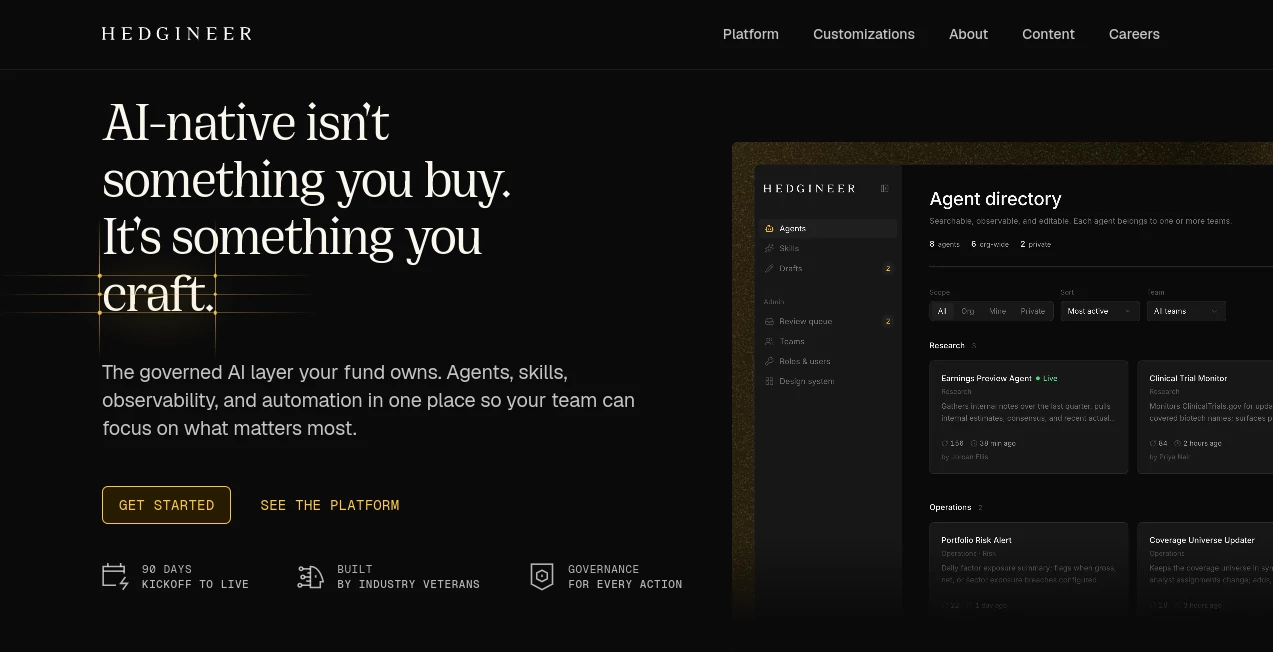
Hedgineer is an AI platform built specifically for hedge funds and asset managers that want to move beyond scattered AI experiments and build a connected, controlled system across the organization. Instead of asking investment teams to manage a collection of unrelated AI tools, the platform brings agents, reusable skills, workflow automation, monitoring, and governance into one environment.
Its approach is particularly interesting for firms where AI needs to work with sensitive research, portfolio information, risk data, internal documents, and operational processes. The platform can be deployed directly into a firm's cloud environment, allowing the organization to retain ownership of its AI agents, workflows, and underlying data.
The company positions its implementation around a 90-day process. During that period, engineers, financial analysts, and product specialists work together to deploy the platform, automate two or three high-value workflows, and help the firm's own employees learn how to build with AI.
Key Features
- AI agents designed for specific investment, research, risk, investor relations, and operational workflows.
- A shared skill library for capturing company-specific methods, standards, and processes.
- Direct deployment into the firm's own cloud environment and data infrastructure.
- Governance and review workflows for changes made to agents and skills.
- AI usage monitoring across supported AI subscriptions and sessions.
- Custom connectors for internal systems, financial data providers, documents, spreadsheets, and communication platforms.
- Workflow-level analytics covering usage, engagement, and AI spending.
- Integrations with tools and platforms used by investment organizations, including Slack, Microsoft, Snowflake, Databricks, Bloomberg, FactSet, PitchBook, Enfusion, and other financial technology systems.
User Interface
The interface is designed more like an operational control center than a general-purpose chatbot. Teams can view active agents, monitor sessions, manage shared skills, review proposed changes, and examine performance data from a central workspace.
For example, an investment research agent can be configured with defined permissions, connected data sources, and a specific purpose such as preparing an earnings preview. The platform can show how often that agent has been used, its completion rate, connected tools, and average cost per run.
This approach should feel familiar to technical and investment teams because the emphasis is on workflows and measurable outcomes rather than simply chatting with an AI model.
Accuracy & Performance
Performance is handled through workflow design, controlled access, connected data sources, and ongoing measurement rather than relying solely on the underlying language model. Agents can be given precise boundaries around what they are allowed to read, modify, or delete.
The platform also supports review processes before changes to organization-wide agents or skills become active. This creates an additional checkpoint for investment firms where a small change in an automated workflow could affect a report, risk calculation, or research process.
Its workflow examples include research automation, portfolio attribution, factor exposure monitoring, earnings previews, document processing, and investor reporting. These are practical tasks where consistency and traceability can matter as much as raw response speed.
Capabilities
The platform can be customized around the way an investment firm already operates. Research teams can connect internal notes, broker research, filings, transcripts, and other sources to automate tasks such as first-look memos, earnings previews, research summaries, and alerts.
Portfolio and risk teams can use connected data to support attribution analysis, factor exposure reporting, portfolio risk decomposition, tax-lot tracking, and automated checks of fund administrator reports.
Investor relations and operations teams can also automate recurring work. Examples include preparing investor updates in the firm's preferred voice, monitoring AI usage and cost by workflow, and identifying potentially sensitive information such as personally identifiable information or material non-public information.
The skill library adds another useful layer. Teams can document how a recurring process should be performed and make that methodology available to approved agents and AI systems, helping different teams follow consistent standards.
Security & Privacy
Security and governance are central to the platform's design. Rather than requiring a fund to move its operational data into a separate vendor environment, the platform is designed to run directly in the firm's cloud environment and work with its data.
AI activity can be monitored across supported subscriptions and sessions, while potential PII and MNPI issues can be flagged. Changes to important agents and skills can also pass through an approval process before deployment.
This model is particularly relevant for investment organizations that need tighter control over sensitive research, portfolio information, internal communications, and automated decision-support processes.
Use Cases
- Investment Research: Automate earnings previews, research summaries, first-look memos, and recurring research workflows.
- Portfolio Management: Support attribution analysis, portfolio monitoring, and recurring portfolio reports.
- Risk Management: Automate factor exposure monitoring, risk decomposition, and ex-ante risk reporting.
- Investor Relations: Generate investor communications using internal data, preferred formatting, and the firm's established voice.
- Operations: Reconcile reports, detect anomalies, process internal information, and automate repetitive operational tasks.
- Research Document Processing: Extract useful information from internal documents, research reports, spreadsheets, and other sources.
- AI Governance: Track AI usage, review changes, monitor costs, and identify potential compliance issues.
- Team Enablement: Help employees learn how to build and manage their own AI-powered workflows instead of depending entirely on a central engineering team.
Pros and Cons
Pros
- Designed specifically around hedge funds and asset managers.
- Can operate directly within a firm's cloud environment.
- Combines AI agents, skills, workflow automation, governance, and analytics.
- Supports highly customized investment and operational workflows.
- Strong focus on AI governance and controlled deployment.
- Can connect with existing financial and enterprise technology stacks.
- Includes practical support and implementation rather than being positioned solely as a self-service application.
Cons
- The platform is primarily aimed at institutional investment organizations rather than individual users.
- Implementation requires collaboration with the provider's engineering and financial specialists.
- The 90-day deployment model may be more involved than the setup of a conventional consumer AI application.
- Public pricing information is not provided, so organizations need to contact the company to discuss their requirements.
Pricing Plans
No standard public subscription prices are displayed on the website. Instead, the service is presented around a customized implementation model designed for individual investment firms.
The initial engagement is structured around a 90-day kickoff-to-live process. During that period, the team deploys the platform into the firm's cloud, selects two or three high-value workflows for automation, develops the required connectors, agents, and skills, and provides targeted training for the organization's employees.
This makes the pricing model better suited to institutional buyers with specific infrastructure, workflow, security, and integration requirements than to individuals looking for a simple monthly AI subscription.
How to Use the Platform
Getting started is different from signing up for a typical consumer AI tool. The process begins by identifying the firm's most valuable AI opportunities and understanding the systems, data sources, and workflows involved.
- Start by discussing the firm's existing AI usage, infrastructure, and operational priorities.
- Select two or three high-value workflows where automation can provide a meaningful benefit.
- Deploy the platform directly into the firm's cloud environment.
- Connect the required internal systems, financial data sources, and communication tools.
- Build and configure the appropriate agents and reusable skills for each workflow.
- Set permissions that define what each agent can access, modify, or delete.
- Review and approve important agent and skill changes before they become active.
- Monitor sessions, workflow performance, adoption, and AI costs.
- Train internal employees so they can continue building and managing AI workflows themselves.
Comparison with Similar Tools
General-purpose AI assistants are excellent for individual research, writing, coding, and everyday productivity, but investment firms often need something more structured. The key difference here is the focus on turning AI into an organizational system rather than providing another standalone assistant.
Compared with a typical AI chatbot, the platform provides deeper workflow configuration, controlled permissions, reusable skills, connected enterprise data, review processes, and usage analytics. Compared with conventional automation platforms, it puts greater emphasis on AI agents that can work with complex research and investment processes.
The strongest reason to consider this approach is therefore not simply access to an AI model. It is the combination of domain-specific workflows, organizational context, governance, and infrastructure ownership.
Conclusion
For hedge funds and asset managers, the challenge with AI is increasingly less about finding another capable model and more about turning AI into something the whole organization can use responsibly. This platform takes a practical approach to that problem by combining agents, skills, automation, analytics, and governance inside an environment controlled by the investment firm.
The emphasis on direct cloud deployment, financial-domain expertise, customized workflows, and measurable AI adoption makes it a particularly interesting option for organizations that are ready to move from isolated AI experiments toward a broader operating model.
It will not be the right choice for someone looking for a quick personal AI assistant. For an investment organization with complex workflows, sensitive data, and a serious need for controlled AI adoption, however, the approach offers a compelling path toward making AI part of everyday operations.
Frequently Asked Questions (FAQ)
Who is this platform designed for?
It is primarily designed for hedge funds, asset managers, and investment organizations that want to deploy AI across research, portfolio management, risk, investor relations, and operations.
Can the platform run in a firm's own cloud?
Yes. The platform is designed to be deployed directly into the firm's cloud environment, allowing the organization to retain ownership of its agents, skills, workflows, and data.
What types of AI agents can be created?
Agents can be built for tasks such as earnings previews, research analysis, coverage updates, model building, portfolio risk monitoring, attribution reporting, investor communications, and operational workflows.
Does it support existing enterprise tools?
Yes. The platform is designed to connect with an investment firm's existing technology stack and lists integrations and connections involving services such as Slack, Microsoft, Snowflake, Databricks, Bloomberg, FactSet, PitchBook, Enfusion, and other financial data and enterprise systems.
Does it provide AI governance?
Yes. AI sessions can be monitored, usage can be analyzed, sensitive information can be flagged, and changes to important agents and skills can be routed through a review process.
How long does implementation take?
The company's standard approach is built around a 90-day kickoff-to-live process, during which the platform is deployed, selected workflows are automated, and employees receive guidance on building with AI.
Is pricing publicly available?
No standard public pricing plan is shown. The service is positioned around customized implementation for individual investment firms, so organizations need to contact the provider for pricing and project details.
Is this suitable for individual users?
It is primarily intended for institutional investment teams rather than individual consumers. Its value comes from integrating AI into organizational workflows, data, governance, and infrastructure.
AI Workflow Management , AI Investing Assistant , AI Research Tool , Business .
These classifications represent its core capabilities and areas of application. For related tools, explore the linked categories above.

Hedgineer Alternatives Product

PrompTessor

Harvey

Chatzy AI

Trimless for…

Where Is Thi…

LaunchBoard

Somnio

ForexCoupons

Neurohelper
