


















Balzac
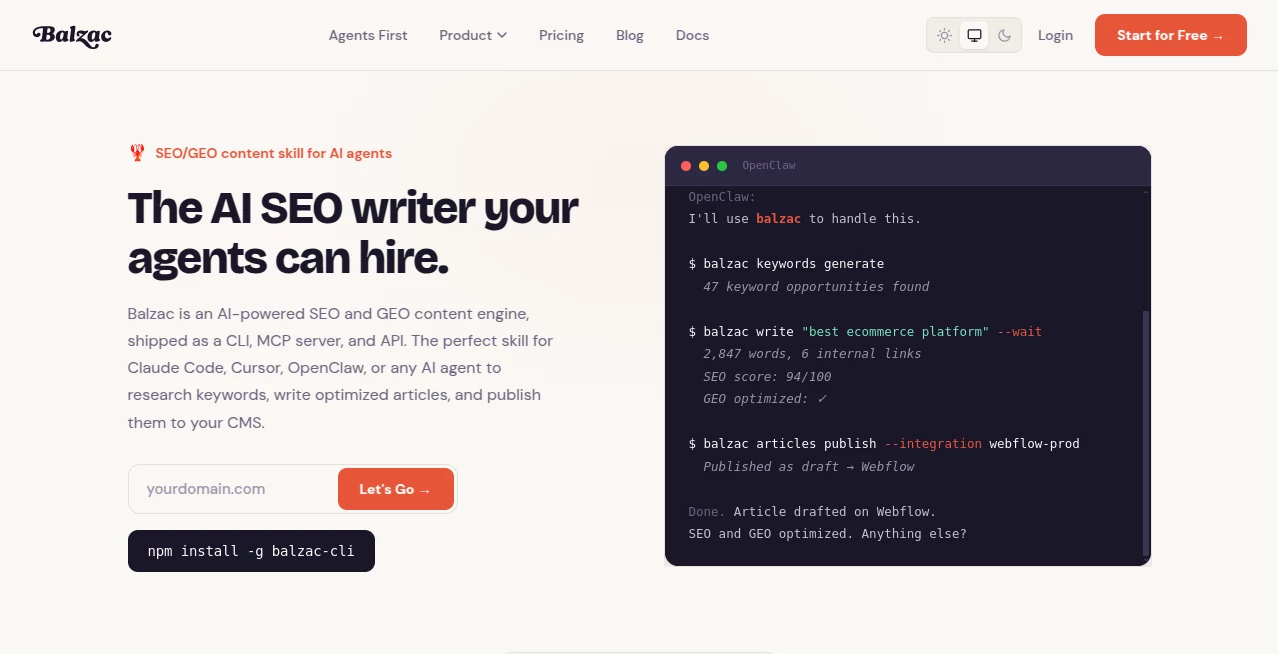
What is Balzac?
Creating content that ranks consistently is one of the biggest challenges for growing businesses. Researching keywords, planning articles, writing long-form content, optimizing for search engines, and publishing across different platforms often requires multiple tools and countless hours of manual work. This platform brings every step together into one streamlined workflow designed for modern AI-powered automation.
Instead of acting as a simple writing assistant, it functions as a complete SEO content engine. From identifying valuable keyword opportunities to generating detailed articles and publishing them directly to a content management system, the entire process can run with minimal human involvement. This makes it especially valuable for SaaS companies, agencies, developers, startups, and marketing teams looking to scale organic growth without expanding their workforce.
Another impressive advantage is its focus on both traditional search engines and AI-powered search experiences. Articles are structured to perform well on Google while also increasing the chances of being referenced by modern AI assistants and large language models. Combined with a natural writing style and built-in content quality controls, it delivers content that feels authentic instead of robotic.
Key Features
User Interface
The platform offers multiple ways to work depending on user preferences. Developers can access a powerful CLI, REST API, and MCP server for complete automation, while teams that prefer visual management can use an intuitive web dashboard. Integration with popular CMS platforms allows articles to move from creation to publication with very little effort.
Accuracy & Performance
Keyword opportunities are discovered using real website data, competitor analysis, search intent, ranking positions, and search volume. The generated articles follow structured SEO practices, including proper heading hierarchy, internal linking, metadata, and optimized formatting. The system also prioritizes content opportunities that have realistic ranking potential instead of relying on random keyword suggestions.
Capabilities
- Automated keyword research
- Competitor analysis
- Long-form SEO article generation
- Optimization for AI search visibility
- Internal linking automation
- Cover image generation
- CMS publishing automation
- Google Search Console integration
- REST API and CLI support
- Support for multiple languages
Security & Privacy
Businesses maintain control over their own workspaces while connecting external services only when required. API-based workflows make it suitable for professional automation pipelines, and direct integrations reduce the need to transfer content manually between multiple third-party applications.
Use Cases
- Scaling blog production for SaaS companies.
- Automating SEO campaigns for digital agencies.
- Creating optimized knowledge base articles.
- Publishing educational content across multiple websites.
- Growing organic traffic with data-driven keyword strategies.
- Automating content workflows for developers using AI agents.
- Producing multilingual SEO content.
Pros and Cons
Pros
- Complete SEO workflow from research to publishing.
- Built specifically for AI agents and automation.
- Supports API, CLI, MCP, and dashboard workflows.
- Direct integration with popular CMS platforms.
- Natural writing style designed to avoid repetitive AI patterns.
- Optimized for both search engines and AI-generated search results.
Cons
- Advanced automation features may require technical knowledge.
- Best value comes from publishing content regularly.
- Some integrations may require initial configuration.
Pricing Plans
Several subscription plans are available to match different publishing needs. Entry-level plans are suitable for experimentation, while larger plans provide higher monthly credit allowances for businesses, agencies, and high-volume content teams. Pricing is credit-based, allowing users to generate articles, rewrite content, and create supporting assets according to their workflow requirements.
How to Use Balzac
- Connect your website or content management system.
- Analyze your website and existing search performance.
- Review recommended keyword opportunities.
- Generate a complete SEO article.
- Review the generated content if desired.
- Publish directly to your preferred CMS.
- Monitor rankings and continue expanding your content strategy.
Comparison with Similar Tools
Many AI writing platforms focus primarily on text generation, leaving keyword research, optimization, publishing, and performance tracking to separate tools. This solution combines every major stage of the SEO workflow into a unified platform. Its automation-first architecture, support for AI agents, integration with Google Search Console, and direct publishing capabilities make it particularly attractive for organizations that want to build scalable content systems rather than simply generate articles.
Conclusion
For businesses aiming to grow organic visibility without building a large content team, this platform delivers a remarkably complete solution. It transforms keyword discovery, article creation, optimization, and publishing into one efficient workflow that can operate almost entirely on autopilot. Whether the goal is increasing search rankings, improving AI search visibility, or automating repetitive marketing tasks, it offers a practical combination of intelligent automation, flexible integrations, and professional-quality output that can significantly accelerate long-term content growth.
Frequently Asked Questions (FAQ)
Who is this platform designed for?
It is ideal for marketers, SaaS companies, agencies, developers, startups, and businesses that want to automate SEO content production.
Can it publish articles automatically?
Yes. It supports direct publishing to several popular content management systems through built-in integrations and automation workflows.
Does it perform keyword research?
Yes. It analyzes websites, competitors, search intent, ranking opportunities, and keyword difficulty before generating content recommendations.
Is it suitable for developers?
Yes. It provides REST API access, a command-line interface, and MCP server support, making it highly suitable for automated workflows.
Can it help with AI search optimization?
Yes. Content is structured not only for traditional SEO but also to improve visibility within AI-generated search experiences.
AI Blog Writer , AI Content Generator , AI Developer Tools , AI SEO Assistant .
These classifications represent its core capabilities and areas of application. For related tools, explore the linked categories above.

Balzac Alternatives Product

Touchpoint

ReezoAI

Ai Book Publ…

PromptFix

Reverse Imag…

Schema Synth

Discord Time…

Translators …

Techvorizon …