
Interhuman AI
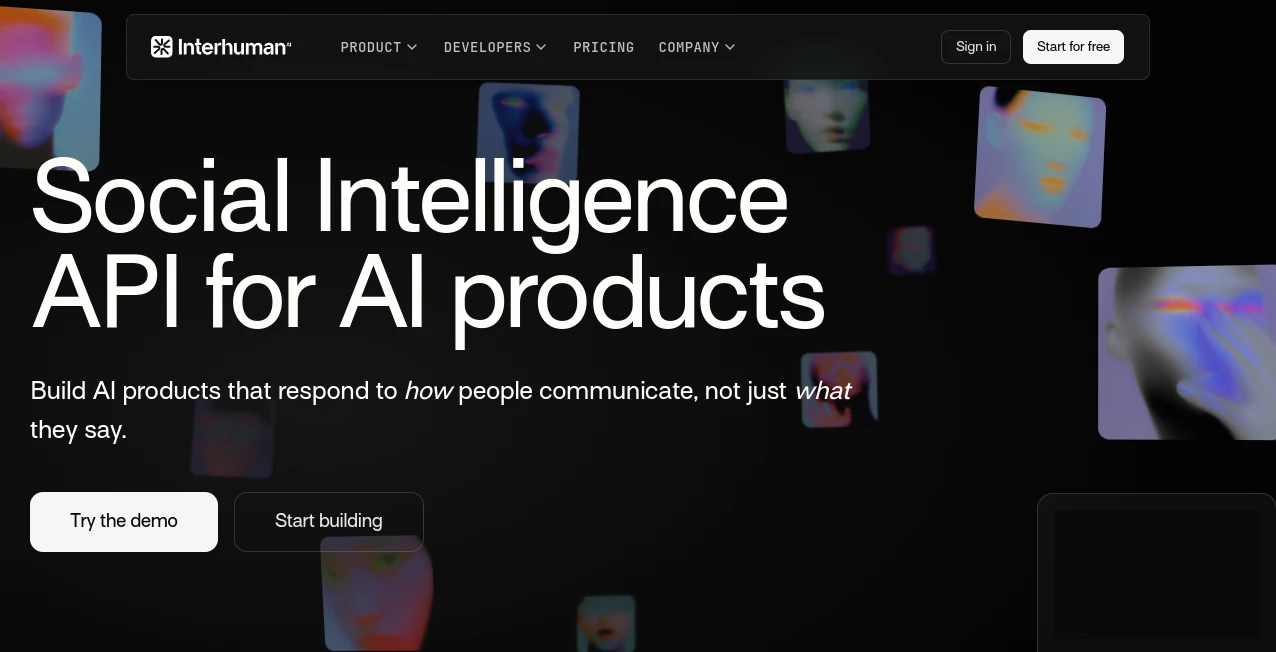
What is Interhuman AI?
Modern AI can process language with remarkable speed, yet it often overlooks the subtle behavioral signals that shape real conversations. This platform bridges that gap by giving developers access to advanced social intelligence through a multimodal API that understands not only spoken words but also facial expressions, vocal patterns, body language, and conversational context.
Built on behavioral science and supported by psychologists, the solution analyzes video, audio, and text simultaneously to detect meaningful communication signals such as engagement, hesitation, confidence, confusion, and agreement. Instead of relying on simple sentiment analysis, it provides explainable insights backed by observable evidence, making AI-powered applications significantly more aware of human interactions.
Whether integrated into virtual assistants, interview platforms, AI tutors, meeting assistants, or coaching applications, the technology helps software respond naturally to human behavior rather than transcripts alone. For organizations seeking more intelligent conversational experiences, it represents a major advancement in multimodal AI.
Key Features
User Interface
The developer experience is clean and practical. After obtaining API credentials, developers can upload recorded conversations or connect live video streams through a straightforward REST API. Documentation is organized with examples, allowing teams to begin building without navigating unnecessary complexity.
The returned responses are delivered in structured JSON, making it simple to integrate detected behavioral signals into existing applications, dashboards, or AI workflows.
Accuracy & Performance
The underlying multimodal model processes video, audio, and text together in temporal alignment instead of evaluating each source independently. This produces more reliable behavioral analysis because facial movements, vocal tone, posture, and spoken language are interpreted as a unified conversation.
Each detected signal includes confidence scores and detailed explanations describing the observable evidence behind every prediction. This transparency helps developers build trustworthy AI systems while avoiding black-box decisions.
Capabilities
- Detects 12 actionable social signals during conversations.
- Processes video, audio, and text simultaneously.
- Measures continuous engagement throughout interactions.
- Generates a Conversation Quality Index for communication analysis.
- Provides explainable reasoning for every detected signal.
- Returns structured JSON responses for easy integration.
- Supports both recorded and live communication workflows.
- Designed specifically for conversational AI products.
- Built on behavioral science instead of traditional emotion detection.
- Suitable for enterprise-grade AI applications.
Security & Privacy
Privacy is treated as a core design principle. The platform follows European values around responsible AI, transparency, and data protection. Uploaded content is handled securely, while organizations maintain control over their data. Optional participation in model improvement programs ensures customers decide whether their information contributes to future model development.
Use Cases
- AI meeting assistants that understand participant engagement.
- Sales coaching platforms that evaluate communication quality.
- AI interview systems providing behavioral feedback.
- Communication training for professionals.
- Virtual assistants capable of responding more naturally.
- AI tutoring systems that recognize learner confusion.
- User research platforms measuring participant reactions.
- Healthcare communication support applications.
- Customer service quality analysis.
- Leadership and presentation coaching.
Pros and Cons
Pros
- True multimodal behavioral analysis.
- Evidence-based explanations improve trust.
- Easy REST API integration.
- Designed specifically for conversational intelligence.
- Behavioral science foundation increases practical value.
- Useful across many AI-powered industries.
Cons
- Primarily intended for developers rather than end users.
- Requires video or audio data for full functionality.
- Enterprise-focused capabilities may exceed the needs of small personal projects.
Pricing Plans
Public pricing information is not currently published. Developers can request API access, explore documentation, and contact the team for custom plans based on project requirements and expected usage.
How to Use Interhuman AI
- Create an account and obtain an API key.
- Connect your application using the REST API.
- Upload a recorded conversation or stream live communication.
- Receive structured JSON containing behavioral insights.
- Integrate the returned signals into your AI workflow.
- Use engagement metrics and conversation scores to improve user experiences.
Comparison with Similar Tools
Most conversational AI services focus primarily on speech recognition or transcript analysis. This platform goes much further by combining visual behavior, vocal characteristics, spoken language, and contextual understanding into a single behavioral intelligence layer.
Unlike conventional sentiment analysis that simply labels conversations as positive or negative, it identifies actionable communication signals with detailed reasoning. This creates opportunities for richer coaching, smarter AI assistants, better interview systems, and more adaptive conversational experiences.
Conclusion
Organizations building next-generation conversational AI require more than accurate transcription. They need systems capable of recognizing how people communicate in real situations. By combining behavioral science with multimodal machine learning, this solution delivers meaningful social intelligence that helps AI understand real human interaction.
For developers creating meeting copilots, AI tutors, interview assistants, communication coaching platforms, or intelligent virtual assistants, it offers an impressive foundation for building experiences that feel significantly more aware, responsive, and human.
Frequently Asked Questions (FAQ)
What makes this platform different from sentiment analysis?
It detects multiple behavioral signals such as hesitation, confidence, engagement, and confusion while providing evidence-based explanations instead of simple positive or negative labels.
Can developers integrate it into existing applications?
Yes. A REST API and structured JSON responses make integration straightforward for web, desktop, and enterprise AI applications.
Does it analyze only speech?
No. It combines video, audio, and text together, allowing it to understand communication more accurately than transcript-only systems.
Who benefits most from this technology?
Software developers, AI companies, communication coaching platforms, interview solutions, tutoring systems, customer support tools, and enterprise conversational products.
Is the platform privacy-conscious?
Yes. It follows European privacy principles and provides transparent data handling with customer control over model improvement participation.
AI Customer Service Assistant , AI API Design , AI Meeting Assistant , AI Developer Tools .
These classifications represent its core capabilities and areas of application. For related tools, explore the linked categories above.

Interhuman AI Alternatives Product

Weblo AI

Maestra

DeepSeek V4

Project Mela

DevUtilX

Defapi

LocaFlow

HelloDay.ai

Tooladda