
Knola
What is Knola?
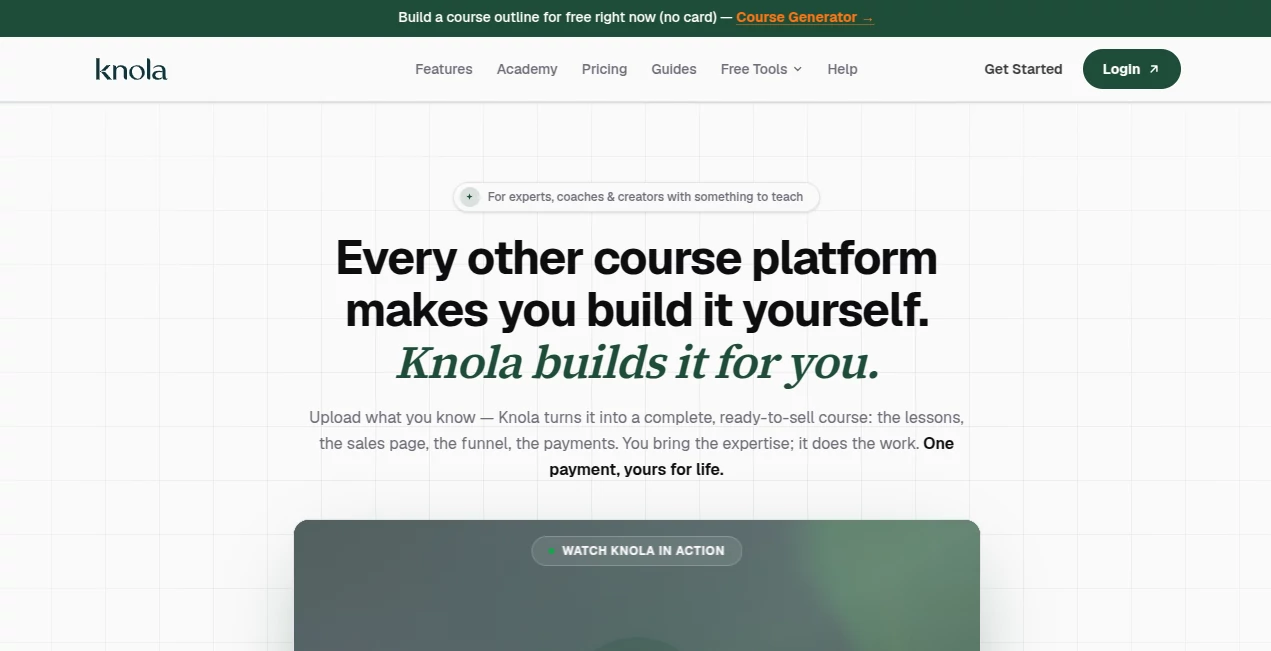
Turning expertise into an online course sounds simple until the real work begins. Planning lessons, organizing source material, creating presentations, writing sales copy, setting up payments, and building a funnel can quickly become a project of its own. Knola takes a different approach by bringing these tasks together in one AI-powered platform designed for experts, coaches, educators, and creators.
The platform can start with something as simple as an idea, a professional skill, or an existing collection of learning materials. Users can upload videos, PDFs, slides, and text, then use the built-in AI tools to shape that material into a structured course. The result is more than a collection of videos; it is a learning product with lessons, supporting resources, sales pages, checkout options, and a complete path toward selling.
For someone who has valuable knowledge but has been putting off course creation because of the technical workload, this approach is particularly appealing. Instead of beginning with a blank course builder, the creator begins with what they already know.
Key Features
- AI-assisted course creation from existing knowledge and source materials.
- Automatic lesson plans, summaries, key tips, and text versions.
- Support for video, PDF, presentation, and text-based course materials.
- Automatic video transcription, audio versions, and clickable captions.
- Automatically generated worksheets, checklists, mini-guides, and downloadable resources.
- AI-generated presentation decks based on individual lessons.
- Speaker scripts that help instructors record lessons more easily.
- AI-generated sales copy based directly on course content.
- AI-powered landing page creation and editing.
- Sales funnels with upsells, downsells, bundles, and order bumps.
- Built-in checkout and automated course delivery.
- Student management, progress tracking, messaging, and analytics.
User Interface
The workflow is organized around the natural stages of launching a course: idea, content creation, slides, sales pages, funnel, checkout, and growth. This structure makes the platform easier to understand than a dashboard filled with disconnected marketing and education tools.
Creators can move from uploading their knowledge to preparing lessons and presentations without constantly switching between different services. The presentation builder also supports branding and logos, while generated speaker notes remain separate from the material shown to students or viewers.
For a first-time course creator, that guided workflow can remove much of the uncertainty that normally comes with deciding what to build next.
Accuracy & Performance
The AI works directly with the material supplied by the creator, which gives the generated lessons, summaries, presentations, and sales copy a useful source of context. This is especially valuable when a course is based on specialized professional knowledge rather than a generic subject.
Video materials can be transcribed and converted into additional learning formats, while existing lessons can be transformed into presentation decks and speaker scripts. The platform also states that its course-generation feature can produce a structured course concept from a job, skill, or hobby in less than 30 seconds.
AI-generated material should still be reviewed before publication. The service itself notes that AI output may be incomplete or inaccurate, so the creator remains responsible for checking the final educational content.
Capabilities
The strongest part of the platform is the breadth of the workflow. A creator can start with an idea or existing materials and progressively turn them into a complete commercial course.
Existing content can be converted into lesson plans and supporting resources. Lessons can become branded presentations with speaker scripts. The same course material can then feed into sales-page copy, landing pages, and funnel content. Checkout and delivery features complete the path from content creation to selling.
Creators can also build offers around multiple products, including bundles, upsells, downsells, and order bumps. Student management and analytics then provide visibility into progress, payments, funnels, and average order value.
Security & Privacy
Content ownership is an important part of the service's positioning. According to its terms and product information, creators retain ownership of their own content, students, and customer information, while the platform provides the hosting and course infrastructure.
The service also states that users can export their content, which can be reassuring for creators who do not want their business permanently tied to a single platform. Users should nevertheless review the current terms and privacy documentation before uploading sensitive or confidential material.
Use Cases
Coaches and consultants: Professional expertise can be transformed into structured programs without building every lesson and marketing asset manually.
Online educators: Teachers and instructors can repurpose existing videos, documents, slides, and written materials into a more complete learning experience.
Business experts: A process, professional skill, or specialized workflow can become a paid training program with lessons, resources, presentations, and a sales funnel.
Content creators: Creators who already have valuable knowledge but lack a formal course can start from an idea and develop it into a sellable educational product.
Existing course owners: People selling courses elsewhere can bring their material into the platform and use its AI capabilities to restructure content and identify additional offers such as upsells and downsells.
Agencies and course builders: The Studio plan supports creating courses for clients, making the platform relevant to people who build educational products as a service.
Pros and Cons
- Pros: Course creation, presentation generation, sales pages, funnels, checkout, and student management are combined in one platform.
- Pros: Supports multiple source formats including video, PDFs, slides, and text.
- Pros: Automatically creates useful educational resources such as worksheets, checklists, summaries, and guides.
- Pros: One-time lifetime plans are available instead of requiring a mandatory recurring subscription.
- Pros: Users can connect their own payment checkout and avoid a percentage fee from the platform on those sales.
- Cons: AI-generated educational and marketing content still requires human review.
- Cons: The lower-priced Solo plan is limited to one course and one funnel.
- Cons: Using the platform's automated payment system can involve transaction fees.
- Cons: Creators looking for highly specialized LMS features may need to compare the available functionality with dedicated learning-management platforms.
Pricing Plans
The pricing model is one of the platform's notable differences. The Solo plan is listed at $97 as a one-time payment and includes one course, one funnel, 10 GB of storage, and support for up to 1,000 students. It also includes the AI lesson, sales-page, and funnel builders, presentation generation, speaker scripts, and access to the included academy.
The Studio plan is currently listed at an introductory $197 one-time payment, with a stated regular price of $397. It supports up to five courses and five funnels, provides 50 GB of storage, supports up to 5,000 students, and includes the ability to create courses for clients.
Both plans include a 30-day money-back guarantee. Creators can also use their own checkout links, including supported external payment services, or use the platform's automated payment system, where a transaction fee may apply.
How to Use the Platform
Start by entering what you know. This can be a professional skill, a hobby, an existing course idea, or material you have already created. The AI can use that information to create an initial course structure.
Next, upload the material you want to teach from. Videos, PDFs, slides, and text can become the foundation for structured lessons. Review the generated lesson plans and supporting resources, then adjust them to match your teaching style and audience.
For lessons that require video or presentation content, generate a slide deck and speaker script. You can present and record within the platform or download the resulting presentation as a PDF or PowerPoint file.
Once the educational content is ready, create the sales page and customize the generated copy. Build a funnel with the appropriate checkout, upsells, downsells, or bundles, then configure payment and delivery.
After launch, use student progress information and sales analytics to identify what is working and where the course experience can be improved.
Comparison with Similar Tools
Traditional course platforms generally provide the infrastructure needed to host and sell a course, but much of the preparation remains the creator's responsibility. Course outlines, lesson resources, presentations, sales copy, funnels, and checkout configuration may require several separate tools or substantial manual work.
The main distinction here is the attempt to connect these stages through AI. Instead of treating course hosting as the central feature, the platform focuses on helping a creator move from knowledge to a finished commercial product.
This makes it particularly attractive to someone who values speed and simplicity over assembling a large collection of specialized services. On the other hand, creators who already have an established production workflow may prefer dedicated tools for individual parts of the process.
Conclusion
Creating an online course is rarely difficult because the creator lacks knowledge. The challenge is turning that knowledge into lessons, resources, presentations, marketing material, a working funnel, and a reliable way to deliver the final product.
This platform addresses that problem from end to end. Its ability to work from existing knowledge and transform source materials into lessons, resources, presentations, sales pages, funnels, and checkout flows gives creators a much shorter route from idea to launch.
The lifetime pricing approach also makes it stand out in a market where recurring software costs can become significant. For coaches, educators, consultants, and creators who have something valuable to teach but do not want to spend weeks connecting different tools, it is a compelling option worth exploring.
Frequently Asked Questions (FAQ)
Can I create a course without having existing course material?
Yes. The course-generation feature is designed to start from knowledge such as a job, skill, hobby, or initial idea and turn it into a structured course concept.
What types of files can I upload?
The platform supports materials including videos, PDFs, slides, and text. These materials can then be used to create lessons and additional educational resources.
Can it create presentations for my lessons?
Yes. Lessons can be converted into presentation decks, with branding options and speaker scripts designed to help instructors record their teaching material.
Can I sell my course directly?
Yes. The platform provides sales pages, funnels, checkout functionality, and automated delivery. Creators can also bring their own checkout links.
Do I have to pay a monthly subscription?
The listed Solo and Studio lifetime offers use one-time payments. There is also an optional Pro subscription for creators who want expanded functionality and different payment-fee arrangements.
Do I own my course content?
According to the service's information, creators retain ownership of their content, students, and customer list, and their content can be exported.
Is the AI-generated content ready to publish without editing?
It can provide a strong starting point, but creators should review AI-generated lessons, copy, and other material for accuracy, completeness, and suitability before publishing.
Is there a money-back guarantee?
The current lifetime offers include a 30-day money-back guarantee.
AI Course , AI Knowledge Management , AI Education Assistant , AI Presentation Generator .
These classifications represent its core capabilities and areas of application. For related tools, explore the linked categories above.

Knola Alternatives Product
Business Chi…

Manus

Keepmind

Traecta

UPDF AI

YT Video Sum…

MyMap.AI

Omphalis

Llamaroo