


















Landscape Design AI
What is Landscape Design AI?
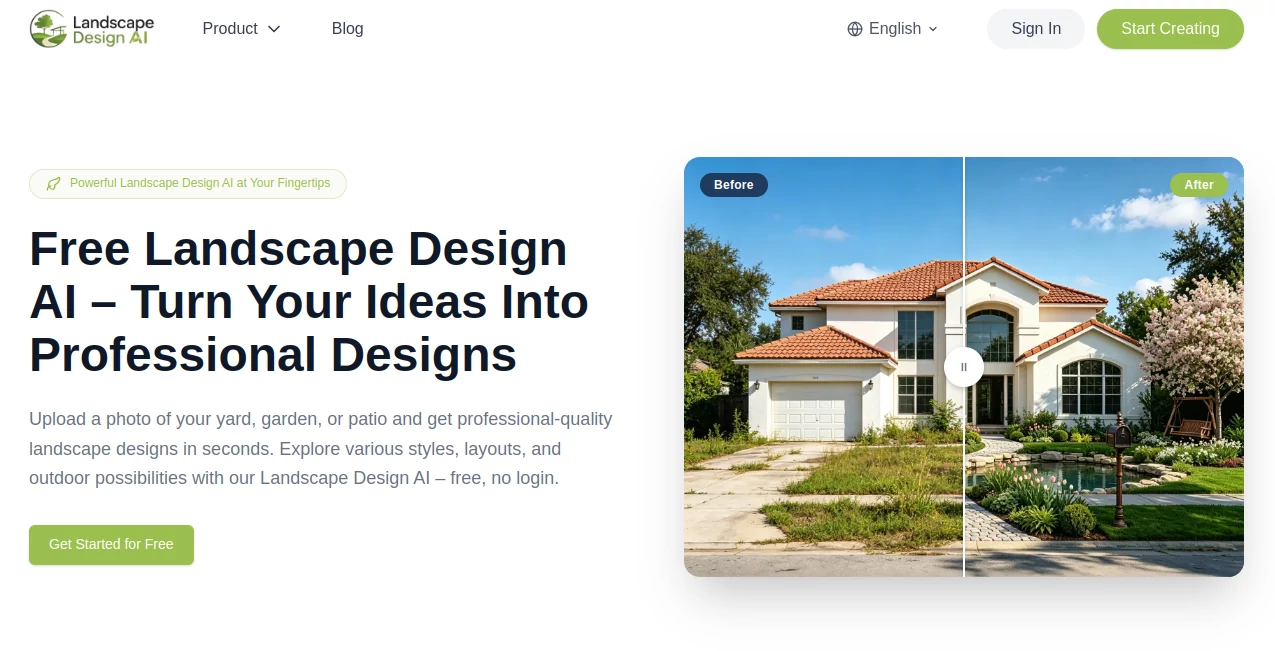
Landscape Design AI is a free online tool that turns a photo of a yard, garden, patio, or other outdoor space into a realistic landscape concept within seconds. Instead of trying to imagine how a new garden bed, seating area, pathway, or planting arrangement might look, users can see a visual version before making changes in the real world.
The process is refreshingly simple. Upload a JPG, PNG, or WebP image, choose the type of space and preferred style, add details about the intended use, sunlight, terrain, and location, then generate a design. There is no need for professional design experience, and the service can be tried without creating an account. :contentReference[oaicite:0]{index=0}
For a homeowner planning a weekend project, a landscaper preparing an early concept, or a property professional looking to improve curb appeal, this approach makes experimentation much easier. You can test a modern backyard one moment and explore a Mediterranean or Japanese-inspired garden the next.
Key Features
- Photo-based landscape design generation
- 30+ built-in landscape styles
- Custom prompts for more specific design ideas
- Support for backyards, front yards, gardens, patios, side yards, and balconies
- Location, sunlight, terrain, and intended-use options
- Photorealistic visual results
- High-resolution downloads without watermarks
- Free generations for trying the service
User Interface
The interface keeps the process focused on the visual task rather than burying users under complicated design controls. After uploading a photo, users can crop the image, select the outdoor space, choose an intended use, pick a style, provide location information, and describe anything specific they want to see.
The setup is particularly approachable for people who have never used professional landscape software. A homeowner can start with something as simple as a backyard photo and gradually refine the idea through the available options. The combination of preset choices and a custom prompt also gives users room to experiment rather than forcing them into a fixed template. :contentReference[oaicite:1]{index=1}
Accuracy & Performance
The service is designed to produce photorealistic landscape concepts rather than simple sketches. Its generation process is intended to preserve important parts of the original outdoor scene while adding proposed landscaping elements, making the before-and-after comparison easier to understand.
Generation is presented as a matter of seconds, which is useful when comparing several concepts in one sitting. The site also offers high-resolution, watermark-free downloads, so a generated concept can be shared with family members, contractors, or other people involved in a project. :contentReference[oaicite:2]{index=2}
It is worth keeping expectations realistic, though. The generated images are design concepts, not construction drawings or engineering documents. The provider specifically states that outputs may not be to scale, physically accurate, code-compliant, or directly buildable. :contentReference[oaicite:3]{index=3}
Capabilities
One of the strongest aspects is the range of visual directions available. The built-in styles include modern, English, cottage, naturalistic, functional, pool backyard, coastal, desert, tropical, Mediterranean, French, Scandinavian, rock garden, Japanese, ranch, kids play areas, and fairy gardens. :contentReference[oaicite:4]{index=4}
The tool also takes practical context into account. Users can specify factors such as location, sunlight, terrain, intended use, and design elements. The website says these inputs can help produce concepts that are better suited to local conditions, although plant suitability and construction decisions should still be checked independently with a qualified professional. :contentReference[oaicite:5]{index=5}
This makes it useful for more than a simple visual makeover. Someone considering a patio renovation, for example, can explore several arrangements before deciding which direction deserves a closer look.
Security & Privacy
Privacy is an important consideration when uploading photographs of a home. The service states that uploaded images are processed securely and are not stored or shared, and its FAQ says uploaded photos are not used for AI training. :contentReference[oaicite:6]{index=6}
The terms of service provide additional detail: users retain ownership of their uploaded content, while the service receives a limited license to process that content for operating the service and generating designs. The terms also explain that third-party services may be involved in authentication and AI generation. :contentReference[oaicite:7]{index=7}
Use Cases
Homeowners: Before spending money on plants, paving, furniture, or other landscaping materials, homeowners can visualize several possibilities and decide which direction feels right.
DIY projects: People who prefer to handle smaller outdoor improvements themselves can use generated concepts as a starting point for brainstorming and planning.
Landscape professionals: Designers and landscapers can use quick visual concepts during early conversations with clients, especially when a client has difficulty explaining what they have in mind.
Real estate: An empty or dated outdoor area can be visualized with a more appealing concept, giving prospective buyers a better idea of the property's potential.
Outdoor renovations: Patios, gardens, front yards, backyards, side yards, and other spaces can be explored without immediately committing to a physical redesign.
Pros and Cons
Pros
- Free to try without requiring an account initially
- Simple photo-to-design workflow
- 30+ preset visual styles
- Custom prompts allow more creative control
- Supports several different outdoor space types
- Photorealistic, high-resolution results
- Watermark-free downloads
- Useful for both homeowners and professionals during the idea stage
Cons
- Generated images should not be treated as construction plans
- AI-generated layouts and plant suggestions still require professional verification
- Commercial use of generated designs may require a separate agreement
- AI results can vary between generations
The provider also notes that generated designs are concepts and may not be unique, to scale, code-compliant, or physically buildable. :contentReference[oaicite:8]{index=8}
Pricing Plans
The service currently offers a free way to experiment with landscape generation. Visitors without an account can make two free generations. After signing in, users receive two additional free generations, followed by two free generations each day that refresh daily. Unused daily generations do not roll over. :contentReference[oaicite:9]{index=9}
The terms also state that the provider may introduce paid plans or additional usage tiers in the future. For anyone simply exploring ideas, the current free allowance makes it possible to test the experience before deciding whether more usage is necessary.
How to Use Landscape Design AI
- Upload a clear photo of your backyard, front yard, garden, patio, balcony, or another outdoor space.
- Crop the image so the area you want to redesign is clearly framed.
- Select the type of space and intended use.
- Choose a preferred landscape style from the available options.
- Provide relevant details such as location, sunlight, terrain, or specific design elements.
- Use the custom prompt area if you have a particular idea that is not covered by the preset options.
- Generate the design and review the result.
- Download the high-resolution, watermark-free image if you want to save or share the concept.
The workflow is deliberately short: upload a photo, choose the visual direction, and generate. :contentReference[oaicite:10]{index=10}
Comparison with Similar Tools
Many AI design products focus on interiors, architecture, image generation, or general visual editing. This service takes a narrower approach by concentrating specifically on outdoor landscape concepts. That specialization is useful when the goal is not simply to create an attractive image, but to visualize how a particular yard or garden could change.
Another advantage is the combination of a real photograph with structured landscape inputs. Rather than starting from a blank canvas, the user begins with an existing space and can specify factors such as style, sunlight, terrain, location, and intended use. This creates a more practical starting point for outdoor renovation ideas.
Still, specialized AI visualization should be viewed as an early planning aid rather than a replacement for professional landscape architecture. Measurements, drainage, utilities, local regulations, plant hardiness, material requirements, and construction feasibility need separate verification before work begins. :contentReference[oaicite:11]{index=11}
Conclusion
For anyone who has ever looked at an ordinary yard and thought, “What could this become?”, this tool offers a remarkably easy way to explore the answer. A single photograph can become a starting point for several different landscaping directions, from clean modern gardens to tropical, Mediterranean, Japanese, desert, or more naturalistic spaces.
Its biggest strength is accessibility. You do not need CAD knowledge, landscaping software experience, or a background in garden design to produce a convincing visual concept. The free access also lowers the barrier to experimentation, making it practical for homeowners who simply want to see an idea before committing time and money to it.
The best way to use the results is as a visual conversation starter: explore ideas, compare alternatives, and then take the strongest concept to a qualified professional when the project moves toward actual construction.
Frequently Asked Questions (FAQ)
What can I design with this tool?
You can create concepts for backyards, front yards, gardens, patios, side yards, balconies, and other outdoor areas. The system is designed to adapt its concepts to different shapes and layouts. :contentReference[oaicite:12]{index=12}
Do I need landscape design experience?
No. The workflow is intended for people without professional design or horticulture experience. You mainly need a suitable photograph and an idea of the style or outcome you want.
How many styles are available?
The website currently advertises more than 30 built-in styles, including modern, Mediterranean, Japanese, desert, rustic, cottage, tropical, coastal, and several other approaches. Custom prompts can also be used for more specific ideas. :contentReference[oaicite:13]{index=13}
Can I upload my own yard photo?
Yes. JPG, PNG, and WebP images are supported, and the workflow includes an option to crop the uploaded image before generating the design. :contentReference[oaicite:14]{index=14}
Are the generated designs construction plans?
No. They are visual concepts intended for planning and exploring ideas. The provider explicitly says they are not construction documents, engineering plans, architectural plans, surveys, or professional landscaping advice. :contentReference[oaicite:15]{index=15}
Can I use the generated images commercially?
The terms currently state that generated designs may be used for personal, non-commercial purposes, while commercial use may require a separate agreement. Businesses should therefore review the applicable terms before using generated designs commercially. :contentReference[oaicite:16]{index=16}
Is there a free version?
Yes. Users can currently try the service with free generations. Visitors without an account receive two free generations, while signed-in users receive additional free generations and a daily allowance. :contentReference[oaicite:17]{index=17}
Are uploaded photos stored?
The website states that uploaded images are processed securely and are not stored or shared, and its FAQ says they are not used for AI training. The terms also explain how uploaded content is processed to provide the service. :contentReference[oaicite:18]{index=18}
How realistic are the results?
The service is built around photorealistic, high-resolution landscape concepts. It aims to preserve the existing structure of the photographed space while integrating proposed landscaping elements into the scene. :contentReference[oaicite:19]{index=19}
Can the AI guarantee that a suggested plant or layout will work?
No. Even when location and environmental information are considered, generated concepts should not be treated as definitive horticultural or construction advice. Plant suitability, drainage, local regulations, utilities, materials, and other practical details should be checked with qualified professionals before implementation. :contentReference[oaicite:20]{index=20}
AI Art Generator , AI Design Generator , AI Interior & Room Design .
These classifications represent its core capabilities and areas of application. For related tools, explore the linked categories above.
Landscape Design AI details
Website unavailable — View Alternatives
Pricing
- Freemium
Apps
- Web App
Categories

Landscape Design AI Alternatives Product

RGB to CMYK …

Banana AI

WonderShare …

String Art G…

Just Christm…

Curved Text …

LPM AI:

FastMoro AI

GPT Image 2
