
Larridin
What is Larridin?
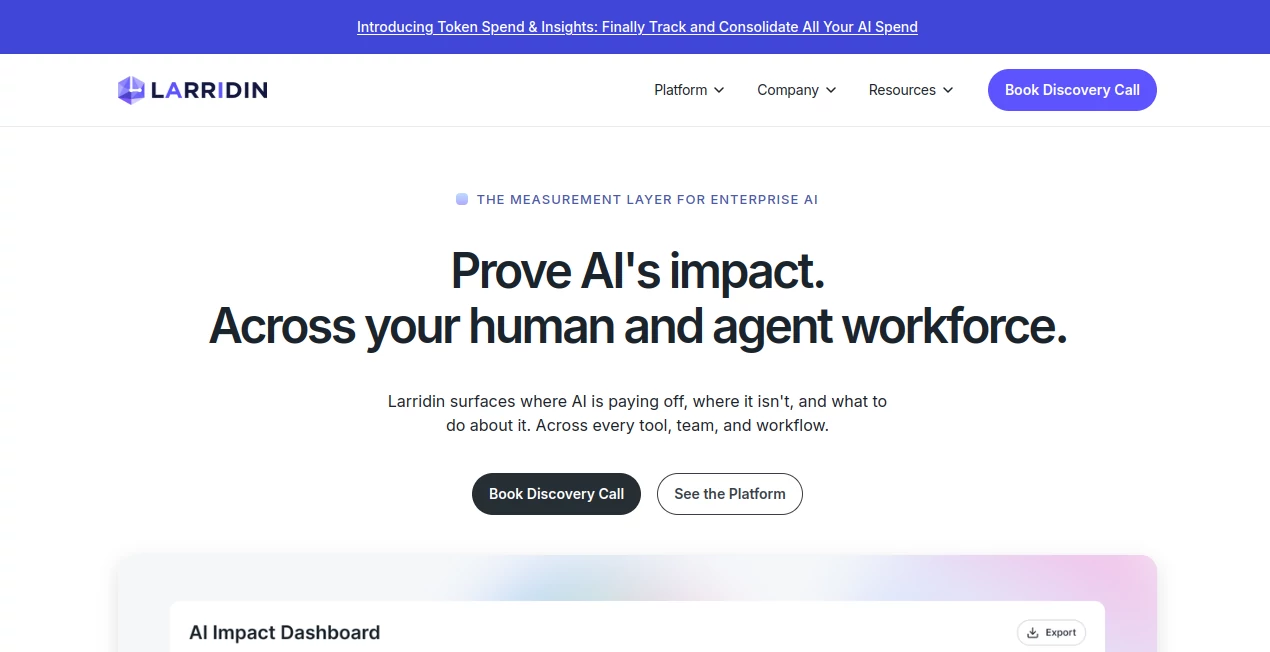
Larridin is an enterprise AI measurement and intelligence platform designed for organizations that need to understand what their AI investments are actually delivering. Instead of looking only at licenses, usage reports, or isolated productivity figures, the platform connects AI adoption, workflows, spending, proficiency, and business outcomes in one place.
That distinction matters as companies add more AI applications, agents, and automated workflows to their daily operations. A leadership team may know how much it has spent on AI, yet still struggle to answer a more important question: what changed because of that investment? This platform is built to help answer it with measurable evidence.
The experience is particularly relevant for larger organizations where AI usage can spread across departments faster than IT or finance teams can track it. It provides visibility into sanctioned and unsanctioned AI tools, identifies adoption patterns, and helps leaders decide where to invest, where to improve, and where spending may be going to waste.
Key Features
- AI adoption measurement: Monitor which AI applications teams are using and measure adoption depth and AI fluency by team, role, and location.
- Workflow intelligence: Map how work is actually performed and identify where AI is helping, creating friction, or presenting an opportunity for automation.
- Spend and token intelligence: Track licenses, model calls, and token consumption while connecting spending with teams, workflows, projects, and use cases.
- Developer intelligence: Connect development systems such as GitHub and Jira to understand how AI-augmented engineering affects velocity, quality, and output.
- AI impact measurement: Connect AI activity with business outcomes so organizations can evaluate whether their investments are producing meaningful results.
- Shadow AI discovery: Detect AI applications being used across an organization, including tools that may not have been formally approved by IT.
User Interface
The interface is built around dashboards rather than a collection of disconnected reports. The main dashboard provides an executive-level view of AI adoption, workflows, spending, hours saved, and agent effectiveness, while deeper views allow teams to investigate individual areas.
This makes the platform useful for both strategic conversations and practical investigation. A CIO can start with a high-level view of adoption and investment, while an engineering leader can move deeper into developer activity or a finance team can examine where AI spending is concentrated.
Accuracy & Performance
One of the platform's strongest ideas is that AI measurement should be based on observed behavior rather than employee surveys alone. Its workflow intelligence capabilities continuously observe application activity, tool transitions, timing, and workflow patterns to build a picture of how work is being performed.
For organizations evaluating hundreds of AI applications, this approach can be much more useful than asking employees to manually report which tools they use. The platform can begin surfacing organizational metrics after deployment and develop a more detailed behavioral picture over time.
Its measurement model also goes beyond simple activity counts. Adoption can be examined alongside proficiency, workflow performance, spending, and business outcomes, giving leadership a more useful basis for deciding what to do next.
Capabilities
The platform covers several layers of enterprise AI management. Adoption measurement helps organizations discover which tools are actually being used and how deeply teams rely on them. Workflow intelligence then provides context around how those tools fit into real business processes.
For finance teams, spend intelligence brings together AI subscriptions, model usage, tokens, and other sources of AI expenditure. This can make it easier to identify unused licenses, unexpected consumption, or areas where spending could be redirected.
Engineering organizations get another layer of visibility through developer intelligence. Connections with development tools can be used to examine what AI-assisted teams are actually shipping, rather than assuming that more AI usage automatically means better engineering performance.
The result is a broader measurement system that treats AI as part of the organization's operating model rather than simply another software category.
Security & Privacy
Security and privacy are especially important when an enterprise monitoring platform observes application and workflow activity. The platform states that its Scout technology is SOC 2, HIPAA, and GDPR compliant, with sensitive processing designed to occur in the browser where possible. Its privacy approach also includes role-controlled access and monitoring of AI usage for governance purposes.
For highly regulated organizations, on-premise deployment options are available through dedicated AI appliances. The platform's workflow intelligence documentation also describes permission-controlled access, authorized administrators, and logged access to monitored information.
Companies should still review the applicable commercial agreement, deployment architecture, data retention policies, and compliance documentation before deploying any monitoring system in a sensitive environment.
Use Cases
Enterprise AI governance: Organizations can build a continuously updated picture of the AI tools being used across departments and identify applications that have appeared outside traditional procurement or IT processes.
AI budget optimization: Finance and technology leaders can examine where AI spending is going, identify unused licenses, and connect consumption with specific teams or business activities.
Developer productivity: Engineering leaders can study the relationship between AI-assisted development and measurable output, including development velocity, reviews, commits, and deployment activity.
Workflow optimization: Operations teams can discover repetitive or inefficient workflows and identify points where AI or automation could create a meaningful improvement.
Executive reporting: CIOs, CFOs, CHROs, CISOs, and AI leaders can use shared measurements when discussing AI investment, adoption, risk, workforce capability, and business impact.
For example, imagine a 2,000-person software company where AI tools have been adopted separately by engineering, sales, customer success, and product teams. Instead of debating which department is using AI most effectively, leadership can examine actual usage, spending, workflow changes, and measurable results to decide where the next investment should go.
Pros and Cons
- Pros: Comprehensive enterprise AI measurement across tools, teams, workflows, and spending.
- Pros: Useful combination of adoption, proficiency, productivity, governance, and ROI intelligence.
- Pros: Workflow mapping is based on observed behavior rather than relying entirely on surveys.
- Pros: Supports both executive reporting and deeper operational analysis.
- Pros: Includes capabilities for identifying shadow AI and optimizing AI-related spending.
- Cons: The platform is primarily designed for enterprises rather than casual individual users.
- Cons: The breadth of data and reporting may require internal teams to establish clear measurement goals before deployment.
- Cons: Pricing is not presented as a simple public self-service subscription, so organizations generally need to engage with the sales team.
Pricing Plans
The platform follows an enterprise sales model rather than publishing standard monthly plans for individual users. Prospective customers are encouraged to book a discovery call or request a platform demonstration to discuss their organization's requirements.
This approach makes sense for a system that can span departments, AI applications, development environments, workflows, and enterprise spending. The final commercial arrangement can therefore depend on the size and needs of the organization, deployment requirements, and the capabilities included in the agreement.
How to Use the Platform
- Start by defining the teams or organizational areas where AI measurement is most important.
- Deploy the required browser and desktop components so the platform can begin observing relevant application and workflow activity.
- Review the initial AI inventory and adoption data to understand which applications are being used and by whom.
- Examine workflow intelligence to identify processes where AI is helping, creating friction, or offering a potential automation opportunity.
- Review AI spending, licenses, model calls, and token usage to locate unnecessary or poorly attributed costs.
- Connect relevant development and operational systems when measuring AI impact on engineering or other business functions.
- Use the resulting measurements to prioritize investments, improve adoption, optimize workflows, and demonstrate AI impact to leadership.
Comparison with Similar Tools
Many enterprise software products focus on one part of the AI management problem. Some concentrate on governance, others on software spending, employee productivity, developer metrics, or application discovery. The approach here is broader because these areas are treated as connected parts of the same AI operating picture.
For example, knowing that a department has high AI adoption does not necessarily mean that its AI investment is producing strong results. Likewise, reducing software licenses may lower costs without improving the underlying workflow. By bringing adoption, spending, workflows, proficiency, and business impact together, the platform is better suited to organizations that want to evaluate AI as a business transformation rather than simply as a collection of applications.
It is therefore most compelling for companies with substantial AI adoption and a genuine need for organization-wide measurement. Smaller teams looking for a simple productivity application may find the enterprise-focused approach more extensive than they need.
Conclusion
AI adoption is moving quickly, but measuring its real business value remains difficult for many organizations. Simply counting licenses or asking employees which tools they use cannot tell the whole story. What matters is understanding how AI changes work, where money is being spent, which teams are becoming more capable, and whether those changes translate into better business outcomes.
This platform takes a strong position on that problem by connecting AI discovery, adoption, workflows, spending, developer activity, and impact measurement. Its enterprise focus, behavioral measurement approach, and emphasis on connecting AI activity to business results make it particularly interesting for organizations that have moved beyond experimentation and now need accountability.
For companies asking not just “Where are we using AI?” but “Is our AI investment actually working?”, this is a compelling platform to evaluate.
Frequently Asked Questions (FAQ)
What is this platform designed to measure?
It is designed to measure AI-powered work across areas such as AI adoption, proficiency, workflows, spending, developer productivity, and business impact.
Can it discover AI tools used by employees?
Yes. Its Scout technology is designed to detect AI applications across an organization, including tools that may not have been formally approved or purchased through the company's standard processes.
Can it measure AI spending?
Yes. Spend and token intelligence can bring together AI licenses, model calls, token consumption, and other sources of AI expenditure, with the ability to attribute costs to teams, projects, workflows, and use cases.
Is it useful for engineering teams?
Yes. Developer intelligence capabilities can connect with development systems such as GitHub and Jira to help organizations understand AI-augmented engineering output, velocity, quality, and ROI.
Does it support AI governance?
Yes. The platform provides AI discovery, usage monitoring, policy-related capabilities, and visibility into shadow AI, making it useful for organizations building a more structured AI governance program.
Is it suitable for small individual users?
The product is primarily positioned for enterprise organizations and leadership teams. Individuals looking for a standalone writing, image, coding, or productivity assistant are not its main audience.
Does it publish fixed pricing?
No standard public self-service pricing plans are presented. Organizations can request a discovery call or demonstration to discuss their requirements and commercial options.
What makes its approach different?
The main distinction is the attempt to connect AI adoption, workflow behavior, spending, proficiency, and business outcomes instead of measuring these areas separately.
AI Workflow Management , AI Productivity Tools , AI Analytics Assistant .
These classifications represent its core capabilities and areas of application. For related tools, explore the linked categories above.

Larridin Alternatives Product

Audio Convert

mainaro

Syncity AI

Unix Timesta…

CloudByte PMS

Period Calcu…

Manus

CheckAEO

HISAB 360