
Locai
What is Locai?
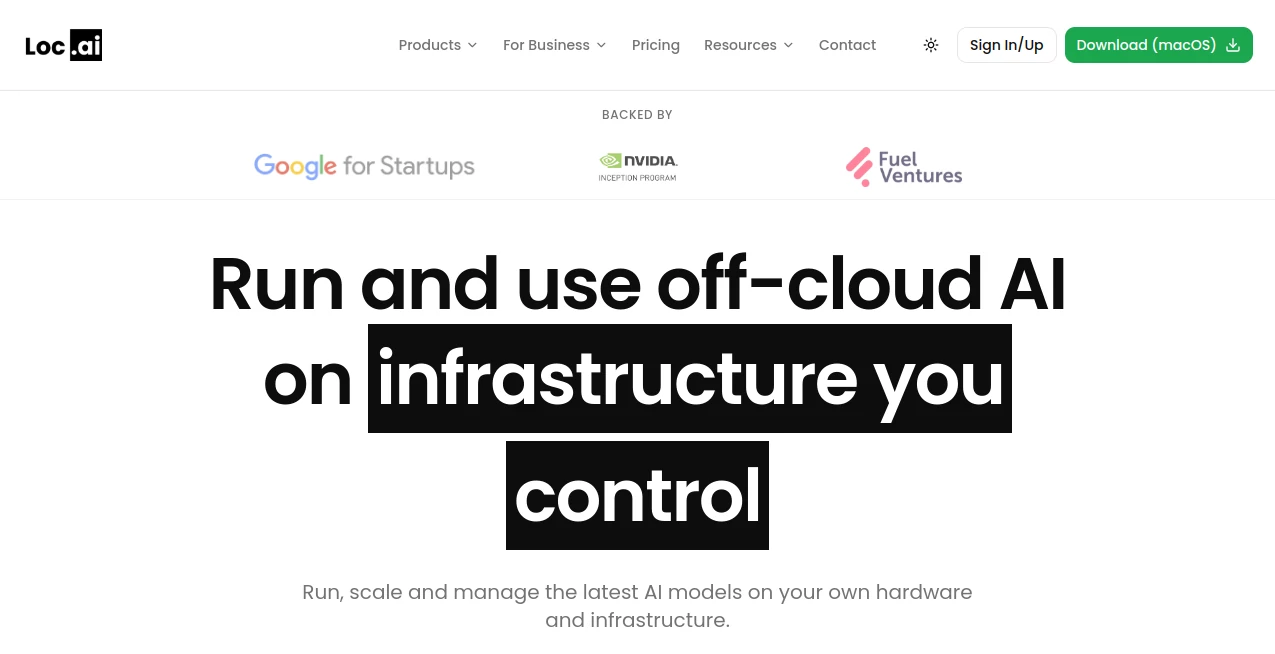
Locai is a sovereign AI infrastructure platform designed for organizations that require complete control over their artificial intelligence workloads. Instead of sending sensitive information to public cloud providers, businesses can deploy language, vision, audio, and image models directly on their own infrastructure, whether that means on-premises servers, private cloud environments, or fully air-gapped networks. This approach allows enterprises to embrace modern AI while maintaining compliance with strict security and data residency requirements.
Unlike traditional AI platforms that charge per token and rely heavily on cloud services, this platform focuses on infrastructure ownership. Teams can integrate existing AI applications using an OpenAI-compatible API, minimizing migration effort while reducing long-term operating costs. For industries where privacy, compliance, and operational reliability are essential, this solution offers a practical path toward enterprise AI adoption without sacrificing control.
Key Features
User Interface
The workspace is designed with business users in mind, offering a clean environment for AI conversations, document processing, intelligent agents, and collaboration. Administrators benefit from a centralized management console that simplifies model deployment, user management, infrastructure monitoring, and compliance oversight across multiple devices.
Accuracy & Performance
Models execute directly on local hardware, reducing network latency while improving responsiveness. The platform supports modern language, vision, and audio models running on CPUs, NVIDIA GPUs, AMD hardware, and Apple Silicon. Organizations can also deploy their own optimized models in GGUF, ONNX, or TensorFlow Lite formats for maximum flexibility.
Capabilities
The platform supports a broad collection of enterprise AI workloads including conversational assistants, document summarization, transcription, information extraction, object detection, image analysis, video processing, and intelligent workflow automation. Because every model operates within a unified environment, outputs from one model can seamlessly become inputs for another without requiring complex integrations.
Security & Privacy
Security is one of the strongest advantages of the platform. Data never leaves the customer's infrastructure, making it suitable for financial institutions, healthcare providers, legal firms, government agencies, and other highly regulated industries. Zero telemetry architecture, private deployment options, air-gapped installations, and centralized compliance controls help organizations meet strict governance standards while protecting confidential information.
Use Cases
Organizations can use the platform for secure document analysis, private AI chat assistants, internal knowledge management, meeting transcription, legal document review, financial reporting, quality assurance with computer vision, manufacturing inspections, healthcare record processing, and enterprise research. Development teams can also build AI-powered applications while maintaining full ownership of their infrastructure and customer data.
Pros and Cons
Pros
Complete data sovereignty for enterprise environments.
Supports language, vision, audio, and image AI models.
Compatible with existing OpenAI-based applications.
Runs on diverse hardware platforms.
No token-based pricing for infrastructure deployments.
Excellent choice for regulated industries.
Cons
Primarily designed for enterprise customers rather than casual users.
Requires suitable infrastructure for self-hosted deployment.
Some advanced enterprise capabilities require managed plans.
Pricing Plans
A free Developer plan is available for individual experimentation with limited devices. Business users can choose paid Starter plans for production deployments, while Enterprise customers receive custom pricing based on deployment size, infrastructure requirements, and support needs. Workspace subscriptions are also available for managed and unmanaged business teams. Pricing follows an infrastructure licensing model instead of usage-based token billing.
How to Use Locai
Create an account and choose the deployment model that fits your environment. Install the management software on your infrastructure, deploy supported AI models from the registry or import your own models, configure connected devices, and integrate applications using the OpenAI-compatible API. Once deployment is complete, teams can securely access AI capabilities without exposing sensitive information to external cloud providers.
Comparison with Similar Tools
Compared with cloud-based AI platforms, this solution places data ownership and infrastructure control at the center of its architecture. While services like OpenAI or Anthropic require information to be processed through remote infrastructure, this platform keeps workloads inside the customer's environment. Compared with lightweight local model runners, it provides enterprise-grade orchestration, centralized management, compliance controls, multi-model support, and scalable deployment across organizations.
Conclusion
For organizations that cannot compromise on security, compliance, or data privacy, this platform represents a compelling enterprise AI solution. It combines modern artificial intelligence capabilities with infrastructure ownership, enabling businesses to deploy advanced language, vision, and audio models without depending on public cloud providers. Its flexible deployment options, hardware compatibility, and enterprise-focused management tools make it particularly attractive for regulated industries seeking long-term, scalable AI adoption.
Frequently Asked Questions (FAQ)
What makes this platform different from cloud AI services?
It allows organizations to run AI models on their own infrastructure so sensitive data never leaves their environment.
Can existing OpenAI applications be migrated?
Yes. The platform offers an OpenAI-compatible API that simplifies migration with minimal code changes.
Which AI models are supported?
It supports language, audio, vision, and image models, including formats such as GGUF, ONNX, and TensorFlow Lite.
Who is the platform best suited for?
It is ideal for enterprises, government agencies, healthcare providers, financial organizations, manufacturers, and any business with strict compliance requirements.
Is there a free version?
Yes. A free Developer plan is available for testing and learning before moving to commercial deployments.
Large Language Models (LLMs) , AI API Design , AI Business Ideas Generator , AI Developer Tools .
These classifications represent its core capabilities and areas of application. For related tools, explore the linked categories above.

Locai Alternatives Product

Fugte

Schema Synth

Random Promp…

IdeaHunter

Website Audi…

UPDF AI

Astic AI

IdeaFast

KaneAI