












Maisa AI
What is Maisa AI?
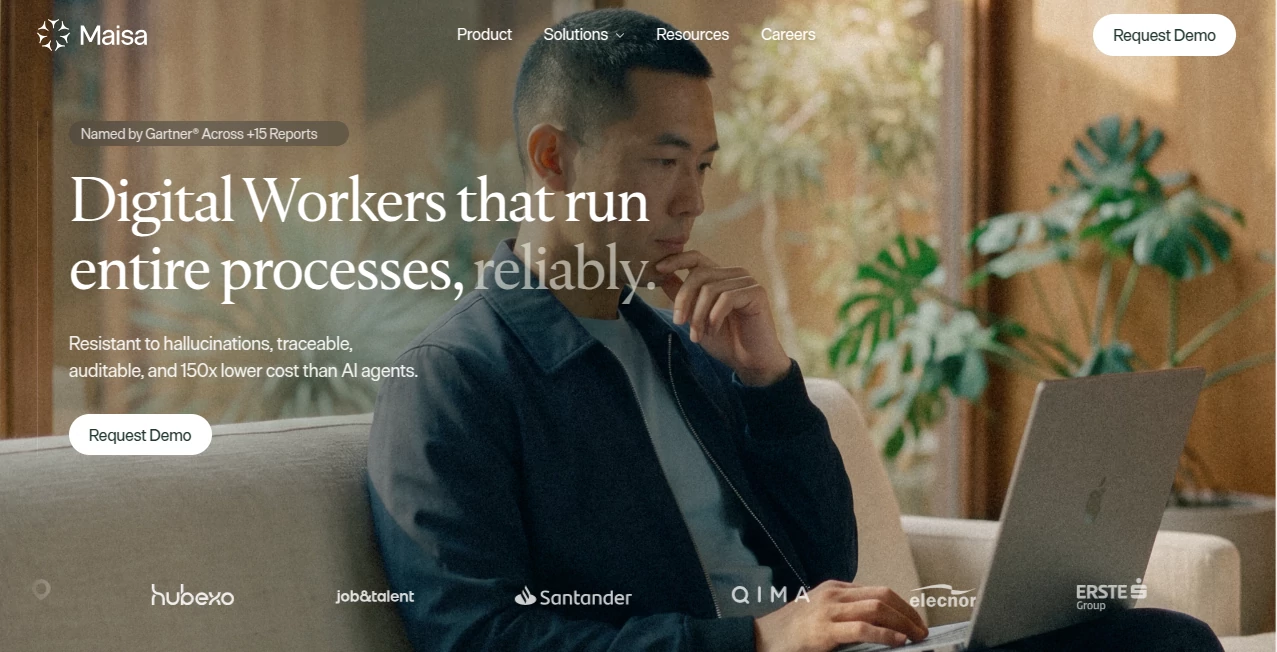
Enterprise teams are increasingly looking beyond simple chatbots and copilots. The real challenge is getting AI to handle complete business processes where accuracy, traceability, security, and predictable costs actually matter. Maisa is built around this idea, providing digital workers designed to execute complex workflows from beginning to end rather than simply assisting with individual tasks.
The platform is particularly focused on regulated and process-heavy environments such as banking, insurance, engineering, manufacturing, energy, and mobility. Its approach combines AI reasoning with code-backed execution, giving organizations more visibility into how work is performed and making automated processes easier to monitor and audit.
For a company dealing with repetitive, multi-step operations across several systems, this can be a much more practical approach than asking employees to coordinate a collection of disconnected AI tools.
Key Features
- Digital workers designed to execute complete business processes.
- Natural-language onboarding through Maisa Studio.
- Code-backed execution through the Knowledge Processing Unit.
- Detailed traces for monitoring and auditing individual runs.
- Support for more than 300 integrations across modern and legacy systems.
- Model-agnostic AI that reduces dependence on a single model provider.
- Enterprise governance, security, monitoring, and cost controls.
- Custom AI models that can be tuned around an organization's own working methods.
User Interface
The experience is designed around business processes rather than technical workflow diagrams. Teams can describe the job, rules, information, and expected outcome in natural language, much like briefing a new member of the team. The platform can then connect the digital worker to relevant systems, company knowledge, and operational data.
This approach is especially useful for business teams that understand their processes well but do not want every automation project to depend on a specialist development team. Monitoring and operational controls are also available from the same environment, making it easier to see what is running and how it is performing.
Accuracy & Performance
Reliability is one of the strongest parts of the platform's positioning. Its Knowledge Processing Unit combines AI capabilities with code-backed execution, allowing deterministic parts of a process to be handled without unnecessarily relying on an AI model.
The platform also creates traces of the work performed by digital workers. This makes individual steps easier to inspect and gives teams a clearer explanation of how a result was reached. For regulated operations, that level of visibility can be far more valuable than simply receiving an answer from a conventional AI assistant.
The company reports that its digital workers can deliver substantial cost advantages at scale, including claims of approximately 90x lower cost per run at scale compared with conventional approaches. These figures should be evaluated against each organization's specific workflow and deployment requirements.
Capabilities
The platform is built for processes that involve multiple systems, decisions, documents, approvals, and repetitive operational work. Examples include loan origination, invoice reconciliation, KYC verification, claims intake, trade finance, compliance reporting, and other high-volume business operations.
Its 300+ integrations allow digital workers to interact with both modern applications and legacy infrastructure. This is important for larger organizations, where replacing an existing technology stack simply to introduce AI is rarely realistic.
Another useful capability is model agnosticism. Organizations can select different models for different parts of a process instead of being permanently tied to one AI provider. Over time, this can help teams balance quality, speed, availability, and operating costs.
Security & Privacy
Security and governance are positioned as core parts of the platform rather than optional additions. The service is designed for industries where business processes may involve sensitive information, compliance requirements, and strict operational controls.
The platform states that it is GDPR compliant and lists SOC 2 Type II and ISO 27001 certifications, with the site noting that audits are in progress for the marked certifications. Organizations considering deployment should confirm the latest certification and compliance status directly with the provider before using it for sensitive workloads.
Traceability also plays an important role in governance. By maintaining detailed execution traces, teams can investigate how automated work was performed instead of treating AI output as an unexplained black box.
Use Cases
The strongest use cases are repetitive business processes where employees currently move information between multiple systems or spend significant time checking, reconciling, classifying, or processing information.
- Automating loan origination and financial operations.
- Processing and reconciling invoices.
- Performing KYC verification.
- Handling insurance claims intake and related workflows.
- Automating trade finance processes.
- Generating compliance reports.
- Processing customer onboarding operations.
- Supporting equity research workflows.
- Resolving supply chain tasks.
- Generating certification and compliance documentation.
- Automating policy management and customer verification.
For example, an insurance company could use a digital worker to process an incoming claim, gather information from connected systems, apply business rules, prepare the necessary documentation, and move the case through the required workflow. That is considerably different from asking an AI chatbot to summarize a claim.
Pros and Cons
Pros
- Designed for complete business processes rather than isolated AI prompts.
- Strong focus on reliability, traceability, and auditability.
- Useful for regulated industries with demanding compliance requirements.
- Natural-language process creation can reduce the barrier for business teams.
- 300+ integrations support both modern and legacy environments.
- Model-agnostic architecture can reduce vendor lock-in.
- Suitable for high-volume, repetitive operational workflows.
- Built-in monitoring and governance are valuable for enterprise deployments.
Cons
- The platform is primarily aimed at enterprise organizations rather than casual individual users.
- Pricing is not presented as a simple public self-service plan.
- Businesses may need a discovery or demo process before deployment.
- Smaller teams with straightforward automation requirements may find the platform more extensive than necessary.
- Organizations with highly customized legacy environments may require additional implementation work.
Pricing Plans
There are no standard public pricing tiers displayed for the platform. Instead, the website directs organizations toward a demo and enterprise deployment process.
This approach makes sense for a platform intended to automate complex business operations because the cost can depend on the processes involved, integrations required, deployment scale, and organizational requirements. Businesses interested in using it should request a demo and discuss the specific workflow they want to automate before comparing the investment with existing operational costs.
How to Use It
- Identify a repetitive business process that involves meaningful operational effort.
- Describe the process, rules, required information, and desired outcome in natural language.
- Connect the systems, applications, company knowledge, and data sources required for the process.
- Configure the digital worker around the organization's policies and operating requirements.
- Test the workflow and review its execution traces.
- Deploy the worker into production with the appropriate monitoring and governance controls.
- Track performance, cost, and outcomes and improve the process as more operational data becomes available.
The company promotes a path from pilot to production in around 60 days, supported by its implementation methodology. Actual deployment time will naturally depend on the complexity of the workflow, integrations, security requirements, and internal approval processes.
Comparison with Similar Tools
Traditional RPA platforms are excellent at following predefined instructions, while AI copilots are useful for tasks such as drafting, summarizing, research, and answering questions. AI workflow builders can also connect applications and automate sequences of actions.
This platform takes a different position by focusing on end-to-end digital workers that can reason about a process while using code-backed execution for predictable operations. The distinction becomes particularly important when an automated workflow is business-critical and needs to provide evidence of what happened at every stage.
For a simple personal automation, a lightweight workflow builder may be easier and faster. For a large organization processing thousands of cases across multiple systems, however, traceability, governance, model flexibility, and operational control can become more important than simply connecting a few applications together.
Conclusion
AI becomes much more valuable when it can move beyond answering questions and actually complete meaningful work. That is the central idea behind this platform. Instead of positioning AI as another assistant employees have to supervise constantly, it provides digital workers designed to take responsibility for complete operational processes.
The combination of natural-language onboarding, extensive integrations, code-backed execution, detailed traces, model flexibility, and enterprise governance makes it particularly interesting for organizations dealing with complex and regulated workflows.
It is not necessarily the right choice for someone looking for a basic chatbot or a small personal automation. But for enterprises searching for a controlled way to automate repetitive, high-volume processes without giving up visibility and governance, it offers a compelling approach to practical AI adoption.
Frequently Asked Questions (FAQ)
What is a digital worker?
A digital worker is an AI-powered system designed to perform a complete business process rather than simply answering questions or assisting with one isolated task. It can work across connected systems, use organizational knowledge, follow business rules, and complete multi-step operations.
Who is this platform designed for?
It is primarily designed for enterprises and organizations with complex, repetitive, or highly regulated processes. Banking, insurance, engineering, manufacturing, energy, and mobility are among the industries highlighted by the company.
Does it work with existing business systems?
Yes. The platform states that it supports more than 300 integrations and can connect digital workers to both modern applications and legacy systems.
Does it require developers?
The platform is designed so business teams can describe processes using natural language. However, enterprise deployments can still involve technical, security, integration, and governance requirements depending on the organization's environment.
How does it reduce AI hallucinations?
Its architecture combines AI reasoning with code-backed execution. Deterministic operations can therefore be handled through code and tools, while AI models are used where flexible reasoning or language understanding is actually needed.
Is pricing publicly available?
No standard public pricing plans are displayed. Organizations are directed toward a demo and enterprise discussion to determine the appropriate deployment and requirements.
Is it suitable for regulated industries?
Yes. Regulated industries are a central focus, with features such as execution traces, auditability, governance, security controls, and compliance support designed around enterprise requirements.
Can different AI models be used?
Yes. The platform describes its intelligence layer as model-agnostic, allowing organizations to select appropriate models for different tasks and reduce dependence on a single model provider.
What types of processes can it automate?
Examples include loan processing, invoice reconciliation, KYC verification, insurance claims intake, trade finance, compliance reporting, customer onboarding, research workflows, and supply chain operations.
How quickly can an organization deploy it?
The company promotes a path from pilot to production in approximately 60 days. The actual timeline depends on the complexity of the process, integrations, data, security requirements, and internal approvals.
AI Workflow Management , AI Productivity Tools , AI Developer Tools , Business .
These classifications represent its core capabilities and areas of application. For related tools, explore the linked categories above.

Maisa AI Alternatives Product

AI Entity

MyToolster W…

Miro

Alai

cznull

Luma AI

PowerballTax

Grow Creator
DiRe-RAPIDS