
















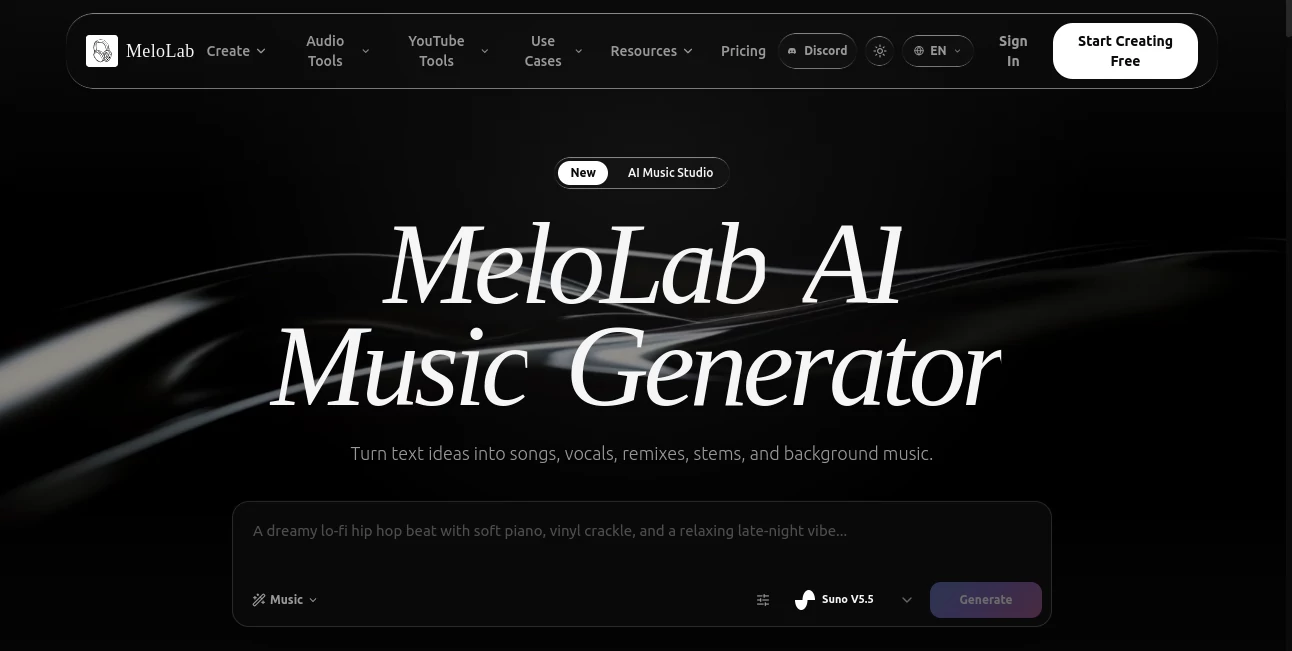
MeloLab AI Music Generator
What is MeloLab AI Music Generator?
MeloLab is an AI music creation platform designed for people who want to turn simple ideas, lyrics, melodies, or visual inspiration into finished music. Instead of requiring a traditional production setup, it brings song generation, vocals, instrumental creation, remixing, stem separation, and browser-based editing into one workspace.
The platform supports several AI music models, giving creators the freedom to experiment with different approaches rather than relying on a single generation engine. A songwriter might use it to sketch a chorus, while a YouTube creator could generate background music for a video or podcast. For producers, the ability to work with individual stems makes the workflow considerably more interesting than simply generating and downloading a finished track.
One particularly useful detail is that the service lets users start without entering a credit card. The free option includes a limited number of lifetime credits, making it practical for testing the generation quality before deciding whether a paid plan is worthwhile.
Key Features
- Text-to-music generation for complete songs and instrumental tracks.
- AI-generated vocals and songs with custom lyrics.
- Multiple music models with different strengths in vocals, arrangement, speed, and sound quality.
- Stem separation for extracting vocals, drums, bass, and other instrumental elements.
- AI remixing for transforming an existing musical idea into another genre or style.
- Voice and cover-style workflows for reimagining songs.
- Hum-to-song functionality that turns a melody idea into a fuller musical production.
- Browser-based multi-track studio with editing and arrangement capabilities.
- Image-to-music generation for creating soundtracks inspired by uploaded images.
- MP3 and WAV export options.
- API access for developers who want to integrate music generation into applications.
User Interface
The interface is built around the idea of getting from an idea to an audible result quickly. A creator can describe the desired music, select an appropriate model, generate a track, and preview it directly in the browser. This makes experimentation feel closer to working with a creative tool than configuring a complicated audio production system.
The dedicated studio goes further by providing a multi-track environment with tracks for vocals, drums, bass, synths, audio, and MIDI. Users can work with clips, adjust tempo-related settings, transpose material, change speed, extract stems, and prepare a track for export.
That combination is a strong point. Someone may begin with a simple text prompt and later move into a more hands-on editing workflow without having to move the project immediately into another application.
Accuracy & Performance
Music generation is not really about factual accuracy in the way a search or writing assistant is. Here, performance is better judged by how closely the generated result follows the requested genre, mood, instrumentation, structure, lyrics, and vocal direction.
The service currently provides access to several models, including Suno, Mureka, MiniMax Music, ACE Step, Google Lyria, and HeartMuLa. This model variety is valuable because different engines can produce noticeably different musical results from the same basic concept.
Generation is designed to be fast enough for experimentation, with the dedicated music generator describing complete tracks as being produced in under 30 seconds in typical workflows. Results can then be previewed in the browser before downloading them.
Capabilities
The feature set goes well beyond basic text-to-song generation. Creators can start with lyrics, a genre idea, an instrumental concept, or even a melody they hum. The system can then turn that starting point into a more developed musical piece.
Stem separation is another useful capability. Rather than treating a generated song as one unchangeable audio file, creators can separate components such as vocals, drums, bass, and instruments. This opens the door to remixing, rearranging, karaoke creation, and more detailed production work.
The image-to-music workflow is also an interesting addition. An uploaded image can be analyzed for visual elements such as mood, colors, subjects, and composition, which are then translated into musical characteristics. For example, a dramatic landscape can become the starting point for an atmospheric soundtrack.
For developers, an API is available with authentication, credit management, generation jobs, webhooks, and library-related functionality. This makes the platform relevant not only to individual creators but also to applications that need programmatic access to AI music generation.
Security & Privacy
Users should review the platform's current Terms of Service and Privacy Policy before uploading material or using generated content in commercial projects. This is particularly important for musicians and businesses working with copyrighted recordings, private compositions, client material, or other sensitive audio.
The service also makes licensing information visible before export, which is useful when deciding whether a particular generated track is appropriate for commercial use. Paid plans include commercial use rights for eligible generated music, while the free plan is intended for personal use.
Use Cases
Content creators: YouTube, TikTok, podcast, and social media creators can produce original background tracks, intros, transitions, and music tailored to a particular video or audience.
Musicians and producers: The platform can serve as a fast idea-generation environment for demos, arrangements, genre experiments, vocal concepts, and remix projects. Stem separation is especially useful when a creator wants more control over an existing generation.
Film and video production: Creators can generate mood-matched music and cinematic ideas for scenes, trailers, short films, and other visual projects without beginning every soundtrack from an empty timeline.
Game and app developers: Developers can explore background music, ambient tracks, and other audio concepts for games and interactive products.
Visual artists: The image-to-music workflow offers a creative way to turn artwork, photographs, landscapes, or other visual material into an accompanying musical atmosphere.
Songwriters: Someone with lyrics but no finished arrangement can use the lyrics-to-song workflow to explore how those words might sound with vocals, instrumentation, and a complete arrangement.
Pros and Cons
Pros
- Multiple AI music models are available from one platform.
- Supports full songs, vocals, instrumentals, and background music.
- Stem separation adds genuine production flexibility.
- Includes a browser-based multi-track studio.
- Supports image-to-music and hum-to-song workflows.
- Offers MP3 and WAV downloads.
- Provides an API for developers.
- A free starting option is available without requiring a credit card.
Cons
- The free plan has limited lifetime credits and is intended for personal use.
- Advanced generation can consume credits quickly when experimenting extensively.
- AI-generated music can still require human editing when a precise arrangement or artistic direction is needed.
- Commercial usage depends on the applicable plan and eligibility of the generated music.
- The number of available models and features may feel overwhelming to first-time users.
Pricing Plans
The platform uses a credit-based system with free and paid options. The Free plan costs $0 per month and currently provides 8 lifetime credits, one concurrent generation, access to current text-to-music models, selected studio functionality, and seven days of song storage. Generated music under this plan is intended for personal use.
The Plus plan is listed at $12.42 per month when billed annually, with 400 credits per month, up to three concurrent generations, 30 days of song storage, priority queue access, and commercial use rights for eligible music.
The Pro plan is listed at $33.25 per month when billed annually and includes 1,200 credits per month, up to five concurrent generations, longer-term storage under fair-use terms, the highest priority, advanced creator support, and commercial use rights for eligible music.
One-time credit packs are also available for creators who need additional generation capacity without immediately changing their subscription. Current packs include 100 credits for $7.99, 300 credits for $19.99, and 1,000 credits for $59.99.
How to Use the AI Music Generator
- Create an account and start with the free option if you want to test the workflow.
- Choose the type of music you want to create, such as a full song, instrumental, or background track.
- Write a descriptive prompt explaining the genre, mood, instruments, vocals, tempo, or overall direction.
- Add lyrics when you want the generation to include a specific vocal concept.
- Select an available AI music model based on the type of result you want to explore.
- Start the generation and wait for the track to be processed.
- Preview the result directly in the browser and compare different generations.
- Move the project into the studio when you need additional editing or more control.
- Use stem separation when you want to work independently with vocals, drums, bass, or other musical elements.
- Export the finished result in the available audio format and check the applicable license terms before commercial use.
Comparison with Similar Tools
Compared with a basic AI song generator, this platform takes a broader approach by combining generation with production-oriented tools. A simple generator may be enough when the only goal is to create a complete song from a prompt. Here, users can also experiment with several underlying models, separate stems, remix material, work in a multi-track environment, and use additional creative inputs such as images or hummed melodies.
It is also useful for creators who want to compare different AI music engines without building separate workflows around every model. The ability to switch between models can make experimentation more efficient, particularly when one model produces better vocals while another works better for a particular instrumental style.
For professional musicians, however, it should be viewed as a creative production aid rather than an automatic replacement for a full traditional studio. Human arrangement, editing, mixing, and artistic judgment can still make a major difference in the final result.
Conclusion
MeloLab stands out by treating AI music generation as more than a one-click song generator. Its combination of multiple models, vocals, instrumental creation, remixing, stem separation, image-based generation, and an in-browser multi-track studio gives creators several ways to develop an idea.
The free plan makes it easy to test the experience, while the paid tiers provide substantially more generation capacity and commercial-use options for eligible music. For YouTubers, musicians, producers, podcasters, game developers, and visual creators looking for a faster way to explore original music, it offers a compelling collection of tools in one place.
The biggest advantage is flexibility: you can begin with a vague musical idea and gradually turn it into something more structured, editable, and ready for a real project.
Frequently Asked Questions (FAQ)
What can I create with the platform?
You can create complete songs, vocal tracks, instrumental music, background music, remixes, and other AI-generated musical content. It also supports workflows involving lyrics, melodies, and visual inspiration.
Can I generate music from text?
Yes. You can describe a song using natural language, including its genre, mood, instrumentation, vocal style, tempo, and other musical characteristics.
Can I create instrumental music?
Yes. Instrumental generation is supported alongside full songs with vocals.
Can I separate vocals and instruments?
Yes. The stem separation workflow can separate elements such as vocals, drums, bass, and other instruments so they can be worked with individually.
Can I use the generated music commercially?
Commercial use rights are included with eligible generated music on the paid plans. The free plan is intended for personal use, so creators should check the license information shown before exporting a track.
Is there a free plan?
Yes. The Free plan currently includes 8 lifetime credits and allows users to explore the available music-generation workflow without entering a credit card.
Can developers use an API?
Yes. An API is available for programmatic music generation and related operations, with authentication, credits, jobs, webhooks, and other developer functionality.
Can I create music from an image?
Yes. The image-to-music workflow analyzes visual characteristics such as mood, colors, subjects, and composition and uses them as inspiration for a musical composition.
Can I edit generated music?
Yes. The browser-based studio provides a multi-track environment where creators can work with generated material, clips, stems, tempo, pitch, speed, and other production elements.