


















Modulate AI Music Detection API
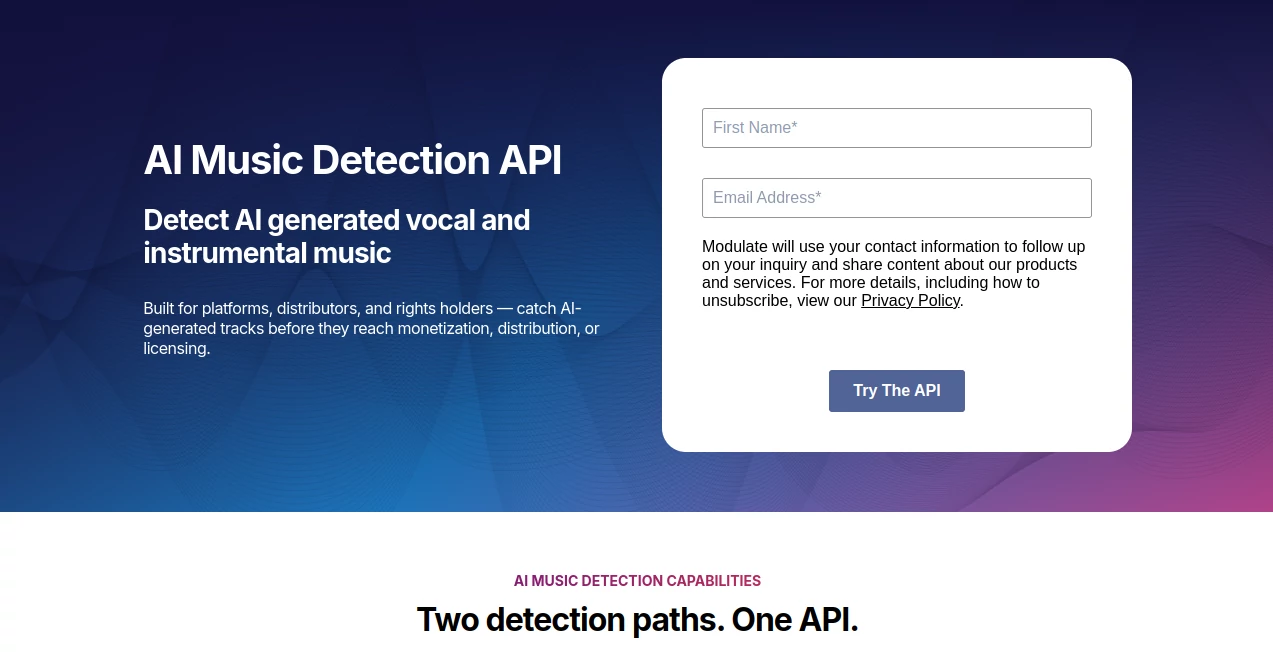
What is Modulate AI Music Detection API?
As AI-generated music becomes part of everyday publishing, identifying synthetic audio is no longer a niche requirement. This solution gives developers, streaming platforms, distributors, and rights holders a practical way to distinguish AI-generated vocals and instrumentals from human-created recordings. Instead of relying on a single score, it examines audio in small segments, producing detailed evidence that supports every final verdict. The result is a dependable system built for large-scale music verification without slowing existing workflows.
Key Features
User Interface
The API is straightforward to integrate and supports both batch uploads and real-time streaming through WebSocket connections. Responses follow a structured format, making them easy to process inside moderation or content management systems.
Accuracy & Performance
Rather than treating an entire song as one sample, the engine evaluates every four-second window independently. Separate detection models for vocals and instrumentals help reduce false positives, especially in mixed productions where only part of a track is AI-generated.
Capabilities
- Detects AI-generated vocals and instrumental music independently.
- Returns confidence scores and detailed segment analysis.
- Supports both uploaded files and live audio streams.
- Works with popular audio formats including MP3, WAV, FLAC, AAC, OGG, and M4A.
- Allows adjustable detection thresholds for different business needs.
Security & Privacy
The platform is designed for enterprise environments with strong security practices and compliance-focused architecture. Structured API responses allow organizations to automate moderation while maintaining clear audit trails.
Use Cases
- Screening music uploads before publication.
- Supporting copyright and licensing reviews.
- Preventing royalty abuse caused by undisclosed AI-generated tracks.
- Adding AI content verification to music distribution platforms.
- Monitoring compliance with platform disclosure policies.
Pros and Cons
- Pros
- Detailed window-level analysis instead of a single score.
- Real-time streaming support.
- Independent vocal and instrumental detection.
- Simple API integration for developers.
- Cons
- Primarily designed for businesses and developers rather than casual users.
- API integration requires basic technical knowledge.
Pricing Plans
The service offers API-based pricing starting at approximately $0.07 per hour of processed audio. Organizations with larger requirements can contact the sales team for enterprise options.
How to Use Modulate AI Music Detection API
- Create an API key.
- Upload an audio file or stream audio in real time.
- Receive a clip-level verdict together with segment-by-segment analysis.
- Use confidence scores and detailed results inside your moderation or review workflow.
Comparison with Similar Tools
Many music detection services provide only a single probability score for an entire recording. This platform stands out by separating vocal and instrumental analysis while delivering evidence for every section of the audio. That extra visibility makes it especially useful for hybrid tracks that combine human performances with AI-generated elements.
Conclusion
For organizations dealing with modern music libraries, reliable AI music detection is becoming an essential capability. With accurate segment-level analysis, flexible API integration, and support for both batch and streaming workflows, this solution offers a practical way to improve transparency, automate moderation, and protect digital music ecosystems.
Frequently Asked Questions (FAQ)
Can it detect both AI vocals and AI instrumentals?
Yes. Separate detection models analyze vocal and instrumental content independently.
Does it support live audio?
Yes. Real-time streaming is available through a WebSocket API.
What audio formats are supported?
Common formats such as MP3, WAV, FLAC, AAC, OGG, OPUS, MP4, and M4A are supported.
Who is this API designed for?
It is ideal for music platforms, distributors, developers, publishers, and rights management organizations that need automated AI music verification.
AI Music Generator , AI API Design , AI Speech Recognition , AI Developer Tools .
These classifications represent its core capabilities and areas of application. For related tools, explore the linked categories above.
Modulate AI Music Detection API details
Website unavailable — View Alternatives
Pricing
- Free
Apps
- Web App
Categories

Modulate AI Music Detection API Alternatives Product

Skillselion

UpMocker

Blinkly AI

NetlifyAPP
Dedoctive

Custom Song

SAM Audio

Elispeak

BetterAntisp…
