mvntSTUDIO
What is mvntSTUDIO?
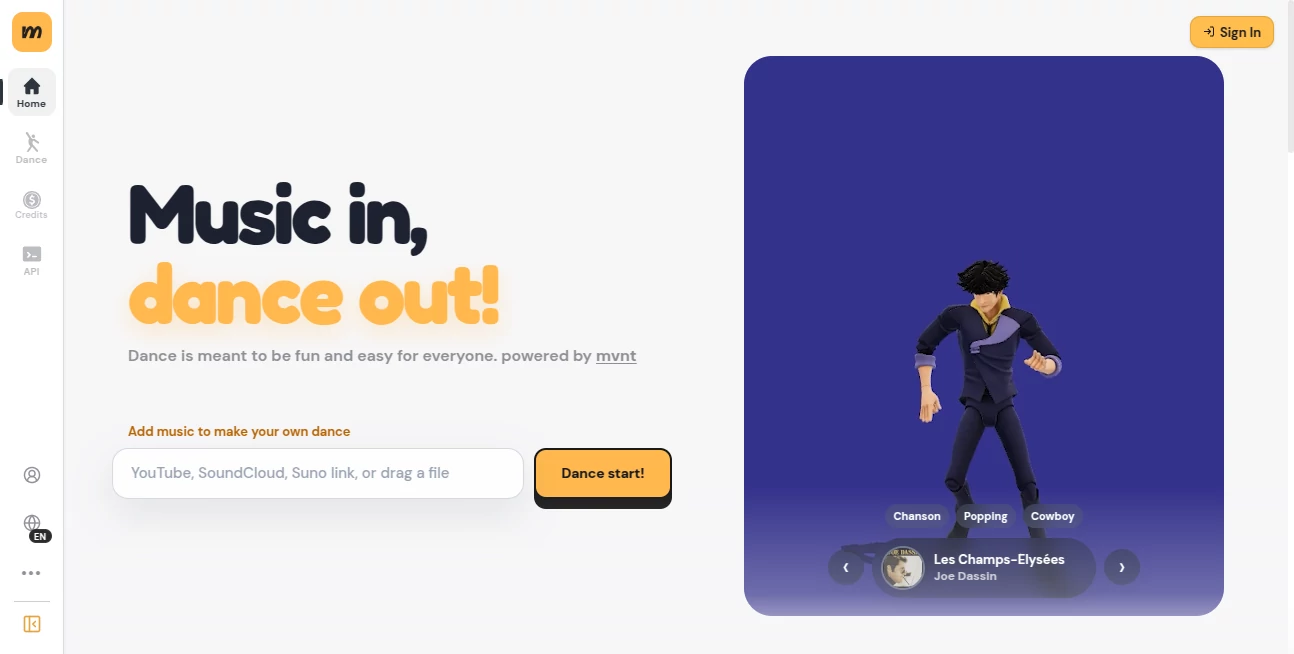
Creating believable dance animation has traditionally required motion capture, experienced choreographers, and hours of manual work. This platform introduces a refreshing alternative by transforming music into production-ready dance animations through artificial intelligence. Designed for creators, game developers, virtual performers, and entertainment studios, it makes choreography accessible without sacrificing creativity.
Instead of starting from a blank timeline, users can upload a music file or provide a supported media source and receive AI-generated dance movements that naturally follow rhythm and musical structure. The experience feels playful for beginners while remaining valuable for professionals looking to accelerate production workflows. It is an exciting step toward making digital choreography faster, smarter, and easier to explore.
Key Features
User Interface
The interface focuses on simplicity. Uploading music, generating choreography, previewing movement, and exporting results require only a few straightforward steps. Even users without animation experience can begin experimenting within minutes, making the platform approachable for creators from different backgrounds.
Accuracy & Performance
The AI analyzes musical timing and rhythm to produce dance sequences that align naturally with the soundtrack. Generation is fast enough for rapid experimentation, allowing users to compare multiple results before selecting the best choreography. This quick turnaround encourages creativity instead of slowing projects with lengthy production cycles.
Capabilities
- Generate dance animation directly from music.
- Create choreography suitable for virtual performers.
- Support image-to-dance generation for digital characters.
- Produce motion references for animation pipelines.
- Export videos for demonstrations and social content.
- Generate choreography for short-form entertainment.
- Provide inspiration for professional choreographers.
- Offer a community gallery to explore creations from other users.
- Support creative workflows for gaming and virtual production.
Security & Privacy
User-generated projects remain under the creator's control during production. As with any cloud-based creative platform, users should review current privacy policies before uploading commercial or confidential material. For most creative experimentation, the workflow is straightforward and suitable for collaborative production environments.
Use Cases
- Creating dance references for game characters.
- Designing choreography for virtual idols and digital performers.
- Producing engaging social media dance content.
- Generating animation ideas before investing in motion capture.
- Building dance sequences for music videos.
- Supporting animation teams during early concept development.
- Visualizing choreography for performers and instructors.
- Creating entertaining content for online communities.
Pros and Cons
Pros
- Extremely easy to begin using.
- Fast AI-powered choreography generation.
- Transforms music into synchronized dance animation.
- Useful for both hobbyists and professionals.
- Supports modern creator workflows.
- Community gallery encourages inspiration.
Cons
- Advanced choreography customization is still evolving.
- Some highly complex movements may require manual refinement.
- Professional productions may still combine AI with traditional animation tools.
Pricing Plans
The platform offers online access, while pricing may evolve as new capabilities are introduced. Users should check the official website for the latest subscription options, available plans, and commercial licensing information.
How to Use mvntSTUDIO
Begin by creating an account and opening a new project. Upload a music file or choose a supported audio source, then let the AI analyze the rhythm. After generation, preview the dance animation, regenerate alternative versions if desired, and export the result for creative projects, presentations, or animation workflows.
Comparison with Similar Tools
Many AI animation platforms primarily focus on text-to-video generation or avatar animation. This solution stands out by specializing in music-conditioned choreography, making dance the center of the creative process rather than an additional feature. Its emphasis on rhythm-aware movement generation makes it particularly attractive for entertainment, gaming, music production, and virtual performances where believable dance matters.
Conclusion
Artificial intelligence continues to reshape creative production, and dance animation is becoming part of that transformation. By lowering the technical barrier to choreography creation, this platform enables creators to move from musical inspiration to animated performance within minutes. Whether developing virtual entertainers, experimenting with social content, or accelerating professional animation pipelines, it delivers an innovative approach that makes dance generation more accessible than ever before.
Frequently Asked Questions (FAQ)
Who is this platform designed for?
It is suitable for content creators, animators, game developers, virtual production teams, musicians, and professional choreographers.
Can beginners use it?
Yes. The workflow is intentionally simple, allowing users with little animation experience to create dance sequences quickly.
Can the generated dances be used as animation references?
Yes. Many creators use generated choreography as motion references before producing final animations.
Does it support virtual characters?
Yes. The platform supports workflows that generate dance for digital characters and virtual performers.
Is it useful for social media creators?
Absolutely. Short-form dance content, music videos, and viral entertainment are among its strongest use cases.
AI Animated Video , AI Image to Video , AI Video Generator , AI Music Generator .
These classifications represent its core capabilities and areas of application. For related tools, explore the linked categories above.

mvntSTUDIO Alternatives Product

Happy Horse …
Voe4 AI Video

Yevideo

Happy Horse

시댄스 2.5

WonderShare …

Seedance 2.0

UniVideo

Sora2 AI Vid…