Neta
What is Neta?
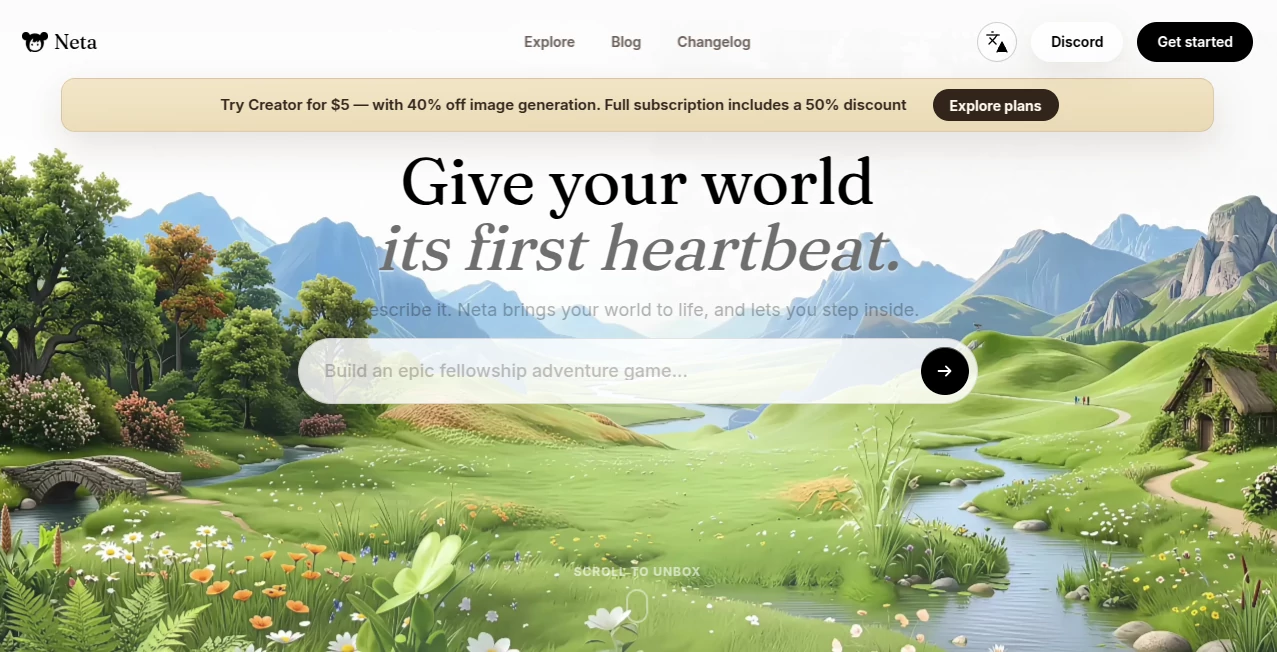
Neta Studio is an AI-powered creative platform built for people who want to turn a simple idea into an interactive world. Instead of starting with code, complicated game engines, or a blank canvas, users can describe a world in a sentence and let the platform develop characters, locations, stories, visuals, and playable experiences around that idea.
What makes the platform particularly interesting is the way it connects several creative tasks in one workflow. A concept can become a visual world, an interactive story, a browser-based game, a cinematic scene, or a collection of visual assets. The experience is designed for creators who want to experiment quickly without spending hours setting up technical infrastructure.
The platform currently presents itself as an AI world builder and game generator, with examples ranging from interactive visual novels and roleplay scenarios to maps, timelines, cinematic videos, character art, and playable browser experiences.
Key Features
- AI World Building: Describe an idea and generate a structured world containing characters, locations, events, factions, and other story elements.
- Playable Game Creation: Turn a concept into a browser-based playable experience without traditional programming.
- Interactive Storytelling: Create stories where AI-driven characters can participate in real-time conversations and help move the narrative forward.
- Character Creation: Build characters with details such as appearance, personality, background, abilities, voice, posture, and actions.
- Visual Asset Generation: Generate character sprites, scene backgrounds, illustrations, posters, and other visual elements as part of a creative project.
- AI Video Creation: Worlds and scenes can be developed into cinematic or POV-style video experiences.
- Templates and Remixing: Existing creations can be adapted and forked, making it easier to use a successful creative structure as the starting point for something new.
- Browser Publishing: Generated experiences can be published and played directly in a web browser without requiring users to download a game.
User Interface
The interface is centered around describing what you want to create rather than configuring dozens of technical settings. The starting point can be as simple as a sentence describing a world, story, character, or experience.
This approach is especially useful for writers, game designers, artists, and curious creators who have an idea but do not necessarily want to learn a traditional game engine first. The platform also provides visual workspaces for managing worlds, scenes, characters, and generated assets, giving larger projects more structure as they grow.
Accuracy & Performance
Performance is less about conventional factual accuracy and more about how well the system interprets creative instructions. Detailed prompts can guide elements such as character appearance, lighting, atmosphere, composition, story direction, and visual style.
For world-building projects, the platform goes beyond producing a single isolated image. Its workflow can connect characters, locations, events, and relationships so that the generated experience feels more like a coherent project rather than a collection of unrelated AI outputs.
For example, a creator can begin with a fictional universe and gradually expand it with locations, characters, story events, visual assets, and interactive scenes. This makes the platform more suitable for larger creative concepts than a tool designed solely for one-off image generation.
Capabilities
The range of creative possibilities is one of the platform's strongest points. Its public examples include interactive games, visual novels, roleplay scenes, world portals, maps, timelines, cinematic videos, character designs, sticker packs, posters, and other visual experiences.
Its visual novel workflow is particularly notable. A single concept can be expanded into characters, locations, events, branching interactions, dialogue, visual assets, and a playable browser experience. AI-generated dialogue can also respond dynamically during an experience instead of relying entirely on a fixed script.
Creators can also work with structured image templates. These templates are designed to maintain consistency in areas such as composition, layout, color direction, and art style, which can be valuable when producing multiple character cards, turnaround sheets, or other assets for the same project.
Security & Privacy
Users should review the platform's current terms and privacy documentation before uploading sensitive material or using generated content commercially. The terms state that prompts, reference materials, generated outputs, and related metadata may be processed as necessary to provide and improve the services.
The platform also notes that AI-generated outputs may not always be unique and does not guarantee that generated material is original, accurate, lawful, non-infringing, or automatically suitable for commercial use. Creators remain responsible for checking third-party rights and ensuring that their projects comply with applicable laws and platform rules.
Use Cases
- Indie Game Development: Quickly prototype game concepts, characters, worlds, scenes, and interactive mechanics before investing in conventional development.
- Visual Novels: Build interactive stories with characters, branching conversations, scenes, and generated artwork.
- Anime and Manga Projects: Develop anime-inspired characters, environments, story scenes, and visual concepts.
- Creative Writing: Turn a story idea into a living environment with characters and locations that can be explored and expanded.
- World Building: Create fictional universes with interconnected characters, locations, events, factions, and histories.
- Video Concepts: Transform creative ideas and worlds into cinematic or first-person video experiences.
- Character Design: Produce consistent visual references and character assets for games, stories, and creative projects.
- Rapid Prototyping: Test an idea through a playable browser experience before committing to a larger production workflow.
Pros and Cons
- Pros: Very low barrier to entry for world building and game creation.
- Pros: Combines storytelling, visual generation, world building, and interactive experiences in one workflow.
- Pros: No traditional coding is required for the advertised creation workflow.
- Pros: Browser-based playable experiences can be shared without requiring downloads.
- Pros: Existing public creations and templates can provide useful starting points for new projects.
- Cons: AI-generated results can vary depending on the quality and specificity of the prompt.
- Cons: Creators still need to review generated content when originality, copyright, or commercial usage matters.
- Cons: Users looking for detailed conventional game-engine control may eventually need more specialized development software.
Pricing Plans
The website currently states that the platform is free to start and does not require a credit card to begin creating. This makes it relatively easy to experiment with world building, games, artwork, and interactive concepts before deciding whether the platform fits a larger project.
Because pricing and available usage limits can change as AI generation services evolve, creators should check the platform's current pricing information before planning a production workflow around a specific allowance or paid feature.
How to Use This Tool
- Start with an idea: Write a short description of the world, story, game, character, or experience you want to create.
- Let the AI build the foundation: The platform can expand the initial idea into characters, locations, events, visual elements, and other world components.
- Customize the world: Review the generated elements and refine the characters, locations, story direction, and creative details.
- Generate visual assets: Create character artwork, backgrounds, illustrations, videos, or other assets required by the project.
- Build the experience: Turn the generated world into an interactive story, visual novel, game, cinematic scene, or another supported format.
- Publish and share: Once the experience is ready, it can be made available as a browser-based project that others can explore or play.
Comparison with Similar Tools
Many AI creative platforms concentrate on a single output, such as an image, video, text document, or character. This platform takes a broader approach by connecting those individual outputs into a shared creative world.
For someone who only needs a single AI-generated illustration, a dedicated image generator may provide a more focused experience. Likewise, professional developers who need complete control over code, physics, rendering pipelines, and deployment may prefer a traditional game engine.
Where this platform stands out is the space between an initial idea and an interactive prototype. A creator can begin with a sentence and work toward a world containing characters, environments, story elements, artwork, and a playable experience without assembling a large collection of separate tools.
Conclusion
Neta Studio offers an appealing approach to AI-assisted creativity by treating an idea as the beginning of an entire world rather than simply the prompt for one image. Its combination of world building, character creation, storytelling, visual generation, video creation, and browser-based game experiences gives creators plenty of room to experiment.
It is particularly compelling for people who have stories or game concepts in their heads but do not want technical complexity to become the first obstacle. The ability to move from a short description toward something visual and interactive makes experimentation much faster.
For indie creators, writers, visual artists, game designers, and anyone interested in interactive storytelling, it is worth exploring as a creative playground. The strongest results will still come from thoughtful prompts and careful editing, but the platform does a good job of shortening the distance between an idea and something people can actually experience.
Frequently Asked Questions (FAQ)
What can I create with the platform?
You can create AI-generated worlds, playable games, visual novels, characters, scenes, maps, timelines, videos, artwork, roleplay experiences, and other interactive creative projects.
Do I need programming skills?
The platform is designed to let users create advertised world and game experiences without traditional coding. You can begin by describing what you want in natural language.
Can generated games be played in a browser?
Yes. Public examples on the platform show playable experiences that run directly in a web browser without requiring a download.
Can I create anime-style content?
Yes. The platform includes anime-focused creative workflows and examples covering anime characters, manga-style artwork, story scenes, and related visual experiences.
Can I create videos?
Yes. The platform supports AI video experiences, including cinematic and POV-style examples created from generated worlds and scenes.
Is it free to start?
Yes. The website currently states that users can start creating for free and that no credit card is required to begin.
Can I use AI-generated content commercially?
Commercial use should be evaluated carefully. The platform's terms state that AI outputs are not guaranteed to be original or free from third-party claims, so creators should review the output and make sure they have the necessary rights before commercial use.
Can existing creations be modified?
Yes. The platform supports forking or adapting existing public creations, allowing users to take an existing concept or template and develop their own version.
Who is this platform best for?
It is especially suitable for indie game creators, writers, artists, storytellers, anime fans, world builders, and anyone who wants to turn a creative idea into an interactive experience without starting with traditional development tools.
AI Game , AI Video Generator , AI Art Generator , AI Anime & Cartoon Generator .
These classifications represent its core capabilities and areas of application. For related tools, explore the linked categories above.

Neta Alternatives Product

Seedream 4.0…

Spark Robin …
ds video

Mage
Seedance 2.5

AI Baby Dance

happyhorse
Veo 4 AI Vid…
AssiPilot