















happyhorse
What is happyhorse?
Let's be honest for a second. Remember the first time you tried to generate a video with AI? You probably got that weird, glitchy footage where hands melted into thin air or characters looked like they were made of wobbly plastic. It was fun for a laugh, but useless for actual work. Well, those days are officially over. I recently got my hands on a new platform that completely changed my mind about what AI video can actually do. This isn't just another tool that spits out generic stock footage. We're talking about cinema-grade quality that actually understands how the real world moves. Whether you are a stressed-out marketer trying to meet a deadline, a filmmaker on a budget, or an e-commerce owner wanting slick product shots, this changes the game. The tagline "Turn Inspiration into Reality" isn't just a fancy slogan here; it feels like a promise they actually kept. Let me walk you through why this specific engine is making waves right now.
Key Features
What makes this platform stand out in such a crowded market? It boils down to a few specific technical leaps. While everyone else is trying to catch up, this one is already several steps ahead, especially if you care about sound and storytelling.
User Interface
I’ve tested a lot of complex software, and nothing kills creativity faster than a confusing dashboard. Luckily, the designers here prioritized sanity. The interface is clean, almost minimalist. You aren’t bombarded with a hundred sliders right away. You have a clear canvas, a prompt box, and your asset library. The real magic is in the speed. Generating a 5-second test clip takes maybe a minute or two. For a creator like me who iterates constantly (tweaking prompts, changing angles), that speed is a lifesaver. I don't have to go make a coffee while waiting for a render; I just tweak and hit generate again. It feels responsive and modern, not clunky and scientific.
Accuracy & Performance
Here is where this model just leaves the competition in the dust. We have all seen the terrible AI videos where a person walking turns into a lovecraftian horror. That "jitter" is practically gone here. Specifically, the accuracy of the physics is stunning. If you prompt for "steam rising from a ceramic mug," the steam actually behaves like steam, buoyant and ethereal, not like a flat cartoon effect. I also tested facial expressions. Generating a close-up of a person speaking with subtle eyebrow movements used to be a nightmare, resulting in dead eyes. The performance here is smooth; the skin texture actually looks like skin, with proper subsurface scattering and light reflection. It handles subtle micro-expressions shockingly well, which is vital for storytelling.
Capabilities
It’s not just about making a picture move. The headline capability here is audio-visual synchronous generation. Most tools out there generate a silent video, and then you have to awkwardly slap an audio track on top and pray the lipsync works. This platform uses a native multi-modal architecture to generate the video and the audio together in one single pass. Think about what that means: the sound of rain hitting a window synchronizes perfectly with the visuals. The rustle of a jacket matches the movement. For actors, the lip-sync for dialogue is incredibly tight. It supports major languages seamlessly, so creating dubbing for international markets is no longer a weeks-long editing task. It also handles 15-second multi-shot narratives, meaning you can have a scene with a wide shot, then a close-up, all generated in one cohesive timeline.
Security & Privacy
If you are a business owner, you are probably worried about feeding your proprietary product images into a black box. It’s a valid concern. While I always recommend checking the latest terms, major enterprise-grade platforms (especially those backed by large cloud providers like Alibaba Cloud) generally treat your data privacy seriously. For professional users, there are clear distinctions between API usage and consumer app usage. You retain ownership of your generated outputs. If you are using the service for internal campaigns or unreleased product demos, you want to make sure your assets aren't being scraped for training data. The documentation suggests robust data segregation, which is the standard you should demand from any serious B2B tool these days.
Use Cases
Who is actually going to use this? Pretty much anyone who touches visual media. I see three major groups benefiting the most right now.
First, E-commerce and Advertising. Instead of hiring a full production crew to film a bottle of perfume, you can generate stunning, slow-motion B-roll with dramatic lighting in minutes. You can showcase the product in any environment imaginable. Second, Short Dramas and Storytelling. There is a massive boom in vertical short dramas. This tool allows creators to generate scenes that would be prohibitively expensive to shoot on location, like period pieces or fantasy landscapes, with actors who lip-sync perfectly. Third, Social Media Managers. Need a 15-second animated loop for Instagram or TikTok? You can pump out high-energy, weird, and wonderful content faster than your competition can even write a caption.
Pros and Cons
No tool is perfect, and it is important to be transparent about where this stands right now.
The Good: The audio sync is industry-leading. The rendering speed is incredibly fast compared to rivals like Runway or Pika. The cost is surprisingly low (we will get to that). The 1080p output is genuinely crisp, not just upscaled blurriness. The cinematic lighting and depth of field effects look natural, not forced.
The Could-Be-Better: It is a relatively new launch, so the ecosystem of community templates and fine-tuning controls is still growing compared to more established tools. While it handles 15 seconds beautifully, generating longer, complex narratives without any guidance still requires breaking the script down into scenes. Also, if you are looking for hyper-specific niche styles (like 1980s VHS trash art), you might find the model leans towards "beautiful realism" as its default setting, which requires precise prompting to break.
Pricing Plans
Let's talk money, because this is where they really shook the table. AI video generation used to be reserved for people with deep pockets. Not anymore. The official pricing is set at 0.9 Yuan per second for 720p and 1.6 Yuan per second for 1080p. That is the standard rate. However, if you sign up for a membership (which they are heavily discounting during the launch phase), those prices drop drastically. With the "Pro" membership, you are looking at roughly 0.44 Yuan per second for 720p and 0.78 Yuan for 1080p.
To put that in perspective: you can generate a high-quality 5-second social clip for less than the price of a cup of coffee. New users also get free credits to test the waters, so you don't have to commit financially before you see the quality for yourself. They are running a "HappyTime" promotion until May 10th, offering an extra 30% off generation capabilities, making it arguably the best value for money on the market right now.
How to Use the Platform
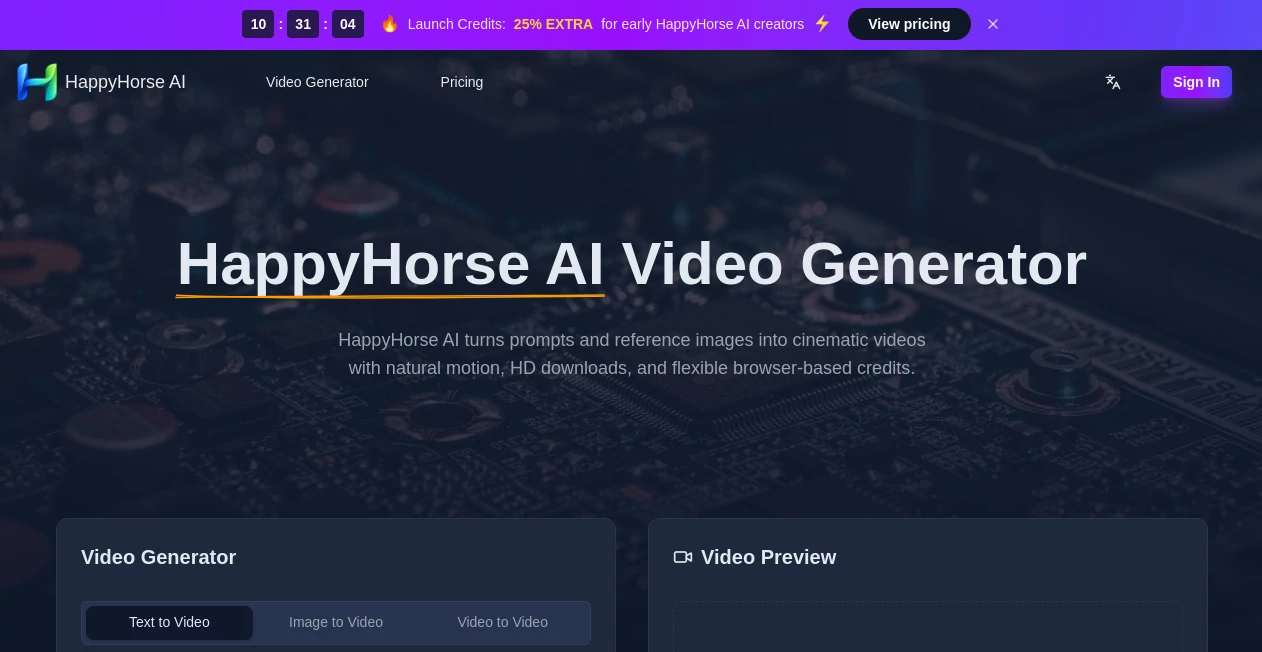
Getting started is dead simple. Head to the website and hit the "Sign Up" button. You will likely get those initial free bonus points (I got 66 points when I signed up, which covered several generations). You have three main options: Text-to-Video, Image-to-Video, or Multi-Image Reference. For beginners, I suggest starting with Image-to-Video. Upload a reference photo of a character or object you like. Then, in the prompt box, write what you want to happen. Think in terms of camera directions: "Camera slowly pushes in on the subject, soft wind blows hair, cinematic lighting." Hit generate, wait about a minute, and watch the magic happen. If you are on the "Pro" plan, you get higher priority queues, meaning your videos render even faster.
Comparison with Similar Tools
How does this stack up against the big dogs? Let’s look at the leaders. Runway Gen-2/Gen-3 is fantastic for surreal, artistic morphing and motion brushes, but it often struggles with realistic human anatomy and specific audio sync. Pika Labs is great for quick iterations and stylized motion, but its realism falls apart when you need complex physics. Sora (from OpenAI) looks incredible in demos, but access is extremely limited and pricing is a mystery to most of us. This tool hits the sweet spot between Sora's ambition and Pika's accessibility. It offers the best of both worlds: realistic physics and native audio, available right now at a predictable, low price. It doesn't have the "melting face" problem that plagues many of its competitors.
Conclusion
The tech world moves fast, but every once in a while, a tool comes out that feels like a genuine leap forward, not just a tiny step. This is one of those rare moments. The barrier to entry for high-quality video production has just been lowered to practically zero. You no longer need a green screen, a sound stage, or a professional actor to test your commercial ideas. You just need an imagination and a decent prompt. Because the platform is backed by a major cloud provider, I expect it to only get faster and more powerful from here. If you are a content creator, marketer, or just someone who loves playing with the bleeding edge of tech, you owe it to yourself to give this a shot while the promotional pricing lasts. Stop fighting with janky, silent AI clips and start making content that actually looks and sounds like the real world.
Frequently Asked Questions (FAQ)
Q: Do I own the copyright to the videos I make?
A: Yes, generally, the platform grants you full ownership of the generated output for commercial use, meaning you can sell the videos or use them in ads. However, always double-check the specific user agreement for any updates regarding proprietary rights.
Q: Can I clone my own voice for a character?
A: The platform currently focuses on standard text-to-speech and lip-sync generation for various languages. For specific voice cloning features, you usually need to check the enterprise API options, though the standard library of voices is quite extensive and high quality.
Q: Is there a watermark on the free version?
A: Yes, the free trial tier typically outputs videos with a branding watermark. Once you upgrade to a paid membership (Standard or Pro), the watermark is removed, allowing for clean, professional exports.
Q: What languages does the lip-sync support?
A: The model natively supports multiple languages including English, Chinese, Japanese, Korean, German, French, and Spanish. It aligns the mouth movements to the specific phonemes of the language you choose, which is a huge time saver for global marketing.