


















Neuroline
What is Neuroline?
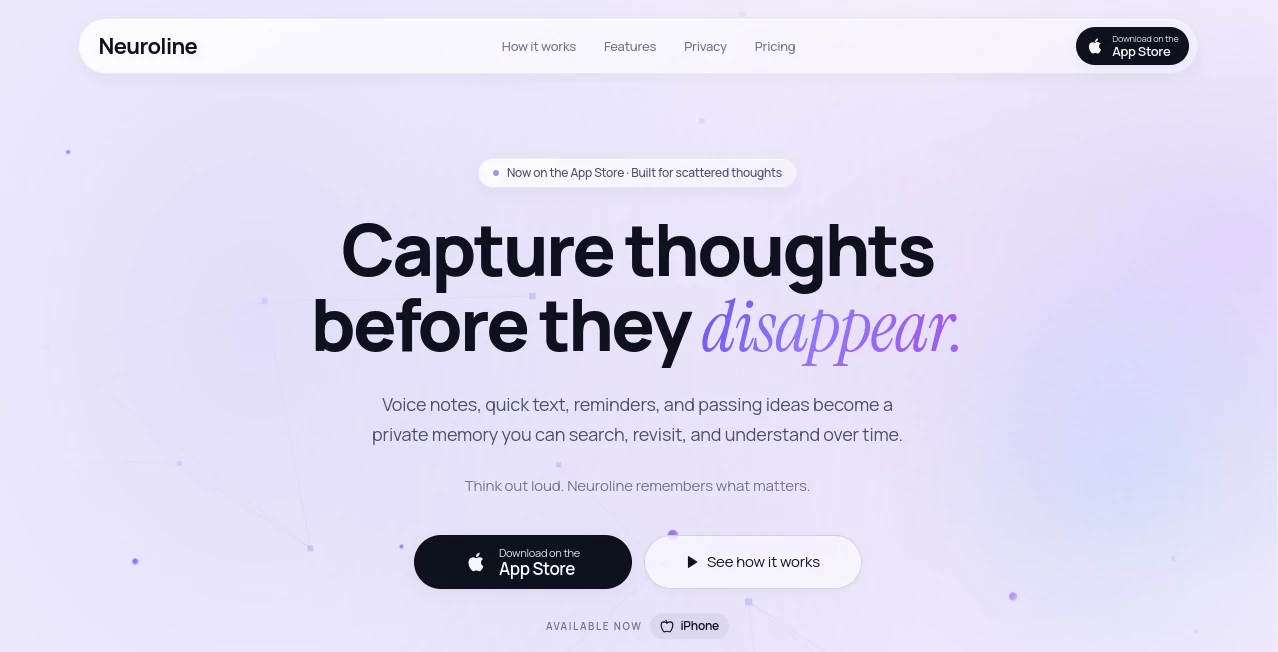
Some ideas arrive at the worst possible moment: while walking, between meetings, before falling asleep, or halfway through another task. Writing them down is easy enough. Finding them again months later is the difficult part. Neuroline is designed around that simple problem, giving scattered thoughts, voice notes, reminders, decisions, and reflections a private place where they can be captured and revisited.
The experience is deliberately simple. You can speak into your phone, type a quick thought, or bring existing notes into your personal memory space. Instead of forcing everything into folders and manually maintained notebooks, the app connects related memories and helps you discover recurring themes over time.
Key Features
- Voice-first thought capture for ideas, reflections, decisions, and reminders.
- Quick text capture when typing is more convenient than speaking.
- Semantic recall that helps find memories by meaning rather than relying only on exact keywords.
- Reflection patterns that highlight recurring themes and ideas across your thoughts.
- Linked memories that connect related moments across your personal timeline.
- Apple Notes import for bringing existing thoughts into one searchable memory space.
- Memory questions that let you explore what you have previously written or recorded.
- Export and deletion controls so your personal memories remain under your control.
User Interface
The interface takes a quieter approach than many productivity applications. Rather than presenting a complicated workspace filled with folders, dashboards, and settings, it focuses on capturing a thought and returning to it later.
The timeline gives your memories a chronological home, while features such as linked memories and recurring themes make older entries easier to understand in context. Voice capture is particularly useful when typing would interrupt the moment. A quick recording can later become something you can search, revisit, and connect with other thoughts.
Accuracy & Performance
Performance benefits from the application's device-first design. Voice notes can be captured quickly, while transcription turns spoken thoughts into searchable memories. Semantic recall is designed to understand what a thought means rather than simply looking for an identical word.
The result is useful when you remember the idea but not the exact sentence you originally wrote. For example, someone might remember reflecting on taking a break but have no idea which note contained that thought. Meaning-based recall can make that kind of memory much easier to retrieve.
Capabilities
The strongest part of the experience is the combination of capture, recall, and reflection. Capturing a thought is only the first step. The application can connect related memories, surface repeated themes, and help users notice what keeps appearing in their thinking.
It can also import existing Apple Notes, allowing users to start with material they already have instead of rebuilding their personal archive manually. WhatsApp and chat exports are listed as a future capability, suggesting that the memory system is intended to become useful across more of the places where people already record their thoughts.
Security & Privacy
Privacy is one of the central ideas behind the product. The current version is designed to keep memories on the user's device, with no cloud sync. The service also states that no account is required and that there is no telemetry or tracking.
Users can export their memories or delete them when they choose. For anyone who wants to record personal reflections, unfinished ideas, private decisions, or thoughts that would feel uncomfortable in a cloud-based service, this device-first approach is an important advantage.
Use Cases
For founders and professionals, it can serve as a lightweight place for capturing decisions, business ideas, meeting thoughts, and questions that appear during a busy day.
Writers can use voice capture to preserve ideas before they disappear, then return to older thoughts when developing a project. Students can record questions, explanations, and learning reflections and revisit them later.
It is also useful for everyday personal reflection. Someone taking a walk might record a thirty-second thought instead of opening a conventional notes application. Later, that small observation can become part of a larger pattern visible across weeks of entries.
Imagine repeatedly writing about wanting more uninterrupted time. Individually, each note may seem insignificant. Together, they may reveal a recurring concern worth paying attention to. That is where the reflection layer becomes more interesting than a traditional notes archive.
Pros and Cons
- Pros: Private device-first approach, no account required, voice and text capture, semantic memory search, recurring pattern detection, linked memories, Apple Notes import, and flexible export and deletion.
- Pros: The interface focuses on thinking and remembering rather than complicated productivity workflows.
- Cons: It is currently designed for iPhone, so users looking for a broad cross-platform workspace may find the platform coverage limited.
- Cons: The free plan has limits on the number of thoughts, recalls, and reflection refreshes.
- Cons: Some integrations, including WhatsApp and chat exports, are still marked as coming soon.
Pricing Plans
The free plan costs $0 per month and provides space for up to 20 thoughts, voice capture, a private timeline, three memory recalls, and one reflection refresh per week. Users can also export or delete their memories.
The Pro plan costs $49.99 per year and expands the experience with unlimited thoughts and voice notes, memory questions, instant access to older ideas and decisions, daily reflection insights, linked memories, imported notes, and longer memory windows.
There is also a Lifetime option priced at $99 as a one-time founder offer. It includes the Pro features, lifetime access to premium functionality, no recurring billing, and early access to new memory features.
How to Use It
- Open the app on an iPhone and enter the private memory space without creating an account.
- Tap the microphone to record a thought, reflection, reminder, or idea, or use quick text when you prefer typing.
- Let the captured thought become part of your personal memory timeline.
- Return later and use semantic recall to find an older memory without remembering its exact wording.
- Explore linked memories and recurring themes to understand how particular ideas appear across time.
- Import existing Apple Notes if you want to bring older thoughts into the same personal memory space.
- Export memories when you want a copy outside the app, or delete them whenever you no longer want to keep them.
Comparison with Similar Tools
Traditional note-taking applications are excellent for storing information, but they often depend on folders, tags, notebooks, and manual organization. General AI assistants can answer questions and generate content, yet they are not necessarily designed to become a long-term private archive of personal thoughts.
This approach sits somewhere in between. It combines the simplicity of a personal journal with semantic search and AI-assisted reflection, while keeping the experience focused on the user's own memories. The distinction is especially noticeable for people who do not want to spend time organizing every thought immediately after capturing it.
Conclusion
For people whose minds move faster than their note-taking habits, this is an appealing concept. It does not ask users to become better at organizing their thoughts; instead, it tries to make those thoughts easier to capture, retrieve, and understand later.
The combination of voice capture, semantic recall, linked memories, and recurring pattern detection gives ordinary notes a more useful second life. Add the device-first privacy model and the lack of an account requirement, and the product becomes particularly interesting for users who want a personal thinking space without turning their private reflections into another cloud service.
Frequently Asked Questions (FAQ)
Is an account required?
No. The current version can be used without creating an account or providing an email address.
Can I record thoughts with my voice?
Yes. Voice capture is one of the main ways to add thoughts, and recorded speech can be transcribed so that it becomes easier to search and revisit.
Can I search old thoughts?
Yes. Semantic recall is designed to help you find memories based on their meaning rather than requiring an exact keyword match.
Does it identify patterns in my thoughts?
Yes. Reflection features can surface recurring themes and connections between memories, helping you see subjects or ideas that repeatedly appear in your timeline.
Can I import my existing notes?
Yes. Apple Notes can currently be imported into the personal memory space. WhatsApp and chat export support is listed as a future feature.
Is my data stored in the cloud?
The current version is designed around on-device storage without cloud sync. The service also states that memories remain under the user's control and can be exported or deleted.
Is there a free plan?
Yes. The free plan includes up to 20 thoughts, voice capture, a private timeline, three memory recalls, and one reflection refresh per week.
What does the Pro plan include?
The Pro plan adds unlimited thoughts and voice notes, the ability to ask questions about your memory, daily reflection insights, linked memories, imported notes, and longer memory windows.
Which devices are supported?
The current product is built for iPhone, making it particularly suitable for people who want to capture thoughts quickly while away from a computer.
Can I delete my memories?
Yes. Memories can be deleted, and the product also provides an export option for users who want to keep their information elsewhere.
AI Recording , AI Productivity Tools , AI Notes Assistant .
These classifications represent its core capabilities and areas of application. For related tools, explore the linked categories above.

Neuroline Alternatives Product

Nova AI
Zamicus

IdeaHunter

Monkey Eatin…

Flow Veo 3

YouMind

Myjourney

LorePanic

justmarkdown
