OpenServ
What is OpenServ?
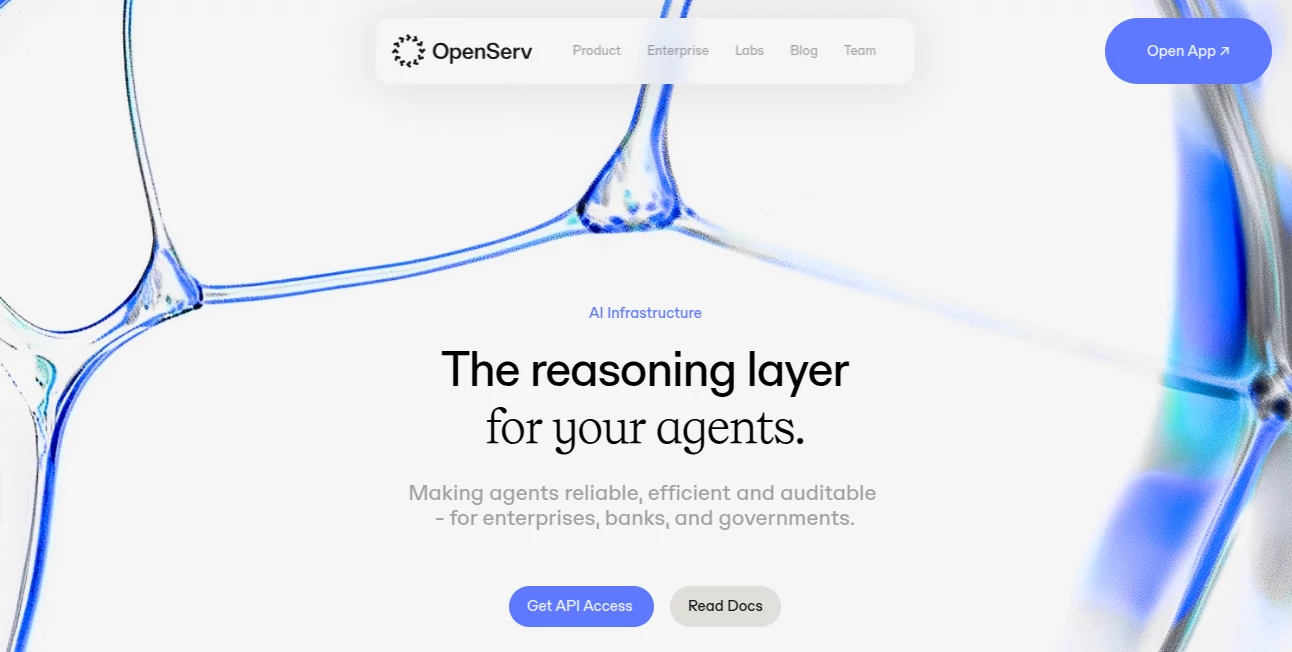
Building an AI agent is one thing. Getting that agent to behave consistently when it is handling real business work is another. OpenServ takes a different approach by providing a reasoning and orchestration layer designed to make AI agents more reliable, efficient, and easier to audit.
The platform is aimed particularly at developers, startups, enterprises, and teams working with agentic systems. Instead of replacing an existing AI stack, it can sit between an application and its language models, adding structured reasoning, validation, observability, and controls around agent execution.
One of the most appealing aspects is the low-friction integration. Existing agents using OpenAI- or Anthropic-compatible SDKs can be connected by changing the model endpoint rather than rebuilding the entire application. The company says the basic integration can take around two minutes, which makes it interesting for teams that already have agents in development or production.
Key Features
- Reasoning infrastructure for AI agents and agentic applications
- Structured execution paths for complex tasks
- Validation of outputs against schemas, rules, and constraints
- Multi-agent workflow orchestration
- Visual workflow design through a no-code builder
- OpenAI- and Anthropic-SDK compatibility
- Execution tracing and observability
- Audit trails for agent decisions
- Tools and integrations for messaging, payments, identity, and data
- Support for private and enterprise-oriented deployments
User Interface
The platform is designed around two different experiences. Developers can work with the SDK and integrate the reasoning layer directly into existing applications, while teams that prefer a visual approach can use the workflow builder to arrange agents and tasks through a graph-based interface.
The visual workflow approach is particularly useful when a process involves several agents or multiple stages. Instead of keeping the entire logic inside a large collection of prompts and application code, teams can see how tasks move through the workflow and make changes without rebuilding the whole application.
For developers, the experience is deliberately lightweight. The platform supports familiar SDK patterns, while the builder provides a more accessible route for teams that want to experiment with agentic workflows without writing every piece of orchestration logic themselves.
Accuracy & Performance
Reliability is one of the central ideas behind the platform. Rather than expecting a language model to produce the correct result in one attempt, the reasoning layer breaks work into structured execution paths and applies validation and constraints along the way.
This matters for tasks where a plausible answer is not enough. An agent processing a compliance workflow, financial operation, research task, or internal business process may need to follow specific rules and produce an output in a predictable format.
The company reports results from production and beta workloads showing improved cost efficiency and reliability. Its current materials also describe testing across thousands of LLM calls and cases where smaller models combined with the reasoning layer were able to compete with larger models at substantially lower cost. These figures are company-reported rather than independent guarantees, so teams should evaluate performance against their own workloads before making production decisions.
Capabilities
The platform goes beyond simple prompt enhancement. Its reasoning engine is designed to turn an agent's work into a bounded execution path, with validation and evidence attached to individual decisions.
Developers can bring existing agents or build new ones, then add reasoning, verification, and auditability around them. The builder also supports multi-agent orchestration, allowing separate agents to collaborate as parts of a larger application.
Another useful capability is compatibility with existing AI infrastructure. The service supports major model providers and is designed to work with OpenAI- and Anthropic-compatible integrations. This gives development teams more freedom to change models without having to redesign their entire agent architecture.
For enterprise workloads, observability is especially valuable. Teams can trace workflow steps, inspect decisions, and create an execution history instead of treating the agent as a black box.
Security & Privacy
Security is positioned as an important part of the architecture rather than an optional add-on. The platform describes protections against prompt injection, encrypted data handling, privacy controls, and deployment options that can support sensitive enterprise environments.
Its enterprise architecture includes on-premise deployment possibilities and data-residency considerations for organizations with stricter requirements. The company also states that prompts are not used to train models unless a user explicitly enables that option.
As with any AI infrastructure handling business data, organizations should review the current security documentation, contractual terms, deployment model, and data-processing requirements before sending sensitive information through the service.
Use Cases
The strongest use cases are workflows where an AI agent needs to do more than generate text. Financial services can use structured agent workflows for areas such as credit decisioning, treasury, and compliance. Government organizations can benefit from traceable execution when AI is introduced into high-trust environments.
Healthcare and life sciences are another potential fit, particularly for workflows where auditability and controlled handling of information are important. Robotics teams can use agentic reasoning for systems that need predictable decisions in physical environments.
For software teams, the platform can also serve as an infrastructure layer for customer-facing AI applications, internal automation, research systems, and multi-agent products. A practical example would be an application that receives a complex request, assigns different parts of the work to specialized agents, validates their outputs, and records the final decision for later review.
Pros and Cons
Pros
- Designed specifically around reliability and observability for AI agents
- Works with existing OpenAI- and Anthropic-compatible SDK patterns
- Supports both code-first and no-code workflow development
- Provides structured validation and audit trails
- Useful for complex multi-agent workflows
- Designed with enterprise and regulated workloads in mind
- Can potentially reduce inference costs by making smaller models more effective
Cons
- The platform is primarily aimed at developers and organizations building AI systems rather than casual AI users
- Some advanced enterprise capabilities may require contacting the sales team
- Performance benefits can vary significantly depending on the agent architecture and workload
- Teams looking for a simple chatbot or basic content-generation tool may find the platform unnecessarily advanced
Pricing Plans
The current offering is focused on beta and developer access rather than a large collection of traditional consumer subscription plans. The service currently provides new beta users with $15 in credits to explore its reasoning capabilities, according to the current product information.
For organizations interested in larger deployments, enterprise access and personalized onboarding are available through the company's sales process. This approach makes sense for a platform that is intended to become part of an organization's AI infrastructure rather than simply being used as a standalone web application.
Because pricing and access terms can change as the platform moves through its beta and expands its enterprise offering, teams should check the current commercial terms before planning a long-term deployment.
How to Use the Platform
Getting started is relatively straightforward for developers who already have an AI agent. First, create an account and obtain API access. Then connect the existing application to the compatible inference endpoint instead of sending requests directly to the original model endpoint.
The next step is to configure the reasoning layer around the agent's existing workflow. Prompts, tools, and the main agent loop can remain largely intact while the new infrastructure handles additional reasoning and validation.
For teams using the visual builder, the process is different. Agents can be added to a workflow, connected through a visual graph, and assigned specific stages of a larger process. Verification and audit capabilities can then be added before the workflow is deployed.
A sensible way to evaluate the platform is to start with one real workflow rather than migrating an entire AI stack immediately. Compare the original system with the new setup in terms of accuracy, failed calls, latency, cost, and how easily the team can understand what happened during each execution.
Comparison with Similar Tools
Many AI development platforms concentrate on creating agents, connecting tools, or providing access to language models. This platform takes a somewhat different position by emphasizing the reasoning layer between those components and the final application.
Compared with a basic agent framework, it puts more emphasis on structured execution, verification, and auditability. Compared with a conventional no-code automation service, it is more deeply focused on AI agents and multi-agent reasoning. And compared with a direct model API, it provides an additional layer intended to make complex agent workloads more predictable.
That distinction is important when choosing a platform. If the goal is simply to call an LLM and return a response, an additional reasoning layer may not be necessary. If the application has multiple agents, complex business rules, repeated tool calls, or strict requirements for traceability, the additional infrastructure can become much more valuable.
Conclusion
Reliable AI agents need more than a powerful language model. They need structure, verification, visibility, and a way to understand what happened when something goes wrong. That is where this platform makes its strongest case.
Its combination of reasoning infrastructure, multi-agent orchestration, SDK compatibility, workflow design, validation, and auditability makes it particularly interesting for teams moving from experimental AI agents toward serious production systems.
It will not be the right choice for every AI project, and its value is easiest to see in complex workflows rather than simple prompt-and-response applications. For developers and organizations building agents that need to operate consistently under real-world constraints, however, it offers a thoughtful layer between raw model intelligence and dependable software.
Frequently Asked Questions (FAQ)
What is OpenServ used for?
It is used as infrastructure for building and running more reliable AI agents. Its capabilities include reasoning, workflow orchestration, validation, observability, and auditability.
Can existing AI agents be connected?
Yes. The platform is designed to work with existing agents and supports OpenAI- and Anthropic-compatible SDK integrations, allowing developers to add the reasoning layer without rebuilding their entire agent.
Does it support no-code development?
Yes. The Agent Builder provides a visual workflow environment where users can create and orchestrate multi-agent systems without implementing every orchestration step manually.
What AI models are supported?
The current platform information states that it works with major model providers, including OpenAI, Anthropic, Google, DeepSeek, Qwen, and xAI.
Is there a free way to try it?
During the current beta, users receive $15 in credits to explore the reasoning capabilities. Access and commercial terms may change as the service evolves.
Are prompts used to train AI models?
The company states that prompts are not used to train models unless the user explicitly chooses to enable that option.
Is it suitable for enterprise applications?
Yes. Enterprise use is one of its main target areas, with features focused on traceability, reliability, security, private inference, and deployment requirements for regulated environments.
How long does integration take?
The current product documentation says that teams can typically switch an existing compatible setup in about two minutes by changing the relevant endpoint configuration.
Can it handle multi-agent workflows?
Yes. Its builder is designed to orchestrate multiple agents and connect them into larger workflows, while providing verification and an audit trail for the execution.
Is it suitable for simple AI chat applications?
It can be used as part of an AI application, but its biggest advantages are aimed at more complex agentic systems where reliability, cost control, structured execution, and traceability matter.
AI Workflow Management , AI No-Code & Low-Code , AI API Design , AI Developer Tools .
These classifications represent its core capabilities and areas of application. For related tools, explore the linked categories above.

OpenServ Alternatives Product

globalize.now

AI Agent Ski…

ClawBridge

ShipAhead

DeepSeek

Mythx AI

ChatFlowchart
Kimi K2.5

AI text clea…