
Paid.ai
What is Paid.ai?
Paid.ai is a monetization platform built for companies developing and selling AI agents. Instead of treating an AI product like traditional software, it helps businesses connect pricing, usage, operating costs, customer value, and billing in one place. This is particularly useful for teams dealing with variable model costs, usage-based products, or AI agents that deliver measurable outcomes.
The platform is designed around a practical problem: an AI agent can generate significant value for a customer while also consuming tokens, model calls, and other resources behind the scenes. Understanding both sides of that equation is essential when deciding what to charge. The platform brings those numbers together so teams can make pricing decisions with a clearer view of their actual margins.
Key Features
- Flexible pricing models including subscription, usage-based, credit-based, outcome-based, and hybrid approaches.
- Real-time tracking of AI costs across products, customers, agents, models, and individual actions.
- Customer value receipts that can show measurable outcomes such as time saved, documents processed, or tasks completed.
- Billing and invoicing designed around AI usage and customer activity.
- Margin visibility that helps teams understand whether individual customers, products, or AI actions are profitable.
- Event and signal tracking for monitoring what AI agents are actually doing.
- SDK support for several popular development environments, including Node.js, Python, Go, and Ruby.
- API and CLI access for teams that prefer integrating monetization capabilities directly into their existing infrastructure.
User Interface
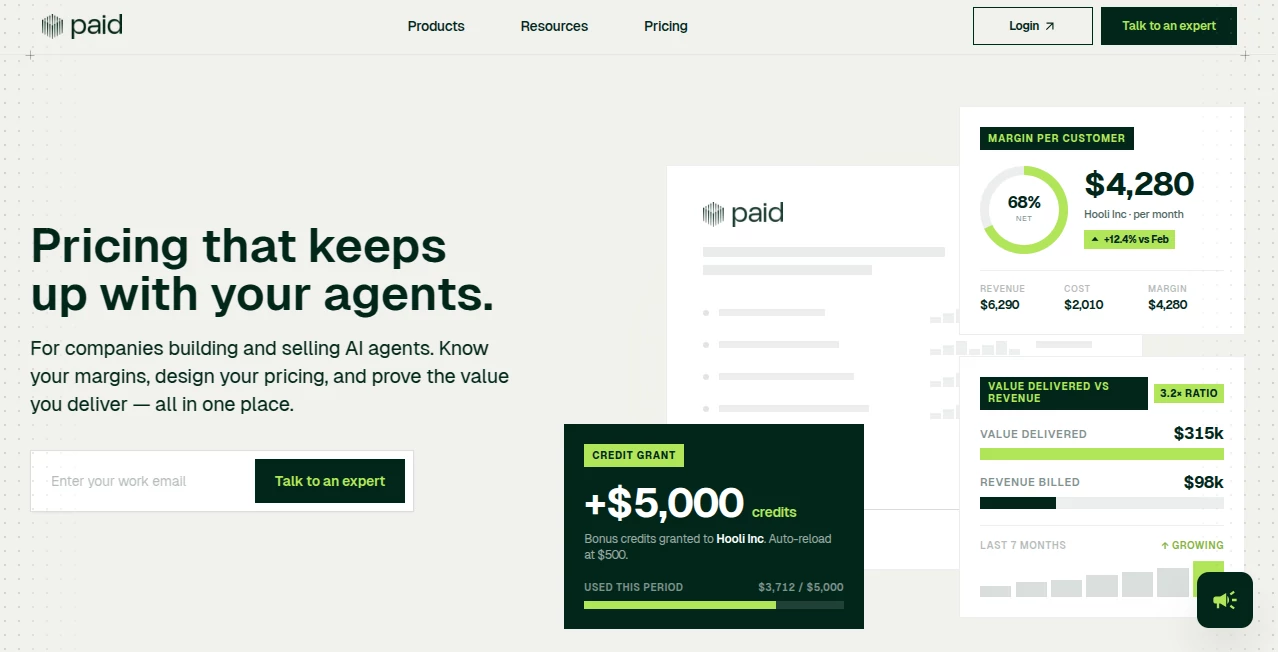
The platform takes a dashboard-first approach, giving teams a central place to configure products, pricing, plans, credits, customers, and usage signals. The interface is aimed more at product, engineering, finance, and operations teams than casual consumers, so the emphasis is on useful business data rather than visual effects.
One particularly useful aspect is the ability to view revenue and costs together. For example, a team can examine how much a customer is generating compared with the cost of running the AI services behind that account. That makes the dashboard much more actionable than a conventional billing screen.
Accuracy & Performance
For a monetization platform, accurate usage and cost data matter more than flashy features. The service is designed to capture AI activity through signals and instrumentation, including information such as token usage, latency, and provider costs. This gives developers a way to connect technical activity with financial results.
The integration is also designed to be lightweight. The official onboarding documentation describes sending a first signal within minutes, while SDK wrappers can automatically capture supported AI calls. For development teams, this reduces the amount of custom tracking code needed to understand AI spending.
Capabilities
The strongest part of the platform is its flexibility around AI pricing. A company can combine recurring platform fees with usage charges, credits, or other pricing structures rather than forcing an AI product into a simple per-seat subscription.
This becomes especially valuable when customers use an AI agent in very different ways. One customer might generate thousands of automated actions each month while another uses the system only occasionally. A usage or credit model can reflect that difference more naturally than a fixed seat-based fee.
The platform also connects pricing with cost intelligence. Teams can inspect margins by customer, product, agent, model, or action. In practical terms, this can reveal that an apparently successful feature is expensive to operate or that a particular customer is consuming considerably more resources than expected.
Security & Privacy
Security is an important consideration when monetization infrastructure is connected to customer and usage data. The service states that its platform is designed for enterprise use and highlights certifications and compliance standards including SOC 2, GDPR, ISO 27001, and HIPAA. It also states that data is encrypted in transit and at rest and independently audited.
Organizations should still review the provider's current security documentation, data processing terms, and privacy policy before connecting production systems or sensitive customer information.
Use Cases
This platform is particularly well suited to companies building AI agents, AI SaaS products, and other applications where usage and value can vary significantly between customers.
- AI SaaS companies: Build subscription plans while adding usage or credit-based charges where appropriate.
- AI agent developers: Track the cost of individual agent actions and connect those costs to customer accounts.
- Product teams: Experiment with pricing models without requiring a major engineering rewrite every time pricing changes.
- Finance teams: Monitor customer-level revenue, operating costs, and margins from a single environment.
- Enterprise AI providers: Give customers clearer evidence of the value delivered by automated agents.
- Usage-based products: Bill customers according to actions, API calls, processed documents, messages, or other measurable events.
Pros and Cons
- Pros: Flexible pricing models, detailed AI cost tracking, customer-level margin visibility, usage signals, value reporting, billing capabilities, SDK integrations, and API access.
- Pros: The platform addresses a problem that becomes increasingly important as AI products move away from traditional seat-based pricing.
- Cons: The feature set is primarily aimed at businesses building AI products rather than individuals looking for a general-purpose AI application.
- Cons: Teams may need some technical knowledge to take full advantage of SDKs, APIs, event tracking, and automated instrumentation.
Pricing Plans
A free plan is available with support for up to $100,000 in annual billings. It includes all pricing models, customer margin tracking, usage visibility, dashboards and value receipts, unlimited invoicing, and unlimited products and plans.
Paid plans are structured around increasing annual billing volumes. The Grow plan supports up to $200,000 in annual billings, Scale supports up to $500,000, and Accelerate supports up to $1 million. These plans include the core monetization and tracking features along with additional support. Enterprise pricing is custom and is intended for organizations with unlimited billing requirements and more extensive services.
The service also offers a 14-day free trial for its paid plans, with no credit card required to get started.
How to Use Paid.ai
Getting started is relatively straightforward for a development team. After creating an account, users can enter a demo workspace, explore sample pricing and usage data, and configure their first product.
The next step is connecting the application through an SDK or API. The platform supports SDKs for Node.js, Python, Go, and Ruby, while API access provides another option for teams with their own infrastructure.
Once the integration is active, the application can send signals representing actions performed by an AI agent. These signals can then be connected to pricing rules, usage charges, credits, and customer accounts.
For example, an AI chatbot could offer monthly plans that include different amounts of chat credits. Each message can consume one credit, allowing the business to combine a predictable subscription with measurable usage. The same principle can be adapted to document processing, automated research, API calls, or other agent actions.
Comparison with Similar Tools
Traditional billing platforms generally focus on invoices, subscriptions, payments, and recurring charges. That works well for conventional SaaS products, but AI applications introduce another layer: the cost of generating each response or completing each automated task can vary considerably.
This platform takes a broader approach by combining billing with cost tracking, pricing configuration, usage signals, and customer value measurement. Instead of only asking whether an invoice was paid, teams can investigate how much it cost to serve the customer and what the AI actually delivered.
That distinction makes it particularly interesting for AI-native companies experimenting with credits, usage-based pricing, outcome-based models, or combinations of several approaches.
Conclusion
For companies building AI agents, monetization can become complicated surprisingly quickly. Model costs change, customers use products differently, and a pricing model that looks attractive on paper can become unprofitable once real usage arrives.
This platform provides a focused solution to that challenge by bringing pricing, usage, costs, margins, billing, and customer value into one business engine. Its strongest appeal is not simply automated invoicing; it is the ability to understand what an AI product costs to operate and how that cost relates to the value being sold.
For an AI startup moving beyond an early prototype, or an established company introducing autonomous agents into its product line, having that financial visibility can make pricing decisions considerably easier. The flexible pricing models and developer integrations also give teams room to experiment without rebuilding their entire billing architecture every time their business model changes.
Frequently Asked Questions (FAQ)
What is this platform designed for?
It is designed for companies building and selling AI agents and AI-native products. Its core functions cover pricing, subscriptions, usage tracking, cost monitoring, margins, billing, and customer value reporting.
Can it track AI operating costs?
Yes. The platform can track AI-related costs and provide visibility into spending by customer, product, agent, model, and action. Its instrumentation can capture information such as token usage and latency for supported integrations.
Does it support usage-based pricing?
Yes. Usage-based pricing is one of the platform's central capabilities. Businesses can define charges around signals representing activities performed by their AI products.
Can AI products use credits?
Yes. Credit-based pricing is supported, allowing businesses to grant customers a defined credit balance and consume those credits as customers use the AI service.
Does it support subscription pricing?
Yes. Businesses can configure recurring platform fees and combine them with usage pricing, credits, or other pricing structures.
Which programming languages are supported?
Official SDK options include Node.js, Python, Go, and Ruby. Developers can also work directly with the platform's API.
Is there a free plan?
Yes. The free plan is available at no cost and supports up to $100,000 in annual billings, along with core pricing, usage, margin, dashboard, invoicing, product, and plan features.
Is it suitable for enterprise use?
The platform is positioned for enterprise use and states that it has certifications and compliance coverage including SOC 2, GDPR, ISO 27001, and HIPAA. Organizations should review the latest security and privacy documentation for their specific requirements.
AI API Design , AI Analytics Assistant , AI Developer Tools .
These classifications represent its core capabilities and areas of application. For related tools, explore the linked categories above.

Paid.ai Alternatives Product

Arobis AI Vi…

Project Mela

Mage Flow AI…

AyeWatch AI

Quso AI

TrackRev

Sellerview.ai

Nimbalyst

DemoDash