
Percision Platform
What is Percision Platform?
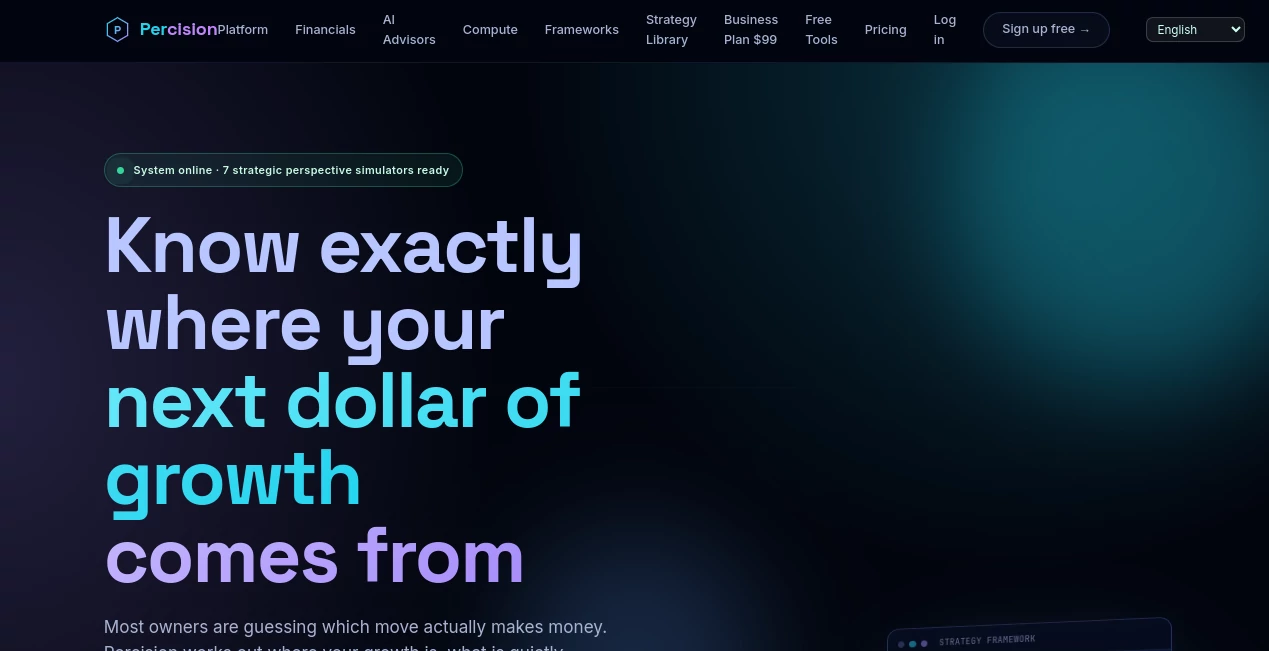
Percision is a strategic intelligence platform built for executives, founders, investors, consultants, and strategy teams that need more than a generic AI chatbot. It takes business context, goals, financial information, market conditions, and constraints and turns them into structured strategic analysis, recommendations, and execution plans. The platform combines more than 27 analytical frameworks with 83 structured reasoning steps, helping teams move from a business problem to a clearer set of strategic options in minutes.
What makes the approach particularly useful is the emphasis on human judgment. The system presents AI-generated recommendations and scenario analysis, but it does not make decisions or take actions on behalf of the leadership team. That distinction makes it more practical for organizations that want to use AI as a serious analytical partner without handing over accountability.
The workflow is straightforward: provide the relevant business context, let the analytical engine process it, review the resulting recommendations, and then turn selected ideas into goals, owners, tasks, and measurable KPIs. For a team that normally spends days assembling information before a strategy meeting, having this first layer of analysis ready in roughly 7–15 minutes can be a meaningful time saver.
Key Features
- More than 27 analytical strategy frameworks
- 83 structured reasoning steps for each strategy run
- Seven specialized AI strategic perspectives covering CEO, CFO, COO, CTO, CMO, VP Business Development, and VP Sales viewpoints
- Strategic scenario analysis and board-ready recommendations
- DCF valuation and Buffett Score analysis
- More than 60 financial ratios with industry benchmarking
- 24+ financial warning signals
- Excel models, audit trails, and footnotes for financial analysis
- Strategy execution with goals, owners, tasks, and KPIs
- Project workspace for managing multiple strategy projects
- Investor intelligence and due diligence workflows
- Automatic board-ready presentation generation through Gamma
- Startup-focused strategic analysis through Startup Genius
- White-label support for eligible Consultant and Practice plans
User Interface
The interface is organized around the way strategy teams actually work rather than around a simple chat window. A central dashboard can bring together strategic goals, financial indicators, progress, and recommendations, giving users a more practical view of the relationship between analysis and execution.
The project workspace is also useful for teams working on more than one initiative. Previous strategy runs can be stored, filtered, restored, and reviewed, while the execution layer helps turn broad recommendations into initiatives with owners and measurable targets.
Accuracy & Performance
The platform is designed around structured reasoning rather than relying on a single conversational response. Its analytical engine uses 83 reasoning steps covering areas such as company enrichment, competitive analysis, segment assessment, and structured synthesis. Three specialist reasoning models are routed toward strategy, finance, and competitive intelligence tasks.
Full strategic analysis is presented as taking approximately 7–15 minutes, while some financial data refreshes can take less than 90 seconds. Naturally, the usefulness of any recommendation still depends on the quality and completeness of the information supplied. The platform itself positions its outputs as recommendations requiring human review, which is an important consideration for high-stakes strategic and financial decisions.
Capabilities
The range of analytical work is one of the strongest aspects of the platform. Core frameworks cover areas such as growth portfolios, organizational alignment, value creation, systems thinking, and strategic durability. Specialized workflows extend into startup evaluation, private equity screening, investor analysis, market entry, pricing, competitive positioning, scenario planning, digital transformation, commercial due diligence, customer value architecture, and operations.
The financial side goes beyond a basic calculator. Users can examine DCF intrinsic value, owner earnings, Buffett-style scoring, industry-percentile benchmarking, financial warning signs, and Sankey-style decomposition. Full Excel models and audit trails make the resulting work easier to inspect and continue working with outside the platform.
Another interesting capability is the collection of seven strategic perspectives. Looking at the same situation from a CEO, CFO, COO, CTO, marketing, business development, and sales perspective can expose tensions that a single recommendation might overlook.
Security & Privacy
Privacy and human oversight are central to the product's positioning. The platform states that business context remains private and that recommendations are clearly identified as AI-generated. Outputs are logged for record keeping, while strategic, financial, and operational decisions remain with the qualified human team.
This approach is especially relevant for organizations handling sensitive strategy and financial information. Prospective users should still review the current privacy policy, terms, and data-handling documentation before submitting confidential or regulated information, particularly when using the platform for investment or corporate financial analysis.
Use Cases
For CEOs and founders, the platform can help answer practical questions such as where growth is coming from, why margins are changing, which initiatives deserve attention, or which strategic options should be investigated next. The emphasis on goals and KPIs also makes it easier to move from a strategy document toward actual execution.
Strategy and corporate development teams can use it for planning cycles, market-entry assessments, competitive positioning, scenario planning, and M&A-related analysis. Investors and VCs can use investor-oriented workflows for company analysis, target evaluation, financial benchmarking, and due diligence preparation.
Independent consultants can benefit from the structured frameworks and automated deliverables when preparing client work. CFOs and finance teams, meanwhile, can use the financial intelligence layer for valuation, ratio benchmarking, warning-signal analysis, and scenario modeling.
It can also be particularly useful for startups. The dedicated startup workflow considers factors such as the founding team, product-market-fit hypothesis, target customer, go-to-market motion, funding stage, and key risks, making it more focused than simply asking a general-purpose chatbot to critique a business plan.
Pros and Cons
- Pros: Extensive strategy framework library, structured multi-step reasoning, specialized executive perspectives, strong financial analysis capabilities, execution tracking, investor workflows, Excel exports, and automated presentation generation.
- Pros: A free diagnostic is available without requiring an account or credit card, allowing potential users to test the approach before committing to a paid workflow.
- Pros: Human oversight is built into the product philosophy rather than treating AI recommendations as autonomous decisions.
- Cons: The depth of the platform may be more than a small business needs for simple day-to-day planning.
- Cons: Strategic recommendations still require knowledgeable human review, especially for financial, investment, and high-impact business decisions.
- Cons: Some advanced frameworks and capabilities are reserved for higher-tier plans.
Pricing Plans
A free tier is available, and the platform also offers a free strategic diagnostic that does not require an account or credit card. Paid access is structured around different levels of strategy work, with additional capabilities becoming available on higher plans. The Business plan is listed at $99, while Consultant and Practice-level offerings provide access to more advanced frameworks and features such as white-label support. Because plan limits and included features can change, users should check the current pricing page before subscribing.
How to Use Percision
- Start with the free strategic diagnostic to identify potential strategic gaps and understand the platform's approach.
- Provide relevant information about the company, including its objectives, financial position, market, competition, team, and strategic priorities.
- Select an appropriate framework or strategy workflow based on the problem you are trying to solve.
- Allow the analytical engine to process the supplied context and generate recommendations, scenarios, and supporting analysis.
- Review the output from the different strategic perspectives and challenge assumptions where necessary.
- Turn selected recommendations into goals, owners, tasks, and measurable KPIs using the execution layer.
- Export financial models, reports, or presentation materials when additional internal or board-level review is required.
Comparison with Similar Tools
Traditional strategy consulting can provide deep human expertise, stakeholder interviews, primary research, and organizational guidance, but those engagements can take weeks and involve substantial costs. General-purpose AI assistants are faster and flexible, yet they typically require users to construct the analytical framework themselves.
This platform sits somewhere between those approaches. It focuses on predefined strategic methodologies, financial models, multiple executive perspectives, and structured reasoning rather than leaving the entire analytical process to an open-ended conversation. That makes it particularly appealing when the goal is to produce a structured first-pass analysis quickly.
It should not, however, be viewed as a universal replacement for experienced consultants, investment professionals, or internal executives. The strongest workflow is likely to be collaborative: use the system to accelerate research, modeling, scenario development, and hypothesis generation, then apply human expertise to validate assumptions and make the final call.
Conclusion
For organizations that want to make strategic analysis faster without turning decision-making over to an AI system, Percision presents a compelling combination of structured reasoning, financial intelligence, executive perspectives, and execution tracking. Its breadth is impressive, particularly for teams dealing with growth strategy, market entry, investment analysis, financial benchmarking, or complex planning questions.
The biggest advantage is not simply generating another AI-written strategy document. It is the attempt to connect business context, analytical frameworks, financial evidence, strategic recommendations, and measurable execution in one workflow. For a leadership team preparing for its next planning cycle, investor review, or major strategic decision, that can make the initial analytical work considerably more organized and easier to challenge.
Frequently Asked Questions (FAQ)
What is Percision?
Percision is an AI-powered strategic intelligence platform that analyzes business context and produces structured strategic recommendations, financial analysis, scenario planning, and execution plans for executives, consultants, investors, and strategy teams.
Who is this platform designed for?
It is designed primarily for CEOs, founders, CFOs, strategy and corporate development teams, investors, VCs, independent consultants, and other leadership teams that need structured strategic analysis.
Can it replace a strategy consultant?
It can accelerate analytical work that is commonly part of strategy engagements, but it does not replace human judgment, stakeholder management, primary research, or the accountability of experienced advisors and executives.
Does it provide financial analysis?
Yes. Its financial intelligence capabilities include DCF valuation, Buffett Score analysis, owner earnings, more than 60 financial ratios, industry benchmarking, warning signals, scenario analysis, and exportable Excel models.
Is there a free option?
Yes. A free tier is available, and the initial strategic diagnostic can be used without an account or credit card. Advanced frameworks and capabilities are available through paid plans.
AI Accounting Assistant , AI Research Tool , AI Business Ideas Generator , AI Consulting Assistant .
These classifications represent its core capabilities and areas of application. For related tools, explore the linked categories above.
Percision Platform details
Website unavailable — View Alternatives
Pricing
- Free
Apps
- Web App
Categories

Percision Platform Alternatives Product

Metal

Manus

Patches Answ…

Syncity AI

Serplux

Zloth

Construction…

AI Entity

Crawlly AI