
















Radily AI
What is Radily AI?
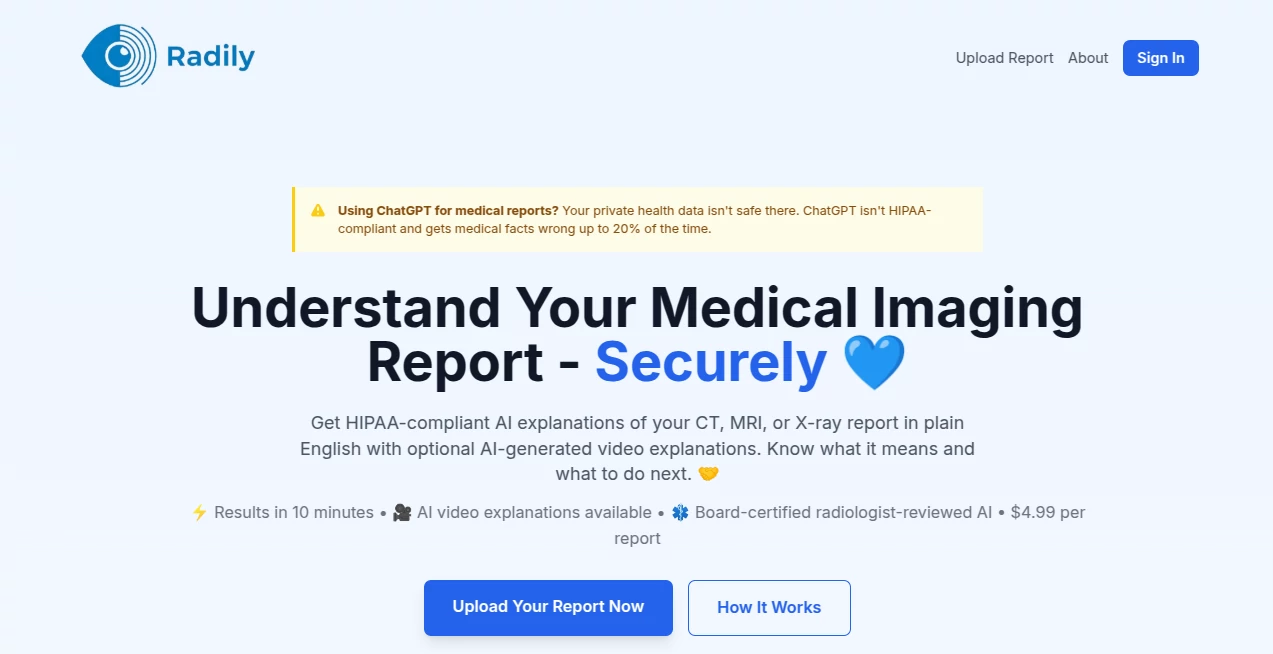
Radiology reporting can be one of the most time-consuming parts of a clinician’s workflow. Dictation, formatting, editing, and ensuring consistency across reports often consume valuable time that could be spent focusing on patient care. This platform addresses that challenge by transforming spoken findings into structured radiology reports within minutes.
Built specifically for radiologists, the solution combines advanced speech recognition with intelligent report generation. Instead of relying on generic AI assistants, it understands clinical terminology, imaging modalities, comparison language, and reporting structures commonly used in radiology departments.
The result is a streamlined reporting experience that helps specialists produce professional reports faster while maintaining full control over clinical decisions and final sign-off.
Key Features
User Interface
The platform offers a clean and workflow-focused interface designed for medical professionals. Users can dictate findings naturally, review structured sections instantly, and export completed reports without navigating complex menus.
Accessibility is another strength. The assistant is available through a web application and messaging-based workflows, allowing radiologists to generate reports from different devices and environments.
Accuracy & Performance
One of the most impressive aspects of the platform is its focus on clinical vocabulary. Speech recognition is optimized for radiology terminology, enabling highly accurate transcription of findings, measurements, anatomical references, and modality-specific language.
Report drafts are typically generated in under two minutes, reducing documentation burden while preserving reporting quality. Internal validation highlights strong transcription performance across multiple imaging modalities.
Capabilities
The platform does far more than simple dictation. It automatically organizes information into structured sections such as history, technique, findings, and impression. This creates consistency across reports and simplifies review before final approval.
- Voice-powered report creation
- Structured radiology report generation
- Support for multiple imaging modalities
- Template-guided report drafting
- Fast export to existing workflows
- Clinical terminology recognition
- Editing and review before sign-off
These capabilities make it valuable for both experienced radiologists and trainees who want consistent reporting standards.
Security & Privacy
Healthcare environments require strong attention to privacy and data protection. The platform is designed with clinical workflows in mind, allowing users to review and approve every report before use. Human oversight remains central to the process, ensuring that final responsibility stays with the radiologist.
By supporting controlled report generation rather than automated diagnosis, the system acts as a productivity assistant while respecting professional accountability.
Use Cases
- Creating radiology reports from voice dictation.
- Reducing documentation workload during busy reporting sessions.
- Standardizing report structure across teams and departments.
- Supporting radiology residents during report preparation.
- Accelerating workflow for CT, MRI, X-ray, ultrasound, and other imaging studies.
- Improving consistency in findings and impression sections.
Pros and Cons
Pros
- Purpose-built specifically for radiology workflows.
- Fast report generation from voice input.
- Structured outputs improve consistency.
- Clinical terminology recognition enhances accuracy.
- Simple review and export process.
- Available across multiple access channels.
Cons
- Primarily focused on radiology rather than broader medical specialties.
- Reports still require professional review and validation.
- Advanced workflow needs may depend on organizational integration.
Pricing Plans
The platform offers a free starting option that allows users to test its capabilities before committing to a paid subscription. Additional professional plans provide expanded reporting capacity and access to advanced features suitable for regular clinical use.
This flexible pricing approach makes it accessible for individual practitioners while remaining practical for larger teams evaluating workflow improvements.
How to Use Radly
Getting started is straightforward and requires only a few steps.
- Open the application or supported assistant interface.
- Dictate radiology findings naturally using voice input.
- Allow the system to generate structured report sections automatically.
- Review the generated history, technique, findings, and impression sections.
- Make any necessary edits or annotations.
- Export the finalized report into your preferred workflow.
The process minimizes repetitive formatting work while keeping the clinician fully in control of the final document.
Comparison with Similar Tools
Many AI writing assistants can transcribe speech and generate text, but they often require extensive prompting and manual correction. In contrast, this solution was developed specifically for radiology reporting.
Its understanding of modality-specific terminology, report structures, and clinical language allows it to produce outputs that are far closer to real-world radiology requirements. Instead of acting as a generic chatbot, it functions as a specialized reporting assistant tailored to medical imaging professionals.
This specialization creates a noticeable advantage in efficiency, consistency, and usability within radiology departments.
Conclusion
Modern radiologists face increasing reporting demands while striving to maintain accuracy and quality. This platform provides a practical way to reduce documentation burden by converting spoken findings into professionally structured reports in a matter of minutes.
Its combination of radiology-focused speech recognition, intelligent report organization, and clinician-controlled review creates a workflow that feels both efficient and reliable. For professionals seeking a smarter approach to reporting without sacrificing oversight, it represents a compelling addition to the modern radiology toolkit.
Frequently Asked Questions (FAQ)
What is this platform designed for?
It is designed to help radiologists generate structured reports from voice dictation more efficiently.
Can users edit reports before exporting them?
Yes. Every generated report can be reviewed, edited, and approved before export.
Does it support different imaging modalities?
Yes. The platform is designed to understand terminology used across various radiology modalities.
Is it intended to replace radiologists?
No. It functions as an assistant that helps with documentation while clinical judgment remains entirely with the radiologist.
Who can benefit most from this solution?
Radiologists, imaging specialists, residents, and healthcare organizations seeking faster and more consistent reporting workflows.
AI Speech to Text , AI Healthcare , AI Productivity Tools , AI Documents Assistant .
These classifications represent its core capabilities and areas of application. For related tools, explore the linked categories above.

Radily AI Alternatives Product

Eleven AI

Nifty
VercelAPP
jpg to excel
Online White…
YouTube Thum…
Linkflare

Embedful

Presenti AI