
RenderHut
What is RenderHut?
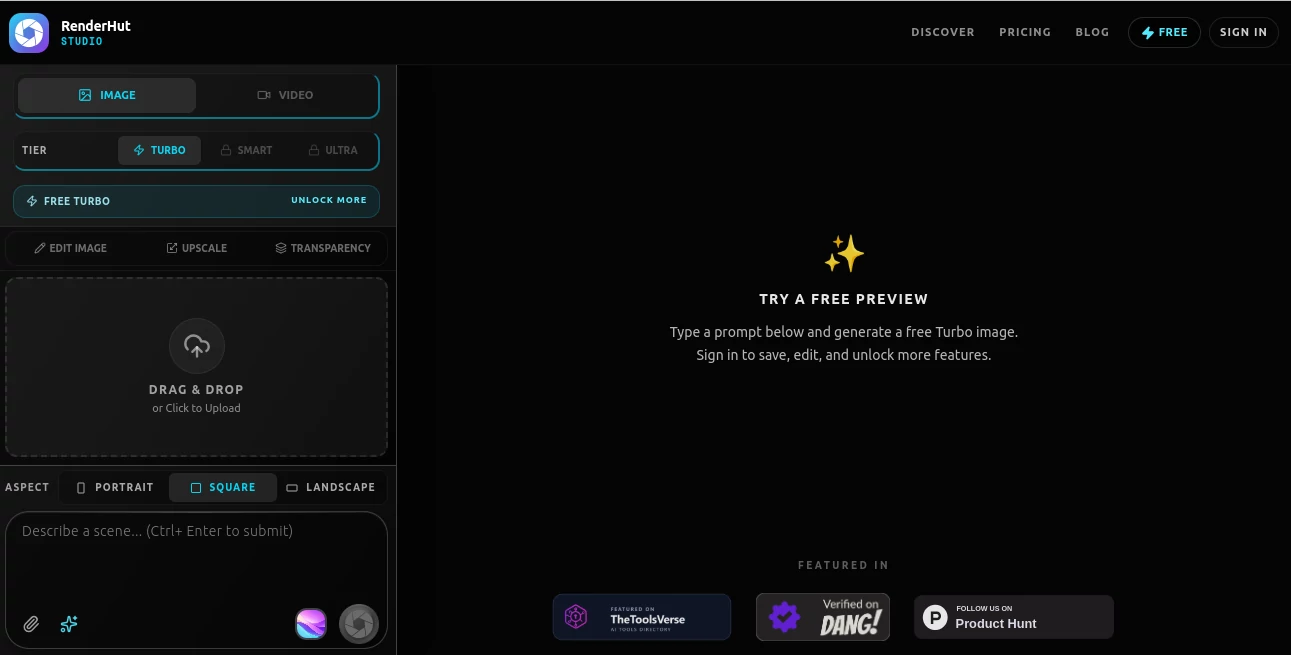
RenderHut is an AI-powered creative platform designed for generating images and videos with the help of modern generative technology. Instead of moving between several specialized applications for visual experimentation, creators can use a single environment to explore ideas and turn them into polished visual content.
The platform is particularly interesting for designers, marketers, content creators, and businesses that need visual material without making every project dependent on a lengthy traditional production workflow. Its focus on both image and video generation makes it suitable for everything from quick creative experiments to more developed visual concepts.
It is also part of Trinity Technologies' product portfolio, where it is described as a creative technology platform focused on digital experiences and rendering solutions. This gives the product a broader positioning than a simple image generator.
Key Features
- AI-assisted image generation for creating original visual concepts.
- AI video generation for developing motion-based creative content.
- A unified creative workflow for working with both images and videos.
- Useful for experimenting with visual ideas before committing to conventional production.
- Designed to support creators and businesses working on digital visual experiences.
- Suitable for a range of creative and commercial content projects.
User Interface
The platform is presented as a modern creative-generation environment rather than a complicated professional production suite. This makes the concept approachable for users who want to concentrate on the visual result instead of spending excessive time learning a complex interface.
For someone working on a campaign, product concept, social post, or visual prototype, a straightforward generation workflow can make the process feel considerably lighter. The emphasis is on getting from an idea to a usable visual output without unnecessary friction.
Accuracy & Performance
Generative image and video quality naturally depends on the model, prompt, source material, and type of scene being created. Results can therefore vary from one request to another. For creative work, however, the ability to rapidly produce and revise visual concepts is often just as valuable as producing a perfect result on the first attempt.
The combination of image and video generation is especially useful when a project needs multiple forms of visual content. A creator can explore an idea as a still image and then consider how that concept could translate into motion.
Capabilities
The strongest aspect of the platform is its broad visual focus. Rather than being limited to one narrow creative task, it brings AI image and video generation together in one product.
This can be useful when developing advertising concepts, visual storytelling, promotional material, digital experiences, or early-stage creative directions. For businesses, it can also provide a faster way to test several visual approaches before investing in a full production.
Security & Privacy
Users should review the platform's current privacy policy and terms before uploading confidential, proprietary, or sensitive material. As with any cloud-based generative service, understanding how submitted content is handled is an important part of choosing the right workflow.
For commercial projects, teams should also make sure that their prompts, uploaded assets, and generated materials are appropriate for the intended use and comply with applicable intellectual-property requirements.
Use Cases
There are plenty of situations where an image-and-video generation platform can save creative teams time. A marketing team might use it to explore several campaign directions before selecting one for production. A designer could generate visual references for a presentation or concept board. A content creator may use AI-generated visuals as the starting point for social media material.
It can also be useful for product demonstrations, promotional concepts, storytelling, digital campaigns, and visual experimentation. For example, someone preparing a presentation for a new product could quickly explore different visual directions instead of commissioning every concept separately.
Another practical use is prototyping. When an idea is still being discussed internally, generating a visual example can make the concept much easier for colleagues or clients to understand.
Pros and Cons
- Pros: Combines AI image and video generation in one creative platform.
- Pros: Useful for rapid visual experimentation and concept development.
- Pros: Can serve both individual creators and business-oriented creative projects.
- Pros: Reduces the need to switch between separate tools for different visual formats.
- Cons: Generative results can vary depending on the request and desired visual complexity.
- Cons: Users working with sensitive commercial assets should carefully review the platform's privacy and usage terms.
Pricing Plans
Pricing information was not clearly available in the publicly accessible version of the platform during research. Because generative platforms frequently change their credit systems, subscriptions, and usage limits, users should check the current offering inside the service before choosing a plan.
For teams considering the platform for regular production work, it is worth comparing the available generation limits and commercial-use conditions alongside the headline subscription price.
How to Use RenderHut
Getting started with an AI visual-generation platform generally involves creating an account, selecting the type of visual content you want to produce, and describing the desired result. A useful prompt should explain the subject, setting, visual style, composition, mood, and other details that matter to the project.
For example, instead of asking for a generic product image, a marketer could describe a modern product displayed on a minimalist studio set, with cinematic lighting and a premium commercial aesthetic. More specific instructions usually give the generation system a clearer creative direction.
Once a result is generated, users can evaluate it and refine their instructions to explore alternative versions. This iterative process is one of the most practical ways to work with generative media.
Comparison with Similar Tools
Many AI products specialize in a single type of generation, such as text-to-image or AI video creation. The main appeal here is the combination of both visual formats within the same creative ecosystem.
Dedicated image generators may offer deeper controls for particular still-image workflows, while specialized video platforms can provide more extensive motion-oriented features. However, users who regularly move between still concepts and video content may appreciate having both capabilities available through one platform.
The right choice ultimately depends on the project. For highly specialized production, a dedicated tool may be preferable. For broader creative exploration, having multiple visual-generation capabilities together can be more convenient.
Conclusion
RenderHut takes an appealing approach to AI-assisted creativity by bringing image and video generation together. Its value is not limited to producing a finished asset; the platform can also be useful during brainstorming, prototyping, campaign planning, and visual experimentation.
For creators and businesses that regularly need fresh visual ideas, reducing the distance between an initial concept and a tangible image or video can make the creative process much faster. It is a promising option for anyone looking to incorporate generative visuals into modern content workflows.
Frequently Asked Questions (FAQ)
What is RenderHut?
It is an AI-powered creative platform focused on image and video generation for creators and businesses.
Can it generate both images and videos?
Yes. The platform is positioned specifically around AI image and video generation, allowing users to work with both visual formats.
Who can benefit from this platform?
Content creators, designers, marketers, businesses, and creative teams can use it to explore concepts and produce visual content more efficiently.
Is it suitable for commercial projects?
It can be considered for commercial creative workflows, but users should review the current terms, licensing conditions, and usage rights before using generated material in paid campaigns or other commercial applications.
Does it replace traditional video production?
Not necessarily. AI generation can accelerate ideation and content creation, but professional projects may still require human direction, editing, post-production, branding, and other production work.
Is pricing information available?
The publicly accessible version of the platform did not provide enough current pricing information to state specific plans or prices reliably. Users should check the service directly for its latest pricing and usage options.
AI Photo & Image Generator , AI Image to Video , AI Video Generator , AI Video Editor .
These classifications represent its core capabilities and areas of application. For related tools, explore the linked categories above.

RenderHut Alternatives Product

Veo4

Image3

Gemini AI Ph…

HappyHorse A…

Seedream 4.0…

Mediagen

Nano Banana 2
seedance2-pro

Image to Ima…