
Sabato
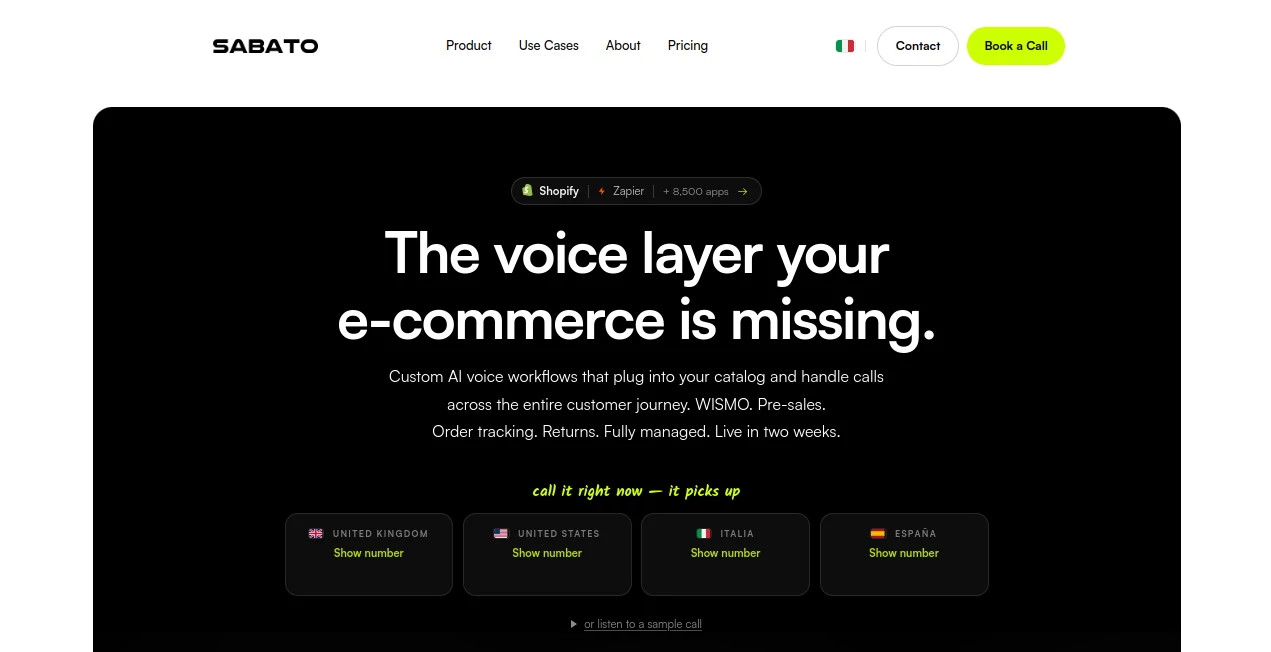
What is Sabato?
Sabato AI is a managed voice AI platform built specifically for e-commerce businesses that want to turn phone conversations into a useful part of the customer journey. Instead of asking store owners to build and maintain complicated voice agents themselves, the platform connects directly with the store's product and order data and provides pre-configured workflows for sales, support, order tracking, cart recovery, and other customer interactions.
The idea is refreshingly practical. An online store may have excellent product pages, fast checkout, and automated emails, yet customers still pick up the phone when they need a quick answer. This platform brings an AI-powered voice layer into that part of the experience. It is designed to operate around the clock and can be deployed in roughly two weeks, with the provider handling configuration, monitoring, and ongoing optimization.
Key Features
- Pre-configured voice workflows designed specifically for e-commerce.
- Real-time access to product catalog, pricing, inventory, and order information.
- Pre-sales consultation and product recommendation workflows.
- Cart abandonment recovery through outbound calls and messaging.
- Real-time order tracking assistance.
- Complaint capture and routing.
- Quote qualification and structured quote collection.
- Call transcripts, AI-generated summaries, search, filtering, and lead scoring.
- Integration with Shopify, Magento, WooCommerce, PrestaShop, and BigCommerce.
- SMS, WhatsApp, CRM, ERP, and PIM connectivity depending on the selected plan and workflow.
- Fully managed setup without requiring the store's team to build voice agents or write prompts.
User Interface
The experience is less about giving users a complicated dashboard and more about making the underlying voice service work with an existing store. Businesses provide their catalog and choose the workflows they need, while the service handles configuration, phone provisioning, testing, and launch.
For teams that want visibility into customer conversations, the platform also provides access to complete call transcripts, summaries, searchable call records, and lead scoring. That makes the system useful beyond answering calls. A store manager can look back at conversations and identify recurring product questions, buyer concerns, or points where customers are dropping out of the buying process.
Accuracy & Performance
Accuracy is especially important for an e-commerce voice agent because a wrong product detail, price, availability status, or order update can quickly create a poor customer experience. The platform addresses this by connecting its workflows to the store's catalog, pricing, inventory, and order information in real time.
Its performance model is also designed around availability rather than traditional business hours. The service is presented as a 24/7/365 voice layer, allowing customers to reach the store at night, during weekends, and on holidays. Calls can also be transcribed, scored, and summarized, giving businesses a way to review what happened after each interaction.
Businesses should still treat AI responses as part of an automated workflow rather than assuming that every answer will be perfect. The service's own terms note that it is not responsible for discrepancies between spoken AI responses and the actual inventory or pricing on a store.
Capabilities
The strongest part of the platform is its workflow-based approach. A store can use voice AI for pre-sales questions, where the assistant helps customers understand products and choose an appropriate option. It can also handle practical post-purchase questions such as checking an order's status.
For abandoned carts, the system can contact customers who left during checkout, understand what prevented the purchase, and send a checkout link through supported messaging channels. Another useful workflow qualifies quote requests by collecting requirements before sending structured information to the business team.
Customer service teams can also benefit from complaint workflows that collect the customer's issue, create a ticket with relevant context, and route it to the appropriate person. Returns, post-delivery feedback, and back-in-stock notifications are among the workflows listed as coming soon.
Security & Privacy
Because the platform works with customer conversations, product information, and order data, businesses should evaluate its data handling and contractual terms before connecting production systems. The service states that it connects with store and business systems to retrieve information needed by its workflows, while its terms describe the product as an automation and voice AI service for e-commerce merchants.
Businesses should also establish clear escalation rules and review how customer information is handled across connected systems before deployment. This is particularly important for stores processing sensitive customer or order information.
Use Cases
- Pre-sales support: Answer product questions, recommend suitable products, and help customers move toward checkout.
- Cart recovery: Contact customers who abandoned checkout and help resolve the reason behind the abandoned purchase.
- Order tracking: Give customers real-time information about their orders and reduce repetitive support requests.
- Customer complaints: Capture issues, gather relevant details, and route them to the appropriate team.
- Quote qualification: Collect requirements from potential buyers before the sales team becomes involved.
- Post-purchase engagement: Gather feedback after delivery and identify potential customer issues.
- Lead qualification: Use call information and lead scoring to identify high-intent prospects that deserve immediate attention.
- Product discovery: Help shoppers who would rather ask questions than search through a large product catalog.
Pros and Cons
Pros
- Designed specifically around e-commerce rather than generic voice automation.
- Connects voice workflows with catalog, inventory, pricing, and order information.
- Does not require the store's team to build or maintain the AI themselves.
- Supports practical sales and customer service workflows.
- Provides transcripts, summaries, search, filtering, and lead scoring.
- Designed for continuous availability throughout the year.
- Supports several major e-commerce platforms.
Cons
- The starting price is considerably higher than many self-service AI tools.
- The service is primarily aimed at established e-commerce businesses rather than casual users.
- Some workflows are still marked as coming soon.
- Available languages, integrations, and concurrency depend on the selected plan.
- Businesses should carefully evaluate data handling and AI accuracy before connecting sensitive production systems.
Pricing Plans
The pricing structure is aimed at businesses that want a managed service rather than a do-it-yourself voice platform.
- Store: Starts at €490 per month and includes up to approximately 1,000 minutes per month, one voice workflow, one language, Shopify native integration, catalog connectivity, product recommendations, call transcripts and summaries, lead scoring, and up to three concurrent calls.
- Merchant: Starts at €990 per month and includes up to approximately 2,200 minutes per month, three voice workflows, two languages, SMS or text follow-ups, human escalation workflows, order tracking, checkout summaries by text, and up to five concurrent calls.
- Enterprise: Starts at €1,990 per month and is intended for high-volume e-commerce operations. It adds unlimited workflows, five languages, custom ERP and PIM integrations, WhatsApp and SMS, a web channel widget, enterprise integrations, more than 100 concurrent calls, and an account manager.
The pricing makes the most sense for stores where missed calls, abandoned checkouts, repetitive support requests, or sales opportunities have enough financial value to justify a managed voice operation.
How to Use It
- Connect your store: Provide access to your e-commerce platform so the service can work with product, inventory, pricing, and order information.
- Select your workflows: Choose the customer journeys that matter most, such as pre-sales consultation, cart recovery, order tracking, or quote qualification.
- Configure business rules: Define escalation paths, workflow behavior, and the tone that should be used when interacting with customers.
- Test the calls: The service provisions phone numbers for the relevant markets and runs test calls before launch.
- Go live: Once the workflows are ready, the voice agents can begin handling customer interactions.
- Review conversations: Use transcripts, summaries, searchable records, and lead scoring to understand customer interactions and identify opportunities for improvement.
Comparison with Similar Tools
There is an important difference between a managed e-commerce voice service and a general-purpose voice AI builder. Generic platforms may give businesses the building blocks to create an agent, but the business is often responsible for designing workflows, connecting systems, testing behavior, and maintaining the setup.
This approach takes the opposite route. The workflows are prepared around common e-commerce situations, the service connects to the store's operational data, and ongoing management is included. That makes it particularly attractive to merchants that care more about having a working customer-facing voice system than experimenting with voice AI infrastructure.
The trade-off is cost. Businesses with an engineering team and highly customized requirements may prefer a DIY platform because it can provide greater control. For an e-commerce company that wants a managed solution with less internal engineering work, the higher monthly price may be easier to justify.
Conclusion
For e-commerce businesses, voice remains a valuable customer channel, particularly when shoppers need advice before purchasing or want a quick answer after placing an order. The strength of this platform is that it does not treat voice AI as a generic chatbot with a telephone number. Its workflows are built around real store operations, from product recommendations and checkout recovery to order tracking and customer complaints.
The managed model is another major advantage. Instead of assembling integrations, prompts, call infrastructure, and maintenance processes internally, businesses can provide their store data and let the service handle much of the operational work. The pricing will likely put it beyond the needs of small experimental projects, but for growing or high-volume stores, the combination of automation, customer support, and sales workflows makes it a compelling option to evaluate.
Frequently Asked Questions (FAQ)
What is this platform designed for?
It is a managed voice AI platform designed primarily for e-commerce businesses. It handles customer conversations across sales, support, order tracking, cart recovery, and other store workflows.
Does it integrate with Shopify?
Yes. Shopify is supported, and the Store plan includes native Shopify integration. The platform also lists Magento, WooCommerce, PrestaShop, and BigCommerce among its supported e-commerce platforms.
Can the voice agent access product information?
Yes. The platform is designed to connect to product catalog, pricing, inventory, and order information so that voice workflows can use current store data.
Does it require developers?
The service is designed as a fully managed solution and states that businesses do not need engineers or prompt-writing expertise to deploy its standard workflows.
Can it handle abandoned carts?
Yes. Cart abandonment recovery is one of the available workflows. The system can contact customers who abandoned checkout, address potential objections, and provide a checkout link through supported messaging channels.
Does it provide call transcripts?
Yes. Calls can be transcribed and summarized, while businesses can search and filter conversations and use lead scoring to identify high-intent buyers.
Is it available 24/7?
The service is designed to operate 24/7/365, including nights, weekends, and holidays.
How much does it cost?
Plans start at €490 per month for the Store tier, €990 per month for Merchant, and €1,990 per month for Enterprise. Features, minutes, languages, and concurrency increase with the higher plans.
How quickly can it be launched?
The company states that its standard implementation can go from kickoff to live operation in approximately two weeks.
Can customers be transferred to a human?
Human escalation workflows are included in the Merchant plan and are designed to route conversations to the appropriate human team when automation should no longer handle the interaction.
Is it suitable for every online store?
It is best suited to e-commerce businesses with enough customer call volume, product questions, sales opportunities, or support requests to benefit from automated voice interactions. Smaller stores may find the monthly managed-service pricing harder to justify.
AI Sales Assistant , AI Customer Service Assistant , AI E-commerce Assistant , AI Voice Assistants .
These classifications represent its core capabilities and areas of application. For related tools, explore the linked categories above.

Sabato Alternatives Product

LorePanic

MyReply

AlpacaBag

livetalktran…

Qwen3 TTS

Chatbots AI

SpeechGen AI

ReviewRespon…

Read PDF Alo…