


















Safe Appeals
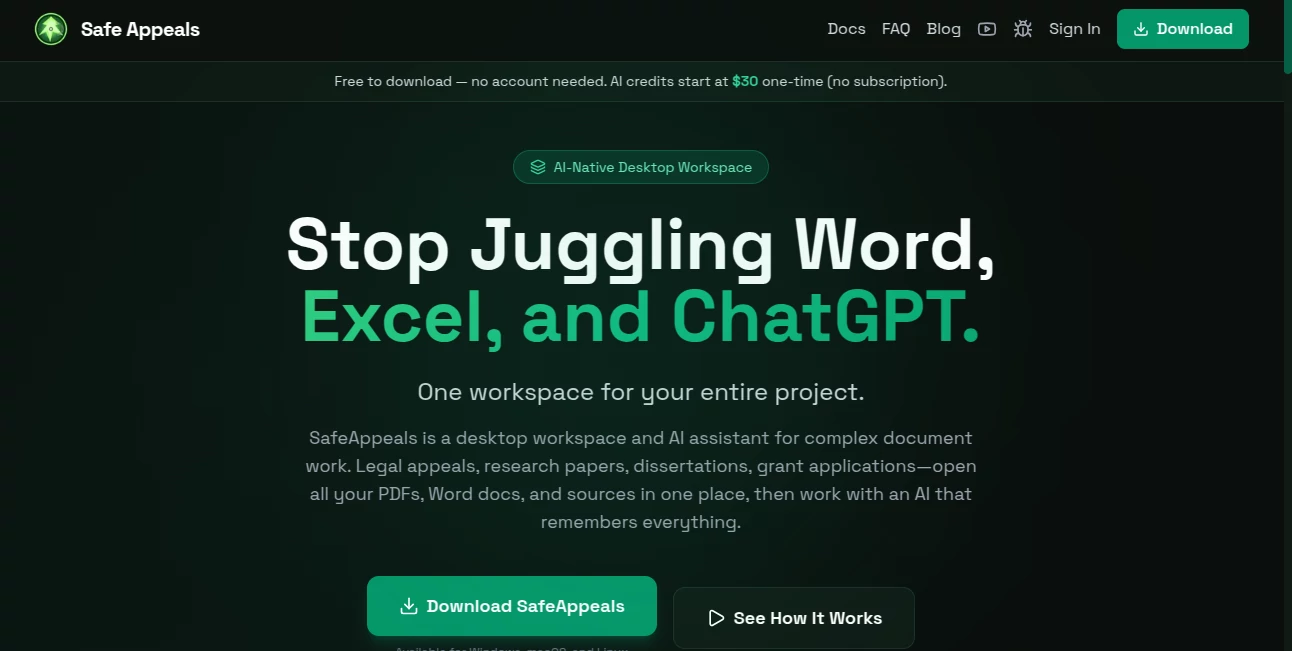
What is Safe Appeals?
Working with large collections of documents can quickly become overwhelming, especially when every file contains information that matters. Whether you're preparing legal paperwork, writing a dissertation, organizing research notes, or reviewing grant applications, switching between dozens of PDFs and text documents often slows down the entire process.
This AI-powered workspace is designed to solve that problem by bringing every document into one intelligent environment. Instead of treating files as isolated pieces of information, it connects them into a searchable knowledge base where conversations, summaries, references, and insights remain available throughout your project. The result is a smoother workflow that helps professionals, researchers, students, and legal users spend less time searching and more time thinking.
Rather than replacing human judgment, the platform acts as a research companion that keeps track of context, remembers previous discussions, and makes navigating complex document collections significantly easier.
Key Features
User Interface
The interface is clean, distraction-free, and built around productivity. Multiple PDFs and documents can be opened simultaneously, allowing users to compare information without constantly switching windows. Conversations with AI remain connected to the documents, making every interaction feel contextual instead of isolated.
Accuracy & Performance
The workspace supports advanced large language models while preserving the context of uploaded files. Instead of requiring repetitive prompts, it understands ongoing conversations and helps locate relevant information across extensive document collections. This greatly reduces the time spent manually reviewing lengthy materials.
Capabilities
- Analyze multiple PDFs and documents together.
- Maintain contextual AI conversations across projects.
- Assist with legal appeals and document preparation.
- Support dissertation and thesis research.
- Organize academic literature efficiently.
- Help draft grant applications and research papers.
- Search information across multiple files instantly.
- Create summaries from large document collections.
- Improve document organization and knowledge retrieval.
- Integrate access to powerful AI language models through a simple credit system.
Security & Privacy
User privacy receives significant attention. According to the platform's published policies, prompts and AI-generated responses are not used to train AI models. Users retain ownership of both their inputs and generated outputs, while payment processing and authentication rely on established third-party providers. The service also emphasizes that AI-generated content should always be reviewed before making legal or professional decisions.
Use Cases
- Preparing legal appeal documentation.
- Managing workers' compensation case files.
- Writing dissertations and graduate theses.
- Conducting academic literature reviews.
- Creating research papers with supporting references.
- Preparing grant proposals.
- Organizing complex business documentation.
- Reviewing lengthy PDF collections for important insights.
Pros and Cons
Pros
- Excellent for handling multiple documents simultaneously.
- AI remembers project context across conversations.
- Supports research-heavy workflows.
- Useful for both legal and academic professionals.
- Flexible credit-based payment model without subscriptions.
- Users keep ownership of their generated content.
Cons
- Internet connectivity is required for cloud AI features.
- AI-generated information still requires human verification.
- Not intended to replace legal or professional advice.
- Heavy document analysis depends on the selected AI model.
Pricing Plans
The platform uses a pay-as-you-go credit system instead of monthly subscriptions. Users can purchase credit packs that provide access to multiple AI language models. Credits do not expire, making the pricing suitable for occasional as well as professional users. A free bring-your-own-API option is also available for those who prefer using their own AI provider credentials.
How to Use Safe Appeals
Begin by creating an account and selecting either the free API option or purchasing AI credits. Upload the PDFs, Word documents, or research materials you want to analyze. Open multiple files inside the workspace and start asking questions in natural language. The AI can summarize documents, locate supporting information, compare sections, and maintain context throughout your research session. As your project grows, the workspace continues organizing conversations alongside your documents, making future research considerably faster.
Comparison with Similar Tools
Unlike traditional PDF readers that simply display documents, this platform transforms document collections into an interactive AI workspace. Compared with generic AI chatbots, it focuses heavily on persistent document memory, contextual conversations, and long-form research workflows. This makes it especially valuable for professionals working with legal files, academic publications, or extensive documentation where context is just as important as individual answers.
Conclusion
Managing complex documents requires more than keyword search and simple note-taking. By combining intelligent document organization with modern language models, this workspace creates an environment where research becomes faster, collaboration becomes easier, and valuable information is never far away. For legal professionals, researchers, graduate students, and anyone dealing with large volumes of documentation, it provides a thoughtful balance between AI assistance and human control while encouraging users to verify important information before relying on it.
Frequently Asked Questions (FAQ)
Can it analyze multiple PDF files together?
Yes. Multiple documents can be opened simultaneously, allowing AI to work across the entire collection.
Is it suitable for academic research?
Yes. It is designed to support dissertations, research papers, literature reviews, and grant writing.
Does it replace professional legal advice?
No. The platform clearly states that AI-generated content should not be treated as legal advice and should always be reviewed by qualified professionals.
How does the pricing work?
Instead of subscriptions, users purchase credits that can be used whenever needed. Credits remain available until they are consumed.
Are my prompts used for AI training?
According to the published privacy information, prompts and AI responses are not used to train AI models.
AI PDF , AI Documents Assistant , AI Research Tool , AI Legal Assistant .
These classifications represent its core capabilities and areas of application. For related tools, explore the linked categories above.

Safe Appeals Alternatives Product

Zloth

AI Complianc…

Robux Tax Ca…

AyeWatch AI

JFIF to JPG …

AI text clea…

DiRe-RAPIDS

Lynote

Remove My Me…
