
Section Coach
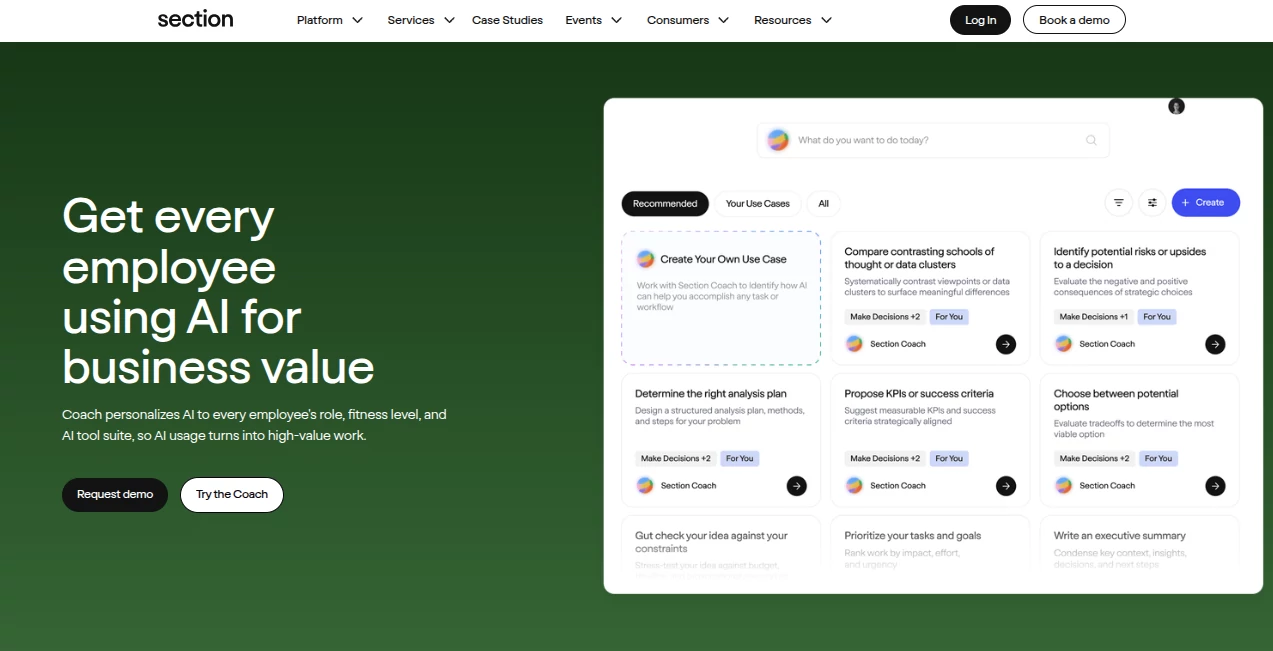
What is Section Coach?
Section Coach is designed for organizations that have invested in AI tools but need their employees to turn those tools into meaningful improvements in everyday work. Instead of treating AI education as a one-time course, it provides personalized coaching based on an employee's role, industry, experience, and current AI skill level.
The platform focuses on practical adoption. Employees can move from basic prompting to more advanced workflows and agent-building skills while discovering AI applications that make sense for the work they actually perform. This makes it particularly useful for companies trying to move beyond simply giving employees access to AI.
Its approach is hands-on rather than passive. Employees practice skills directly, while organizations can use certification and insights to understand whether AI training is translating into stronger capabilities across the workforce.
Key Features
- Personalized AI coaching: Learning is adapted to an individual's role, industry, and existing AI skill level.
- Role-specific use cases: Employees can discover practical ways to apply AI to the responsibilities they already handle.
- AI proficiency development: The learning journey can take employees from basic prompting toward advanced AI workflows and agents.
- Hands-on practice: Interactive exercises encourage employees to actually work with AI rather than simply watch training material.
- Certification: Organizations can establish a shared standard for AI proficiency and track employee progress.
- AI use-case discovery: The platform helps identify opportunities where AI can create greater value in different roles.
User Interface
The experience is built around guided learning and practical interaction rather than a complicated collection of enterprise dashboards. Employees receive coaching appropriate to their level, allowing someone who is just beginning with AI to start with fundamentals while a more experienced user can continue toward sophisticated workflows.
That role-based approach is important in a large organization. A marketer, engineer, manager, or operations professional does not necessarily need the same AI lessons. By connecting learning to the employee's actual responsibilities, the experience feels more relevant and easier to apply.
Accuracy & Performance
The value of this platform is less about producing a single AI-generated answer and more about helping people become better users of AI. Its coaching model is designed around practical skill development, use-case discovery, and measurable proficiency.
The company reports examples of organizations using the platform at significant scale. Havas, for example, deployed the coaching platform across its network and reported reaching 72% proficiency within a few months, with several countries reaching 100% proficiency. These results are organization-specific rather than a guarantee for every customer, but they demonstrate the platform's focus on measurable adoption rather than training completion alone.
Capabilities
A major strength is the breadth of the learning journey. Employees can begin with effective prompting and gradually progress toward building AI-powered workflows and agents. This gives companies a way to develop AI capabilities without assuming that everyone starts with the same level of experience.
The platform also emphasizes identifying high-value use cases. Rather than encouraging employees to use AI simply because it is available, coaching connects AI capabilities with the tasks and problems employees encounter in their normal working day.
For organizations adopting rapidly changing AI tools, this matters. New models, assistants, and agent capabilities can make yesterday's training obsolete. The platform is designed to help employees continue developing their skills as the AI landscape changes.
Security & Privacy
Enterprise privacy is an important consideration because employee information and organizational data may be involved in AI training and analytics. According to the platform privacy notice, the customer's organization acts as the controller of personal information while the provider processes that information on the customer's behalf.
The platform's published subprocessor information states that AI requests are routed through an LLM gateway under zero-retention arrangements for the listed foundation-model providers. It also states that customer data stored through the platform uses encryption at rest, while payment card information for individual self-serve purchases is handled directly by Stripe rather than stored by the platform.
Organizations should still review the current privacy notice, contractual terms, and data-processing arrangements against their own security requirements before deployment.
Use Cases
- Company-wide AI adoption: Give employees a structured path to becoming confident AI users.
- Employee upskilling: Develop practical AI capabilities without requiring every employee to follow the same learning path.
- AI proficiency programs: Establish measurable standards for workforce AI skills.
- Manager enablement: Help leaders understand how AI can be incorporated into their teams' daily work.
- Workflow improvement: Find opportunities where AI workflows or agents can reduce repetitive work.
- Large enterprise rollouts: Support AI education across different departments, roles, and geographic regions.
Pros and Cons
Pros
- Personalized coaching based on role and skill level.
- Strong emphasis on practical, hands-on learning.
- Supports progression from prompting to AI agents and workflows.
- Useful for organization-wide AI adoption.
- Includes certification and proficiency-focused learning.
- Designed around business use cases rather than generic AI theory.
Cons
- The enterprise-oriented approach may be more than an individual casual AI user needs.
- Organizations may need to invest time in aligning the platform with their internal AI strategy.
- Pricing is not publicly presented as a simple standard plan on the product page, so companies may need to contact the provider for an appropriate commercial arrangement.
- The greatest value is likely to appear when employees actively participate in the learning process rather than treating it as mandatory passive training.
Pricing Plans
Pricing information is not presented on the public product page as a straightforward list of standard plans and prices. The offering is positioned primarily for organizations and enterprise-scale AI adoption, with companies encouraged to request a demonstration or discuss their requirements directly.
Individual self-serve purchases are supported according to the platform's privacy documentation, while enterprise access is invoiced. Because pricing can depend on organizational size, requirements, and deployment model, prospective customers should request current pricing directly rather than relying on outdated third-party figures.
How to Use Section Coach
- Create or arrange access for your organization or team.
- Employees begin with an assessment of their existing AI experience and skill level.
- The platform adapts coaching to the employee's role, industry, and capabilities.
- Complete practical exercises and apply AI to realistic work scenarios.
- Progress from effective prompting toward more advanced workflows and agent-building skills.
- Use certification and organizational insights to understand progress and identify additional opportunities for AI adoption.
Comparison with Similar Tools
Many AI learning platforms focus primarily on courses, tutorials, or general-purpose educational content. This approach is different because the emphasis is on connecting AI skills with an employee's actual role and the business problems they encounter.
For example, a traditional AI course might teach everyone the same prompting techniques. A personalized coaching approach can instead ask what an employee actually does and then guide them toward useful applications for those responsibilities. That distinction becomes increasingly important as organizations move from AI experimentation to company-wide adoption.
The platform also sits between training and transformation. It does not simply teach employees what AI is; it aims to help them change how they work with AI, identify useful workflows, and progress toward more advanced agentic capabilities.
Conclusion
For organizations struggling with the gap between purchasing AI technology and getting employees to use it effectively, this platform offers a practical solution. Its strongest idea is simple: AI training becomes more valuable when it is connected to the person's actual job.
The combination of personalized coaching, hands-on practice, proficiency development, certification, and use-case discovery makes it particularly relevant for companies building an AI-capable workforce. It is not simply another library of AI lessons. The focus is on changing everyday behavior and helping employees find productive ways to incorporate AI into their work.
For a business rolling out AI across multiple teams, that focus can make the difference between having AI tools available and actually seeing employees use them to create measurable value.
Frequently Asked Questions (FAQ)
What is Section Coach?
It is an AI coaching platform designed to help employees develop practical AI skills and apply them to their specific roles and responsibilities.
Who is it designed for?
The platform is primarily designed for organizations that want to improve AI proficiency and adoption across their workforce, from employees and managers to larger enterprise teams.
Can employees learn AI at different skill levels?
Yes. Coaching is personalized around an employee's current AI skill level, role, and industry, allowing beginners and more experienced users to follow different paths.
Does it teach AI agents?
Yes. The learning journey can progress from effective prompting toward building agentic workflows and more advanced AI applications.
Does it provide certification?
Yes. Certification is part of the platform's approach to measuring and establishing AI proficiency within organizations.
Is it suitable for large companies?
Yes. The product is specifically positioned for organization-wide adoption. The provider highlights deployments involving large workforces, including Havas, which has used the platform across its global network.
Is pricing publicly available?
A standard public price list is not displayed on the product page. Organizations can contact the provider to discuss their requirements and obtain current pricing.
Does the platform focus only on prompting?
No. Prompting is presented as an early stage of the learning journey. The platform also covers practical use cases, workflows, and progression toward AI agents.
AI Knowledge Management , AI Productivity Tools , AI Education Assistant , AI Coaching .
These classifications represent its core capabilities and areas of application. For related tools, explore the linked categories above.
Section Coach details
Website unavailable — View Alternatives
Pricing
- Freemium
Apps
- Web App
Categories

Section Coach Alternatives Product

PineBill

UPDF AI

Your Own AI

YouTube Thum…

Motion

VercelAPP

LorePanic

Fina Money

Ryne AI