
SemanticGuard
What is SemanticGuard?
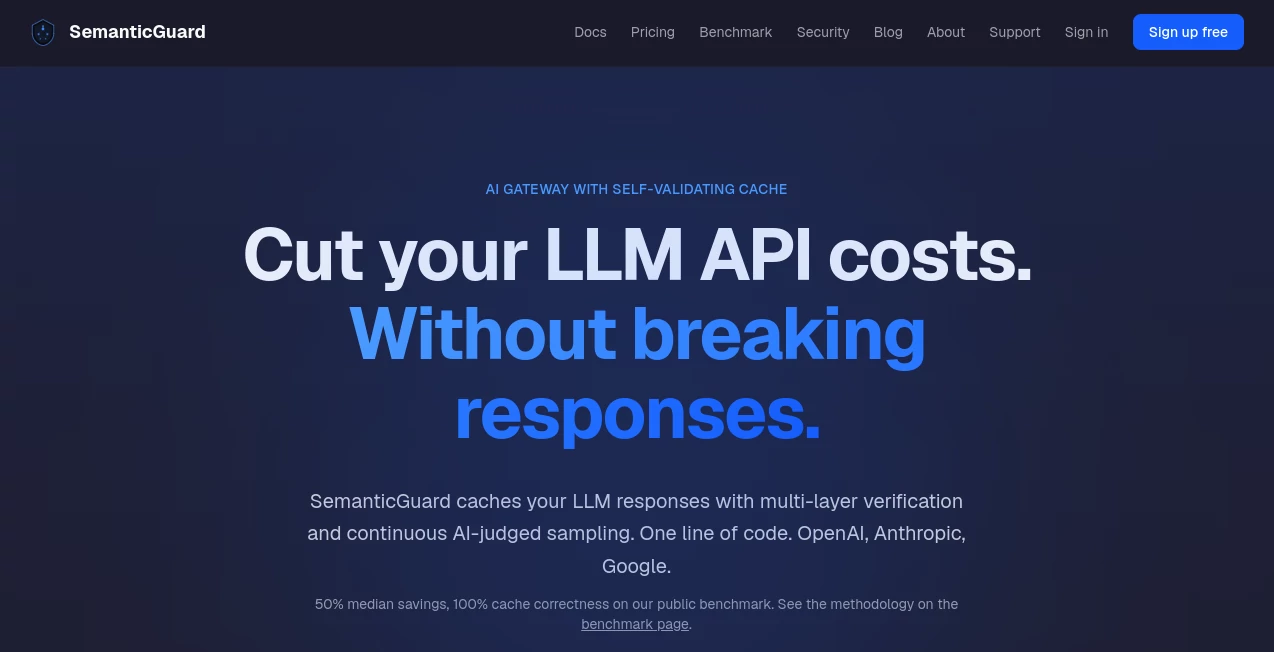
In today’s rapidly evolving AI ecosystem, integrating large language models into real-world applications brings both opportunity and risk. One of the most overlooked challenges is ensuring that AI systems remain secure, reliable, and resistant to malicious input. This is where this platform steps in, offering a powerful safeguard layer designed to monitor, filter, and protect AI interactions in real time.
Instead of leaving developers to manually handle unpredictable model behavior or prompt injection risks, it introduces a structured safety layer that sits between users and AI systems. The result is a more stable, enterprise-ready AI experience that feels both natural and controlled.
Key Features
User Interface
The interface is intentionally minimal and developer-friendly. It avoids unnecessary complexity while giving full visibility into incoming prompts, flagged content, and system responses. Developers can quickly configure policies without deep security expertise.
Accuracy & Performance
Performance is optimized for real-time environments. The system evaluates inputs with low latency, ensuring that AI responses are not delayed. Its detection logic focuses on high accuracy, reducing both false positives and missed threats.
Capabilities
- Prompt injection detection and prevention
- Content filtering based on customizable rules
- AI output validation and moderation
- Policy enforcement across multiple AI endpoints
- Real-time request inspection
Security & Privacy
Security is the core focus. The system is designed to operate without storing sensitive user data unnecessarily. It processes requests in a way that aligns with modern privacy expectations, making it suitable for enterprise-grade deployments.
Use Cases
- Protecting chatbots from malicious prompt manipulation
- Securing AI-powered SaaS applications
- Filtering user-generated content in AI systems
- Ensuring compliance in enterprise AI workflows
- Monitoring AI outputs in customer-facing platforms
Pros and Cons
Pros
- Strong protection against prompt injection attacks
- Easy integration into existing AI pipelines
- Low latency processing
- Flexible policy configuration
Cons
- Advanced customization may require technical understanding
- Best results achieved in structured AI environments
Pricing Plans
The platform typically follows a scalable pricing model depending on usage volume and enterprise requirements. Smaller projects can start with basic protection layers, while larger organizations can opt for advanced security configurations and dedicated support.
How to Use the tool
Getting started is straightforward. Developers integrate the security layer into their AI workflow by routing requests through its validation system. Once connected, every prompt and response is automatically inspected based on defined rules. Over time, teams can refine policies to better match their application needs.
A typical setup involves connecting the API, defining moderation rules, and enabling real-time monitoring dashboards. From there, the system works silently in the background, protecting the application without affecting user experience.
Comparison with Similar Tools
Compared to traditional moderation systems, this solution is more focused on AI-native threats rather than generic content filtering. While many tools only scan output text, this approach evaluates both input prompts and model responses, offering a deeper level of protection. It is especially suited for applications that rely heavily on large language models and need robust guardrails.
Conclusion
As AI adoption continues to grow, security and reliability become just as important as model performance. This platform provides a practical and developer-friendly way to protect AI systems from manipulation, misuse, and unexpected behavior. For teams building production-grade AI applications, it adds an essential layer of trust and stability.
Frequently Asked Questions (FAQ)
What makes this platform different from standard content filters?
It focuses specifically on AI-related threats such as prompt injection and model manipulation, rather than only filtering keywords or general content.
Can it be integrated into existing AI applications?
Yes, it is designed to work with modern AI stacks and can be added as a middleware layer between users and AI models.
Does it slow down AI responses?
No, it is optimized for low-latency processing to ensure real-time performance is maintained.
Is technical expertise required to use it?
Basic integration requires development knowledge, but ongoing management is designed to be simple and accessible.
Is user data stored?
The system is designed with privacy in mind and minimizes unnecessary data retention during processing.
AI Testing & QA , AI API Design , Large Language Models (LLMs) , AI Developer Tools .
These classifications represent its core capabilities and areas of application. For related tools, explore the linked categories above.

SemanticGuard Alternatives Product

vivgrid

Claude and C…

Defapi

Discord Time…

Latency Atlas

Sourcetable

ClawBridge

AgentOne
Timestamp Ro…