


















Shhots AI
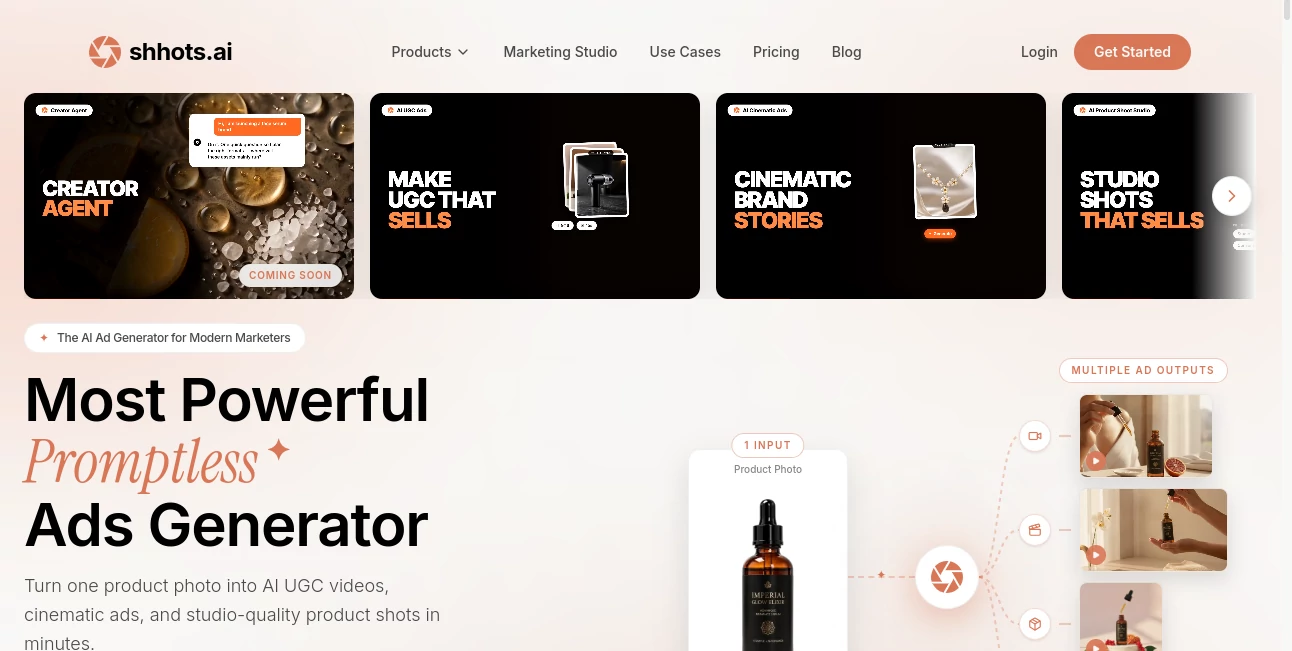
What is Shhots AI?
Creating good advertising content usually takes more than having a good product. You need product photography, video footage, scripts, different aspect ratios, social media creatives, and enough variations to keep testing fresh ideas. That process can become expensive and surprisingly slow, especially for small ecommerce teams and marketers running several campaigns at once.
Shhots AI takes a much simpler approach. Start with a product photo, a product URL, or a connected Shopify catalog, and the platform can turn that starting point into advertising images, UGC-style videos, cinematic creatives, product photography, and short-form content. The workflow is designed to reduce the amount of prompting, editing, and production work normally required to get an ad ready.
One particularly useful detail is that the same product asset can be adapted for multiple channels. A marketer preparing a campaign for Instagram, TikTok, Facebook, Google, or YouTube does not necessarily need to build every creative from scratch. The platform handles different formats and provides outputs intended for specific advertising environments.
The service says it is used by more than 10,000 marketers and has generated more than one million AI ads. Its average generation time is advertised as under two minutes for the overall workflow, while individual image and video generation times vary depending on the type of asset.
Key Features
- Generate advertising images and videos from a single product photo.
- Create UGC-style advertising videos without hiring a creator.
- Produce cinematic product advertisements with AI-generated scenes and motion.
- Generate studio-style product photography and lifestyle visuals.
- Create short faceless videos with AI voiceovers and captions.
- Support for advertising formats across Facebook, Instagram, TikTok, Google, LinkedIn, YouTube, Shopify, and other channels.
- More than 22 ready-to-use image advertising templates.
- Unlimited automatic captions on videos.
- 4K image upscaling.
- Watermark-free exports.
- Commercial licensing included with the paid plans.
- AI-generated UGC available in 12 languages.
- Access to multiple generative video and image models through one workspace.
User Interface
The interface is built around a straightforward production workflow rather than a complicated creative suite. Instead of asking users to construct a detailed prompt for every shot, the platform starts with the product itself and handles much of the creative planning automatically.
A typical workflow can begin with one clean product image. Users can also paste a product URL or use a Shopify product page. From there, the system analyzes the product, determines an appropriate creative direction, and generates advertising assets. This makes the platform particularly appealing to ecommerce owners who want to move quickly without becoming video editors or prompt specialists.
The emphasis on fewer steps is one of its strongest practical advantages. Someone testing several products can spend less time preparing production briefs and more time deciding which creative concepts are worth testing.
Accuracy & Performance
Performance depends on the selected generation type, but the platform is designed around relatively fast advertising production. The company states that AI images typically render in around 30 to 60 seconds, while UGC advertisements can take approximately four to eight minutes depending on their length.
The underlying model selection is another interesting part of the service. Its creative workspace brings together models including Veo 3, Seedance 2.0, Kling 3.0, Nano Banana Pro, and ChatGPT Image 2. The platform can route creative tasks toward an appropriate model, while users can also work with different models through the same environment.
For marketers, the practical benefit is less about knowing which model is technically strongest and more about having several current generation systems available without managing separate subscriptions and workflows.
Capabilities
The platform covers considerably more than simple image generation. Product photographs can become static advertisements, UGC-style videos, lifestyle scenes, cinematic product videos, and other marketing assets.
Its Product Video Shoot workflow can turn product imagery into short advertising videos with UGC-style hooks, product-focused presentations, or cinematic motion. There is also a short-video workflow for creating faceless videos with AI voiceovers and on-screen captions in formats such as 9:16, 16:9, and 1:1.
For ecommerce teams, the Shopify workflow is especially convenient. A Shopify product page URL can be used without requiring a separate store connection, making it possible to create advertising material for individual products directly from their product pages.
The platform also provides access to multiple image and video generation models in one workspace. This is useful when a campaign requires different visual styles rather than one fixed generation approach.
Security & Privacy
The privacy policy states that submitted prompts, product images, brand assets, and generated outputs are processed to provide the service. It also states that customer inputs and outputs are not used to train or improve AI models.
Inputs and outputs are generally processed transiently, although saved outputs remain available in a user's account or workspace. The service also states that it does not sell personal information and uses safeguards such as encryption in transit and access controls.
Payment information is handled by third-party payment processors rather than storing full card numbers or CVV information directly. Users working with commercial product assets should still review the current privacy policy and terms before uploading confidential material.
Use Cases
Ecommerce advertising: Online stores can transform existing product photographs into multiple advertising concepts without organizing a traditional photoshoot for every campaign.
Social media campaigns: Marketing teams can create vertical video creatives for TikTok, Instagram Reels, and other short-form platforms while also producing square and landscape versions for different placements.
UGC-style advertising: Brands that want creator-style advertising but do not want to coordinate with multiple creators can experiment with AI-generated UGC concepts.
Product launches: A new product can quickly receive lifestyle imagery, product advertisements, short videos, and social creatives from a small amount of source material.
Ad testing: Media buyers can produce multiple creative variations instead of repeatedly modifying one advertisement. This can be useful when testing different hooks, scenes, formats, or visual approaches.
Agencies: Agencies handling several clients can use shared credits, commercial licensing, watermark-free exports, and higher-volume plans to produce a larger number of assets.
Faceless content: Creators can turn a storyline into a short faceless video with generated narration and captions without appearing on camera.
Pros and Cons
Pros
- Very simple product-to-ad workflow.
- Does not require detailed prompts for the main advertising workflow.
- Combines image, video, UGC, and product photography features.
- Supports multiple major generative AI models in one workspace.
- Commercial licensing is included in paid plans.
- Exports are watermark-free.
- Useful range of advertising aspect ratios and platforms.
- Shopify product URLs can be used directly.
- Unlimited video auto-captions are included.
Cons
- Video generations consume substantially more credits than individual product images.
- Users producing large quantities of video creatives may need a higher-tier plan.
- AI-generated advertising still benefits from human review before publication.
- Some advanced features shown on the platform are marked as coming soon.
Pricing Plans
The pricing structure is based on monthly credits shared across the platform's different features. Monthly billing starts at $19, while annual billing offers lower effective pricing on the available plans.
Starter – $19/month: Includes 2,000 monthly credits, up to 175 product images, several UGC and cinematic advertisements, 12-language UGC generation, unlimited video captions, 22+ image ad templates, commercial licensing, watermark-free exports, and email support.
Pro – $49/month: Includes 6,000 monthly credits, up to 530 product images, higher UGC and cinematic video allowances, commercial licensing, watermark-free exports, and additional features such as the MCP server for Claude and ChatGPT.
Scale – $99/month: Provides 12,000 monthly credits, higher production limits, priority processing, priority support, commercial licensing, watermark-free exports, and access to the MCP server.
Done-for-You – $499/month: For teams that prefer a managed production service, this option includes 30 finished AI UGC and product videos every 30 days, approved hooks and scripts, multiple aspect ratios, 50 AI image generations, and commercial licensing.
Enterprise and agency packages are also available for organizations producing more than 200 assets per month. These can include bulk credit pricing, API access, dedicated account management, and custom Shopify integration.
How to Use the Platform
Start by uploading a clean product image, pasting a product URL, or using a Shopify product page. A single product image can be enough to begin the creative workflow.
Next, select the type of advertising asset you want to produce. Depending on the workflow, the system can create product imagery, static ads, UGC videos, cinematic advertisements, or short-form content.
The platform then analyzes the product and handles much of the creative process, including elements such as the scene, script, motion, and voiceover. This is where the promptless approach becomes useful: you can focus on the campaign goal rather than writing elaborate generation instructions.
Once the asset is ready, review the result and download the version that fits your campaign. The available formats are designed for common advertising and social media placements, including portrait, square, and landscape formats.
For a real campaign, it is worth generating several variations rather than immediately choosing the first result. A different hook, scene, or format can make a meaningful difference when testing creative performance.
Comparison with Similar Tools
Traditional AI image and video generators are often designed around creative experimentation. They can be excellent when the user wants precise control over a visual concept, but advertising production can require additional work after generation. Scripts need to be written, scenes selected, formats adjusted, captions added, and assets prepared for different platforms.
This platform takes a more specialized route. Instead of positioning itself primarily as a general creative generator, it focuses on turning product information into marketing-ready assets. The combination of product photography, static advertising, UGC, video generation, captions, multiple aspect ratios, and commercial exports makes the workflow particularly relevant to ecommerce and performance marketing.
Another notable distinction is its multi-model workspace. Rather than forcing users to maintain separate accounts for several generation systems, the platform brings several current image and video models together under one subscription. For marketers who value convenience and rapid testing over manual model management, that can be a meaningful advantage.
It is not necessarily the right choice for every creative professional. A filmmaker, designer, or advanced AI artist who needs granular control over every generation parameter may prefer a more specialized production environment. For marketers who care primarily about getting usable advertising variations out quickly, however, the workflow is considerably more focused.
Conclusion
For ecommerce brands and performance marketers, the biggest challenge is often not creating one attractive advertisement. It is creating enough good variations to keep campaigns moving. That is where this platform makes the strongest case for itself.
Starting from a product image or URL, users can move toward product photography, static advertisements, UGC videos, cinematic creatives, captions, and short-form content without assembling a collection of separate tools. The multi-model setup adds another layer of flexibility, while commercial licensing and watermark-free exports make the generated material easier to use in real campaigns.
The $19 Starter plan also gives smaller brands an accessible way to test the workflow before moving to Pro or Scale. For agencies and high-volume ecommerce operations, the larger credit pools and enterprise options make more sense.
It is still important to treat AI-generated advertising as creative material rather than a finished campaign strategy. Human review, brand consistency, factual checks, and performance testing remain essential. Used that way, this platform can become a practical production layer for teams that need more advertising content without adding another traditional photography or video-production cycle.
Frequently Asked Questions (FAQ)
What is an AI ad generator?
An AI ad generator creates advertising assets such as images, videos, scripts, voiceovers, and social creatives using artificial intelligence. The platform reviewed here focuses specifically on turning product assets into advertising content for ecommerce and marketing campaigns.
Can I create UGC-style advertisements?
Yes. UGC-style advertisements are one of the platform's main workflows. The service supports AI-generated UGC advertisements in 12 languages and provides different video lengths depending on the subscription plan and available credits.
Can I use the generated content commercially?
Yes. The paid plans include a full commercial license, and generated assets are exported without watermarks. This allows the content to be used for paid advertising, organic social posts, ecommerce stores, and client work, subject to the applicable terms.
Does it support Shopify products?
Yes. Users can paste a Shopify product page URL and generate advertising assets without installing a separate Shopify application or connecting the entire store.
Which AI models are available?
The platform currently provides access to several generative models, including Veo 3, Seedance 2.0, Kling 3.0, Nano Banana Pro, and ChatGPT Image 2. The available model lineup may change as newer generation systems are added.
How much does it cost?
The paid plans currently start at $19 per month for Starter, followed by Pro at $49 per month and Scale at $99 per month. There is also a $499 monthly done-for-you option and custom enterprise packages for higher-volume teams.
AI Ad Generator , AI Video Generator , AI Advertising Assistant , AI UGC Video Generator .
These classifications represent its core capabilities and areas of application. For related tools, explore the linked categories above.

Shhots AI Alternatives Product

DomoAI

Leonardo.ai

LPM 1.0

Happy Horse:…

hailuo03

Wurt.app
FastMoro AI

UniVideo

Seedance 2.0…
