songapi.dev
What is songapi.dev?
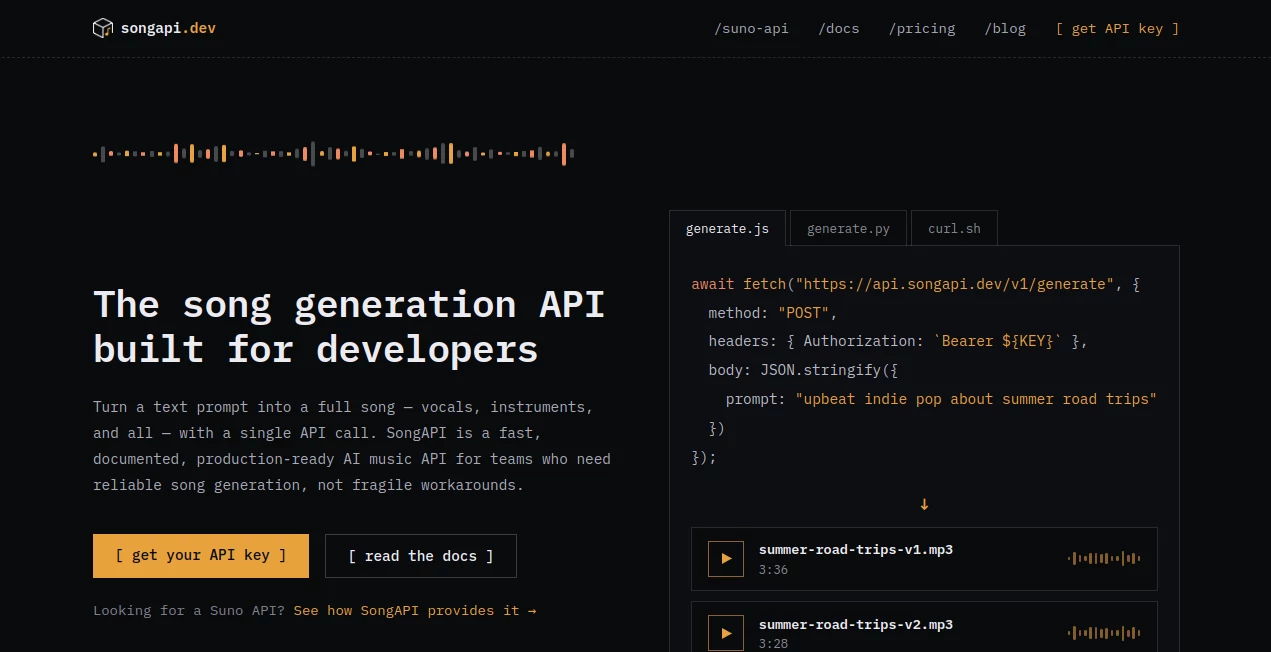
SongAPI is a developer-focused AI music API that turns text prompts into complete songs with vocals, instruments, and musical structure. Instead of building a music-generation workflow around a consumer-facing interface, developers can connect the service directly to their applications through a documented REST API.
The platform is particularly interesting for teams building music products, creative applications, content platforms, games, marketing tools, or automated media workflows. A simple prompt can describe the genre, mood, lyrics, or structure, while the API handles the generation process and returns a finished audio track.
What makes the service practical is its focus on integration rather than experimentation. There is no need to manage browser sessions, cookies, or CAPTCHAs, and developers can test their implementation through a free sandbox before moving to live generation.
Key Features
- Text-to-song generation with vocals and instrumentation.
- Custom lyrics support for more control over generated tracks.
- Standalone AI lyrics generation.
- Song extension from an existing point in a track.
- Cover and restyling capabilities for changing the character of a song.
- Ability to add vocals to instrumental tracks.
- REST API designed for backend integrations.
- Signed webhooks for receiving generation results without constant polling.
- Free sandbox access for integration testing.
- Production-oriented concurrency for applications handling multiple requests.
User Interface
This is primarily a developer service, so the main experience is built around its API, documentation, dashboard, and integration workflow rather than a traditional music-production interface. The setup is straightforward: create an account, obtain an API key, describe the desired song, and process the resulting generation through your application.
The documentation provides examples for common development environments, including JavaScript, Python, and cURL. That makes the first integration relatively approachable even if a team does not want to spend hours figuring out an unfamiliar API.
Accuracy & Performance
For an API-based music service, reliability is just as important as the quality of the generated audio. Requests are handled asynchronously, allowing an application to submit a generation and monitor its progress rather than keeping a request open until the song is finished.
Developers can either check the generation status or use webhooks to receive a notification when the track is ready. The API supports up to 300 requests per minute per key, while generation concurrency depends on the account level. This makes the platform better suited to automated products than a workflow designed around occasional manual generations.
Capabilities
The feature set goes beyond simply creating a song from a sentence. Developers can generate full tracks, create lyrics separately, extend existing songs, create restyled versions, and add vocals to instrumental material. This gives a single integration enough flexibility for applications that need several stages of an AI music workflow.
For example, a developer could build an application where a user selects a genre and mood, enters a short idea, generates lyrics, and then turns those lyrics into a complete track. Another product could automatically create background music for videos or generate personalized songs as part of a larger content experience.
Security & Privacy
Authentication uses bearer API keys, with separate live and sandbox keys. The documentation specifically recommends keeping API keys out of client-side code and making requests from a backend environment instead.
The sandbox uses the same endpoints and schemas as the live environment, allowing developers to test their integration without spending credits. Failed live generations are also automatically refunded, which provides an additional layer of protection against losing credits when a generation does not complete successfully.
Use Cases
- Music applications: Add automated song creation directly inside a web or mobile product.
- Content creation: Generate original music for videos, campaigns, stories, and other digital content.
- Game development: Create music-generation features for interactive experiences.
- Marketing: Produce customized songs for campaigns, promotions, or personalized customer experiences.
- Creative platforms: Give users the ability to turn ideas, lyrics, or concepts into complete tracks.
- Automation: Add music generation to existing workflows without requiring users to manually operate a separate application.
- Music experimentation: Test different genres, moods, lyrics, and arrangements programmatically.
Pros and Cons
Pros
- Developer-first REST API.
- Multiple music-generation operations under one API.
- Free sandbox for testing integrations.
- No subscription is required for live usage.
- Credits do not expire.
- Webhooks are available for asynchronous generation.
- Supports production-oriented concurrency.
- Python, JavaScript, and cURL examples make integration easier.
Cons
- It is aimed at developers rather than casual users looking for a traditional music editor.
- Live generation uses a pay-as-you-go credit system.
- Users building a product still need some backend development knowledge.
- The service is an unofficial Suno API and is not affiliated with or endorsed by Suno.
Pricing Plans
The pricing model is pay-as-you-go, with no monthly subscription or minimum monthly commitment. Credits do not expire, so unused credits can remain available until they are needed.
- Starter: $5 for 1,000 credits.
- Standard: $50 for 10,000 credits.
- Scale: $500 for 105,000 credits, with a 5% discount.
- Volume: $1,250 for 275,000 credits, with a 10% discount.
A standard generation costs 11 credits and produces two song variations. The effective price ranges from approximately $0.055 per generation on the smaller packages to $0.0495 on the largest listed package. An automatic top-up option is also available for accounts that need to maintain their balance.
How to Use SongAPI
Getting started follows a simple developer workflow. First, create an account and obtain an API key from the dashboard. Each account includes a sandbox key, allowing the integration to be tested without consuming paid credits.
Next, send a request describing the desired track. A prompt might specify something such as an upbeat indie-pop song about a summer road trip, along with other musical preferences. The generation request is asynchronous, so the application receives a job and can track its status.
Once the generation is complete, the application can retrieve the finished audio. Developers can either poll for the result or configure a webhook to receive a notification automatically. When moving into production, the live API key is used and generations consume credits.
Comparison with Similar Tools
Traditional AI music websites are often designed around a person sitting in front of a browser and manually creating tracks. This approach can work well for individual creators, but it becomes less convenient when music generation needs to happen automatically inside another product.
This service takes a different approach. Its main advantage is the API layer: developers can programmatically request songs, lyrics, extensions, covers, and vocal additions from the same integration. That makes it a better fit for SaaS products, automated workflows, and applications where music generation is one feature among many.
It is also worth distinguishing it from official developer platforms. The service describes its Suno integration as unofficial and explicitly states that it is not affiliated with, endorsed by, or sponsored by Suno. Teams considering it for production should therefore evaluate the service and its terms carefully before building a critical workflow around it.
Conclusion
For developers who want to put AI-generated music inside their own applications, this platform offers a refreshingly focused approach. Instead of asking developers to work around a consumer interface, it provides a REST-based workflow for generating and manipulating songs programmatically.
The combination of full-song generation, lyrics, extensions, covers, vocal additions, webhooks, sandbox testing, and usage-based pricing makes it a flexible option for creative software and automated media products. The fact that credits do not expire is another useful touch for developers whose usage may fluctuate from month to month.
It is not the right choice for someone simply looking for a visual music-making application. For developers building the next music feature, content platform, or creative workflow, however, the API-first approach is its strongest selling point.
Frequently Asked Questions (FAQ)
What is this AI music API used for?
It allows developers to generate and manipulate AI-generated songs programmatically. Applications can create complete tracks, generate lyrics, extend songs, create covers, and add vocals to instrumental music.
Can developers test the API for free?
Yes. Every account includes a sandbox environment with a test API key. It uses the same endpoints and schemas as the live API, allowing developers to test their integration before spending credits.
Does it require a Suno account?
No. The service states that developers do not need their own Suno account. The upstream account and session management are handled by the service.
How does the pricing work?
Live usage follows a pay-as-you-go model. Credits are purchased in advance, do not expire, and are consumed when generations are created. There are no monthly subscription fees.
Is it an official Suno API?
No. It is an unofficial API provider and states that it is not affiliated with, endorsed by, or sponsored by Suno. Developers should take this distinction into account when evaluating the service for production use.
Can it generate lyrics as well as music?
Yes. Developers can generate lyrics separately and then use those lyrics as part of a subsequent song-generation workflow.
How do applications know when a song is ready?
Generations are asynchronous. An application can check the generation status or use a webhook to receive a notification when processing is complete.
AI Text to Music , AI Singing Generator , AI Music Generator .
These classifications represent its core capabilities and areas of application. For related tools, explore the linked categories above.

songapi.dev Alternatives Product
Musikalis AI…

AI Music API

MusicGPT AI

Soniq Chat

gemini music

Songtell

AISongsGener…

Seedance

Klyra AI