
SpatialReal
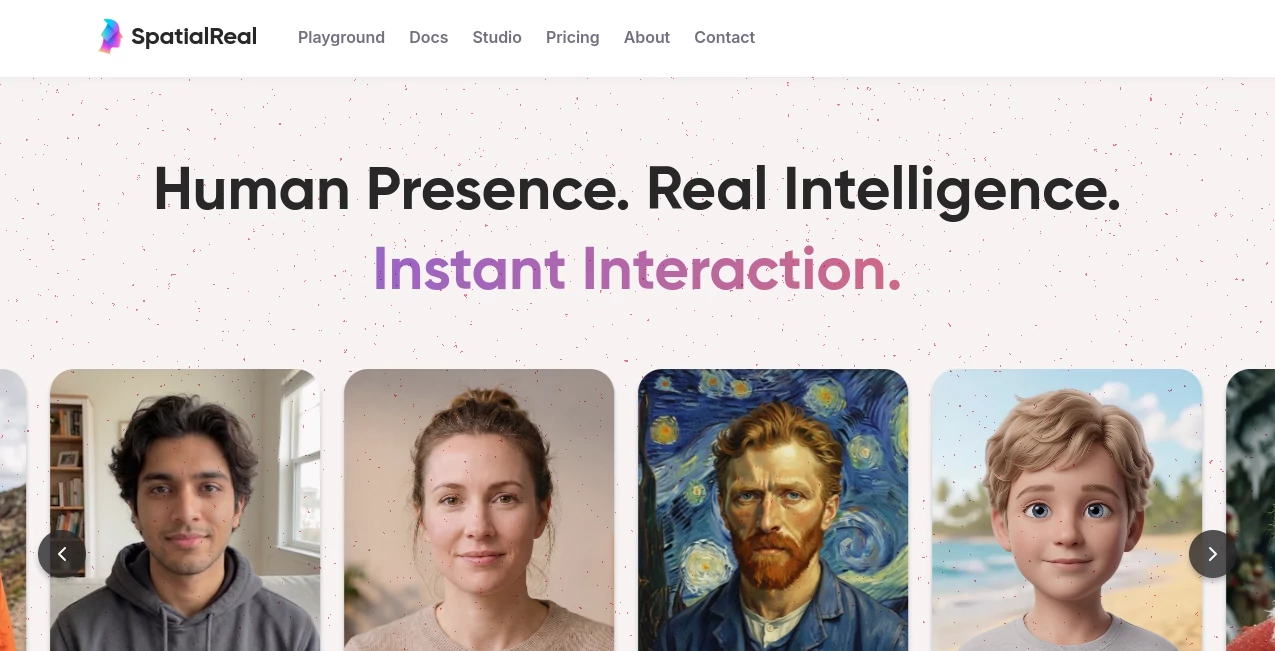
What is SpatialReal?
SpatialReal is a real-time digital human platform designed to make AI interactions feel more natural, immediate, and personal. Instead of relying on conventional video streaming, it uses on-device rendering technology to deliver photorealistic digital avatars with responsive expressions and interactive behavior. The platform is built for products that need more than a text box or voice interface, including customer support, sales, education, recruiting, digital characters, and branded experiences.
One of the most interesting aspects is its focus on low-latency interaction. The company reports response latency below 300 milliseconds, while its technology is designed to use around 10–20 KB/s of bandwidth compared with the much heavier requirements of traditional cloud-rendered video avatars. This makes the approach particularly appealing for developers who want human-like AI experiences without building an expensive video-streaming infrastructure.
Key Features
- Photorealistic digital humans designed for real-time interaction.
- On-device avatar rendering with lightweight GPU requirements.
- Ultra-low-latency interaction designed for natural conversations.
- Customizable digital avatar presence for brands and AI applications.
- Web, iOS, and Android SDK support.
- APIs and SDKs designed for relatively straightforward integration.
- Support for real-time reactions, listening behavior, breathing presence, and adaptive avatar responses.
- Integration options for client-side SDKs, RTC platforms, framework plugins, and custom transport architectures.
User Interface
The platform is presented through a combination of a live playground, Studio environment, and developer documentation. The playground is particularly useful for getting a feel for the available digital humans before committing to an implementation. Several ready-to-experience characters are available, allowing users to see how the technology handles live interaction rather than simply viewing prerecorded demonstrations.
For developers, the Studio acts as a central workspace for accessing the avatar library, managing API keys, monitoring usage, and handling subscriptions. The documentation also provides runnable examples and integration guides, which makes the product feel more like developer infrastructure than a conventional avatar creation website.
Accuracy & Performance
Performance is one of the strongest points of the platform. Its website reports sub-300ms response latency and highlights a substantially lower bandwidth requirement than traditional cloud video avatars. The underlying documentation describes on-device rendering and reports bandwidth in the range of 10–20 KB/s for driver data.
The system is also designed around real-time behavior rather than a fixed sequence of animations. Avatars can react to incoming audio, show listening behavior, and return to an idle breathing state when appropriate. There is also an audio-only fallback mechanism in the web SDK if the WebSocket connection cannot be established, helping prevent the entire experience from failing when the animation service is temporarily unavailable.
Capabilities
The technology focuses specifically on avatar animation and rendering driven by audio input. Voice conversation logic, speech synthesis, and other AI-agent functionality can be handled by the application itself or by external services, giving developers flexibility over the rest of the stack.
Integration can be approached in several ways. SDK Mode is intended for simpler client-centric applications, while RTC integrations can be used with platforms such as LiveKit or Agora. Developers who need deeper control can use a host-based architecture and manage their own transport layer. Web, iOS, and Android environments are supported, making it possible to take the same concept across multiple products.
The platform can also support customized AI presence, allowing companies to build branded digital humans rather than relying exclusively on generic virtual characters. This opens the door to interactive representatives, tutors, interviewers, sales assistants, and other role-specific digital personalities.
Security & Privacy
Privacy is addressed through a dedicated privacy policy covering the consumer service, developer applications using the SDK, and developer services such as the API. The policy distinguishes between situations in which the company acts as a data controller and situations in which it operates as a processor, depending on how the service is being used.
For developers, this distinction is worth reviewing before deploying the technology in applications that handle conversations, user information, interviews, customer requests, or other potentially sensitive data. Teams should also evaluate their own storage, authentication, API-key management, and third-party AI services as part of the complete application architecture.
Use Cases
Customer Support: Businesses can create always-available digital support agents that combine conversational AI with a visible human-like presence. This can make support interfaces feel more approachable than traditional chat widgets.
Sales and Onboarding: A digital representative can explain products, guide new customers through an interface, answer questions, and provide a more engaging introduction to a service.
Education: Interactive tutors can provide personalized learning experiences while using facial expressions, eye contact, and conversational timing to create a more engaging lesson environment.
Recruiting and Training: Digital interviewers can be used for candidate screening, interview practice, role-play exercises, and professional training scenarios where natural interaction is important.
Digital Characters: Creators and companies can develop interactive personalities for entertainment, branded experiences, virtual communities, and other applications where users want to communicate with a recognizable digital character.
Retail and Brand Experiences: A digital brand ambassador can answer questions, introduce products, and interact with visitors on websites or other supported customer-facing environments.
Pros and Cons
Pros
- Strong focus on real-time digital human interaction.
- Very low reported response latency.
- Lightweight bandwidth requirements compared with streamed avatar video.
- Web, iOS, and Android SDK availability.
- Multiple integration approaches for different technical architectures.
- Ready-made avatar experiences make testing easier.
- Free plan available for experimentation and early development.
- Suitable for both consumer-facing experiences and developer-built products.
Cons
- The platform is primarily an avatar rendering and animation layer rather than a complete conversational AI stack.
- Developers may need separate services for speech recognition, speech synthesis, LLM logic, and voice-agent orchestration.
- Some advanced integrations require more development work than the simpler SDK approach.
- The free plan has session and concurrency limits.
- Developers building highly customized experiences may need to understand the underlying integration architecture.
Pricing Plans
The platform offers a free plan with 500 monthly credits, approximately equivalent to 50 minutes of usage. It includes Web, iOS, and Android SDK access, supports two concurrent sessions, and limits individual sessions to 10 minutes.
The Starter plan costs $19 per month and includes 22,000 credits, approximately 2,200 minutes of usage. It supports five concurrent sessions and allows sessions of up to 30 minutes.
The Scale plan is priced at $299 per month and provides 400,000 credits, roughly equivalent to 40,000 minutes. It supports up to 40 concurrent sessions and removes the session-duration limit.
For larger deployments, the Enterprise plan uses custom pricing and offers unlimited concurrent sessions, isolated deployment, all supported platforms, and dedicated integration support. Annual billing is also offered with a stated 20% saving compared with monthly pricing.
How to Use the Platform
Start by creating an account and exploring the available digital humans through the online playground. This is a practical way to understand the interaction quality before writing any integration code.
For a straightforward application, choose the SDK approach that matches the target platform. Web developers can integrate through JavaScript or TypeScript, while iOS and Android projects have their respective SDK packages and platform-specific integration methods.
If the application already uses a real-time communications platform, an RTC-based approach can be more appropriate. Developers working on custom voice agents or requiring complete control over data transport can instead use the host-oriented integration model.
Once the avatar layer is connected, provide the audio input generated by the application's conversational system. The avatar service handles the corresponding real-time animation, while the rest of the AI conversation stack can remain under the developer's control.
Comparison with Similar Tools
Traditional cloud avatar services commonly rely on streaming rendered video from remote infrastructure. That approach can provide impressive visuals, but it may require considerable bandwidth and cloud GPU resources. The on-device model used here takes a different route by sending lightweight driver information and performing more of the rendering work on the user's device.
This distinction matters most for applications where responsiveness is part of the user experience. A sales assistant that takes several seconds to react can feel artificial, while an interactive tutor or support agent with faster responses can maintain a more natural conversational rhythm.
The trade-off is that this is not intended to replace every component of a voice-agent stack. Developers looking for a complete solution covering LLM reasoning, speech recognition, speech synthesis, conversation management, and avatar rendering may still need to connect several technologies. For teams that specifically need a high-quality real-time digital human layer, however, the focused architecture can be an advantage.
Conclusion
For developers and businesses looking to move beyond conventional chatbots and voice-only assistants, this platform offers an appealing way to introduce a visible, responsive digital presence into an application. Its emphasis on on-device rendering, low latency, lightweight bandwidth usage, and multi-platform SDK support gives it a practical angle that goes beyond simply making an animated character.
The strongest fit is likely to be products where the human element actually matters: customer service, education, recruiting, sales, training, branded experiences, and interactive digital characters. The free tier also makes it relatively easy to test the concept before committing to a larger deployment.
It is not a complete conversational AI system by itself, and that is important to understand. Instead, it provides a specialized layer for bringing voice-driven AI interactions to life through responsive digital humans. For teams that already have, or are prepared to build, the conversational intelligence behind the experience, it can be a compelling piece of the overall stack.
Frequently Asked Questions (FAQ)
What is this platform used for?
It is designed for building real-time experiences with photorealistic digital humans. Common applications include customer support, sales assistants, interactive tutors, recruiting, training, digital influencers, brand ambassadors, and virtual characters.
Does it provide AI voice agents by itself?
The avatar technology primarily focuses on real-time avatar animation and rendering from audio input. Speech recognition, speech synthesis, conversation logic, and other agent functionality can be supplied by the developer's application or external services.
Which platforms are supported?
Web, iOS, and Android are supported through dedicated SDKs. Additional integration options are available for real-time communication architectures and custom server-side implementations.
Is there a free plan?
Yes. The free plan provides 500 credits per month, approximately 50 minutes of usage, along with access to the Web, iOS, and Android SDKs. It supports two concurrent sessions and has a 10-minute maximum session duration.
How much does the Starter plan cost?
The Starter plan costs $19 per month and includes 22,000 credits, approximately 2,200 minutes of usage, five concurrent sessions, and sessions of up to 30 minutes.
Can businesses create branded digital humans?
Yes. The platform provides customizable AI presence capabilities intended for tailoring avatar appearance and digital human experiences to a brand or application.
Does it require heavy video streaming?
The technology is designed to avoid traditional full video streaming for avatar delivery. Its website reports bandwidth usage of approximately 10–20 KB/s for its lightweight driver data approach, compared with significantly higher requirements for cloud video avatars.
Is it suitable for developers?
Yes. The service provides APIs, SDKs, developer documentation, runnable examples, and several integration modes. The appropriate approach depends on how much control the development team needs over networking, voice agents, and application architecture.
AI Character , AI Avatar Generator , AI Education Assistant , AI Voice Assistants .
These classifications represent its core capabilities and areas of application. For related tools, explore the linked categories above.
SpatialReal details
Website unavailable — View Alternatives
Pricing
- Freemium
Apps
- Web App
Categories

SpatialReal Alternatives Product

Llamaroo

Pictionary W…

LorePanic

AI page tran…

Dialogues wi…

bridger west…

Emochi

Omni Voice

DaVinci AI