
Stigg
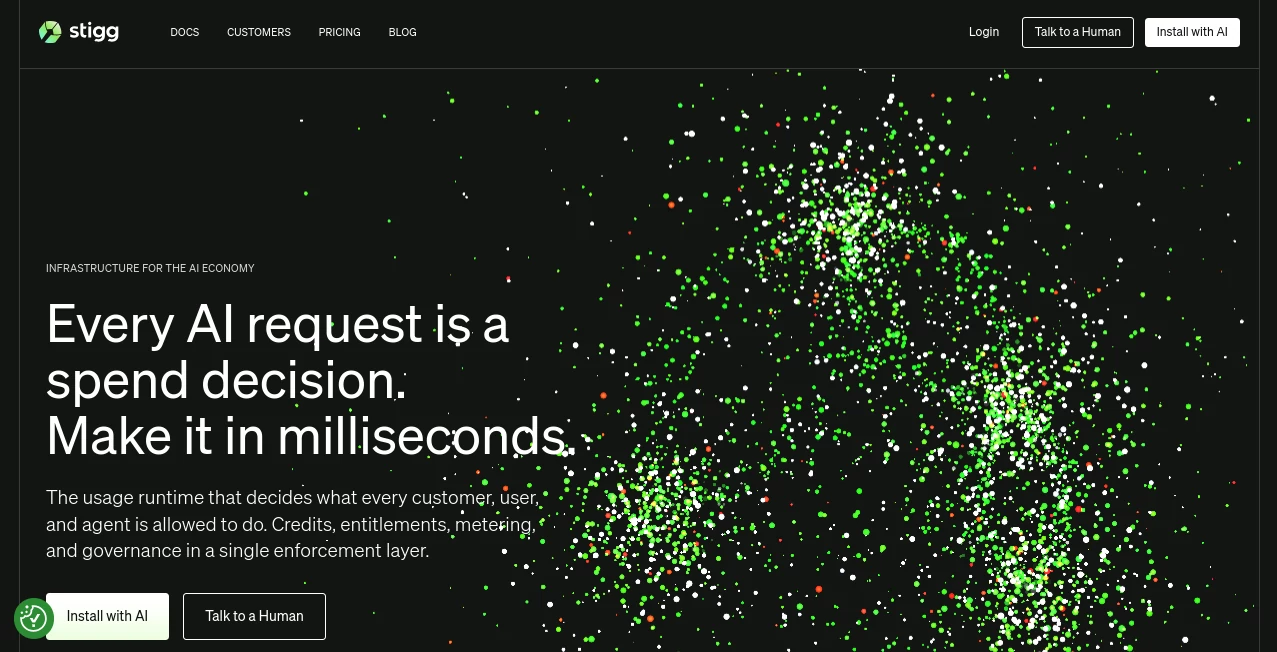
What is Stigg?
Modern software businesses need more than subscription management. As AI-powered applications become increasingly usage-driven, engineering teams require precise control over credits, feature access, usage limits, and customer entitlements without slowing product development. This platform delivers a unified infrastructure layer that makes those decisions in real time while keeping billing systems and product logic cleanly separated.
Instead of embedding pricing rules directly into application code, developers can define entitlements, metering policies, credit systems, and governance rules through a dedicated runtime. This approach allows product teams to launch new pricing models, introduce AI features, or experiment with different subscription tiers much faster while reducing engineering overhead.
Whether a company serves thousands or millions of customers, every request can be evaluated before expensive AI tokens are consumed. Real-time enforcement helps eliminate overspending, improves customer transparency, and provides a reliable foundation for usage-based monetization.
Key Features
User Interface
The platform offers a clean dashboard designed for engineering, product, and revenue teams. Plans, feature entitlements, customer subscriptions, credits, and usage metrics are organized logically, making it easy to understand complex pricing structures without navigating through multiple systems. Search functionality and detailed customer records simplify day-to-day management.
Accuracy & Performance
One of its strongest advantages is its high-performance decision engine. Every API request can be evaluated in milliseconds, allowing applications to verify credits, budgets, feature access, and usage limits before executing costly AI operations. This real-time architecture is especially valuable for AI applications where every request directly impacts operational costs.
Capabilities
- Real-time entitlement enforcement
- Usage-based metering
- Credit wallet management
- Flexible pricing and packaging models
- Feature gating without code deployments
- Subscription management
- Support for AI usage governance
- Developer-friendly REST APIs and SDKs
- Integration with existing billing providers
- Support for multiple deployment models including private cloud environments
Security & Privacy
Enterprise deployments are supported through flexible infrastructure options, including customer-managed cloud environments. Organizations maintain ownership of their usage data while benefiting from audit-friendly transaction records, secure entitlement enforcement, and infrastructure designed for large-scale SaaS applications. This architecture helps businesses meet strict compliance and governance requirements while protecting sensitive customer information.
Use Cases
- Managing AI credits for generative AI products
- Building usage-based SaaS pricing models
- Implementing feature access by subscription tier
- Creating flexible enterprise licensing models
- Launching freemium and trial experiences
- Controlling API usage limits
- Managing customer entitlements across multiple products
- Supporting product-led growth strategies
- Reducing engineering effort required for pricing updates
- Monitoring AI infrastructure spending in real time
Pros and Cons
- Pros
- Excellent real-time entitlement engine.
- Supports complex usage-based pricing models.
- Reduces engineering maintenance significantly.
- Integrates with existing billing infrastructure.
- Designed for modern AI products and SaaS platforms.
- Highly scalable for enterprise workloads.
- Cons
- Primarily targeted at technical and SaaS teams rather than individual users.
- Initial implementation requires developer integration.
- Some advanced capabilities may be unnecessary for small projects.
Pricing Plans
Pricing is provided through custom plans tailored to business requirements. Organizations can contact the sales team to discuss deployment options, infrastructure preferences, usage volume, and enterprise licensing. This approach allows pricing to scale according to customer size and technical needs.
How to Use Stigg
Begin by connecting the platform to your existing application and billing infrastructure using the available SDKs or REST APIs. Define your products, subscription plans, credits, and feature entitlements. Configure usage limits, budgets, and metering rules based on your monetization strategy. After integration, every customer request is evaluated automatically before execution, ensuring accurate access control and real-time spending governance. Product managers can later introduce new pricing tiers or AI features with minimal engineering involvement.
Comparison with Similar Tools
Many traditional billing platforms focus mainly on invoicing and subscription management after usage has already occurred. This solution takes a different approach by making authorization decisions before each request is processed. That distinction makes it especially valuable for AI applications where every API call generates immediate costs. Compared with conventional subscription systems, it offers deeper entitlement management, faster pricing experimentation, and more granular control over feature access and usage governance.
Conclusion
For software companies building AI-native products or modern SaaS platforms, managing usage, credits, pricing, and customer entitlements has become a critical engineering challenge. This platform addresses that challenge with an infrastructure-first approach that separates monetization logic from application code. The result is greater flexibility, faster product iteration, improved governance, and a better customer experience. Teams looking to modernize their monetization architecture will find it to be a reliable and forward-thinking solution.
Frequently Asked Questions (FAQ)
What type of businesses benefit the most from this platform?
It is best suited for SaaS companies, AI product developers, API providers, and enterprise software teams that rely on subscription or usage-based monetization.
Can it work alongside an existing billing provider?
Yes. It is designed to integrate with existing billing systems instead of replacing them entirely.
Does it support AI usage management?
Yes. Real-time credit enforcement, metering, budgets, and entitlement controls are specifically designed for AI-powered products.
Is developer integration required?
Yes. Applications connect through APIs and SDKs, allowing pricing and entitlement logic to operate independently from core application code.
Can pricing models be updated without major code changes?
Yes. One of the platform's biggest strengths is enabling product teams to modify pricing structures, plans, and feature access with minimal engineering effort after the initial integration.
AI Workflow Management , AI API Design , AI Business Ideas Generator , AI Developer Tools .
These classifications represent its core capabilities and areas of application. For related tools, explore the linked categories above.

Stigg Alternatives Product

Plainpaper

RepoClip

JSON to TOON…

DevUtilX

TruthSpine

Standard Com…

NetlifyAPP

EasyRouterAI

Weekly Brief