
Suno V6 App
What is Suno V6 App?
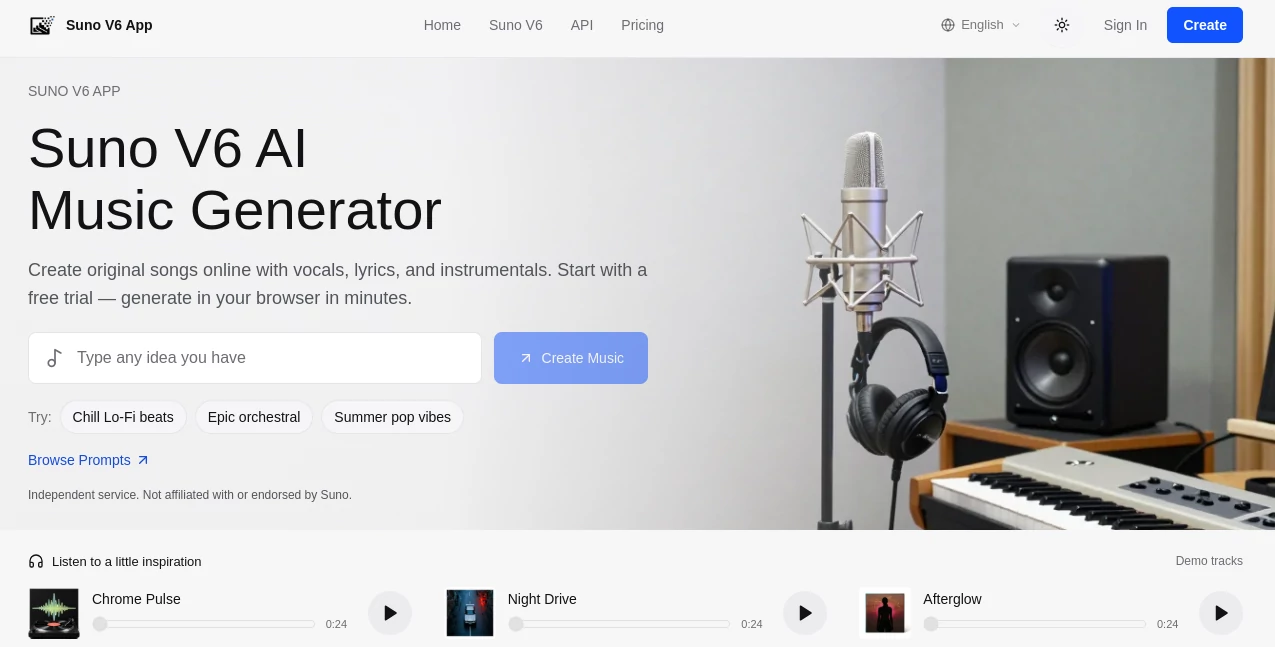
Suno V6 App is an independent browser-based music creation platform that turns written ideas into complete songs with vocals, lyrics, and instrumental arrangements. It is designed for people who want to move from a rough musical concept to something they can actually listen to, edit, or use in a creative project without installing desktop software.
The process is refreshingly straightforward. Describe a mood, genre, tempo, instrumentation, or lyrical direction, and the platform generates a track from the prompt. A creator working on a YouTube video, podcast intro, game prototype, advertising concept, or simply experimenting with songwriting can get a usable musical draft without starting from an empty timeline.
One important distinction is worth mentioning: the service identifies itself as an independent platform and states that it is not affiliated with or endorsed by Suno. :contentReference[oaicite:0]{index=0}
Key Features
- Text-to-song generation from natural-language prompts.
- AI-generated vocals, lyrics, and instrumental arrangements.
- Control over mood, genre, tempo, instrumentation, and song structure.
- Suno V6 (chirp-v6) available as the default generation model.
- Older Chirp models available at lower credit costs.
- MP3 and WAV downloads for further editing or publishing workflows.
- Prompt templates for getting started more quickly.
- Browser-based generation with no software installation.
- Credit-based regeneration for refining musical ideas.
- API access for developers building music-related applications.
User Interface
The interface is built around a simple idea: write what you want to hear and generate it. The browser dashboard handles the prompt, generation, preview, and download workflow without forcing users through a complicated music-production setup.
For newcomers, this is particularly useful. Instead of learning a digital audio workstation before experimenting, a user can begin with something as simple as a description such as “warm summer pop with acoustic guitar and an upbeat chorus.” More experienced creators can make the instructions more specific by adding structure, instrumentation, tempo, and lyrical direction.
Accuracy & Performance
Music generation is naturally subjective, so accuracy is less about producing an objectively correct answer and more about how closely a generated track follows the creative brief. The platform gives users the ability to listen to a result, adjust the prompt, and regenerate it when the first version misses the intended direction.
This iterative approach is one of the more practical aspects of the workflow. Instead of expecting the first generation to be perfect, creators can treat each output as a musical draft and gradually move toward the sound they want.
Capabilities
The platform covers more than simple instrumental background music. It can generate complete songs with vocals and lyrics, while prompts can guide genre, mood, instruments, tempo, structure, and lyrical direction. Finished tracks can then be exported as MP3 or WAV files.
There is also an API for developers. According to the service, the API can be used for projects such as music bots, automated music generation inside video products, creative writing and song-generation applications, and experimental product prototypes.
Security & Privacy
Because music generation can involve account information, prompts, generated content, and payment details, users should review the platform's privacy policy and terms before using it for sensitive or commercial projects. The service provides dedicated privacy, terms, refund, and content-policy pages, giving users a place to review the applicable rules before publishing generated material.
Commercial use also deserves attention. The platform states that commercial usage depends on the subscription plan and applicable copyright laws, so creators should check the licensing terms associated with their account before monetizing or distributing generated tracks.
Use Cases
Content Creation: Video creators can generate original musical beds for social videos, YouTube content, presentations, and other media instead of repeatedly searching through stock music libraries.
Podcasts: Podcast producers can create intros, outros, transitions, and atmosphere tracks that fit the tone of a particular show.
Game Development: Indie developers can prototype background music and ambient concepts while working on game levels. It can be especially helpful during the early stages when the final soundtrack has not yet been commissioned.
Marketing and Advertising: Marketing teams can experiment with jingles, campaign music, and background tracks before investing in a finished production.
Events and Presentations: Speakers, event organizers, and presentation designers can create background tracks tailored to a launch, presentation, or live experience.
Songwriting: Musicians and writers can use generated tracks as creative starting points. Even when the output is not the final song, hearing an arrangement can help shape an idea that was previously only a few lines of text.
Pros and Cons
- Pros: Simple browser-based workflow, complete song generation, vocals and lyrics, prompt-based creative control, MP3/WAV downloads, free trial credits, multiple generation models, and API access.
- Pros: Useful for both quick experimentation and practical creative workflows such as podcasts, games, advertising, and video production.
- Cons: Generation uses credits, so repeated experimentation can consume the available balance.
- Cons: The quality and relevance of individual generations can vary, meaning that some ideas may require several iterations.
- Cons: Commercial usage requires checking the applicable subscription and licensing terms before publication.
Pricing Plans
The service uses a credit-based subscription model. New users can start with trial credits, while paid plans provide larger monthly credit allowances along with additional benefits such as increased song generation, priority queue access, and storage.
- Basic: $10 per month with 1,000 credits.
- Pro: $20 per month with 2,000 credits.
- Max: $50 per month with 5,000 credits.
The availability of a free trial makes it possible to test the generation workflow before committing to a subscription. Users who expect to regenerate tracks frequently may find the larger plans more suitable.
How to Use Suno V6 App
- Create an account or log in through the browser dashboard.
- Describe the song you want to create, including the mood, genre, instruments, tempo, structure, or lyrical direction.
- Generate a track using the default Suno V6 model or another available model.
- Listen to the generated result and consider which parts match your original idea.
- Adjust the prompt when necessary and regenerate the track using available credits.
- Download the finished version as an MP3 or WAV file for editing, publishing, or another creative workflow.
A useful approach is to avoid overly vague prompts. Rather than simply asking for “a good song,” describe the atmosphere and musical elements you want. For example, specifying a relaxed tempo, warm acoustic instrumentation, a nostalgic mood, and a strong melodic chorus gives the generator considerably more direction.
Comparison with Similar Tools
There are several AI music platforms aimed at similar audiences, including Udio, Soundraw, Boomy, AIVA, and Mubert. The biggest advantage here is the combination of a straightforward text-to-song workflow, vocals and lyrics, downloadable MP3/WAV files, multiple models, and an API in the same service.
That does not automatically make it the best choice for every musician. Someone focused heavily on detailed production controls may prefer a specialized music-production workflow, while someone who primarily needs royalty-free background tracks may evaluate platforms designed specifically around that use case.
For creators who value quick experimentation and want to turn a written musical concept into a listenable track directly from a browser, however, the workflow is particularly appealing.
Conclusion
Suno V6 App offers a practical way to turn written musical ideas into complete songs without requiring traditional music-production software. Its combination of natural-language prompting, vocals, lyrics, instrumental generation, downloadable audio, and iterative regeneration makes it useful for a wide range of creative projects.
The service is particularly interesting for creators who frequently need original music for videos, podcasts, games, advertisements, presentations, or early songwriting experiments. The addition of an API also gives developers a path beyond the standard dashboard and opens the door to integrating music generation into their own products.
For anyone curious about AI-assisted music creation, starting with the free trial is a sensible way to understand how well the workflow fits their particular style before choosing a paid credit plan.
Frequently Asked Questions (FAQ)
Is Suno V6 App the official Suno product?
No. The website explicitly describes itself as an independent service and states that it is not affiliated with or endorsed by Suno.
What can the platform generate?
It can generate songs with vocals, lyrics, and instrumental arrangements based on written prompts. Users can guide aspects such as genre, mood, tempo, instrumentation, and structure.
Do I need to install software?
No. The generation workflow runs in a web browser, so there is no desktop installation required.
Is there a free option?
New users receive trial credits that can be used to test the service. Additional credits may also be available through activities such as daily check-ins, tasks, or referrals.
Can I download generated songs?
Yes. Finished tracks can be exported as MP3 or WAV files for further editing, publishing, or delivery.
Which model is used by default?
Suno V6, also referred to as chirp-v6 on the platform, is the default generation model. Older Chirp models are also available and use fewer credits.
Can generated music be used commercially?
Commercial usage depends on the applicable subscription plan and licensing conditions. Users should review the terms associated with their account before distributing or monetizing generated music.
Does it offer an API?
Yes. Developers can access an API for programmatic music generation and use it to build applications such as music bots, automated music features, and experimental creative products.
How can I get better results?
Give the generator specific creative direction. Include the desired genre, mood, instrumentation, tempo, song structure, and lyrical style rather than relying on a very short prompt. If the first generation is close but not quite right, refine the prompt and generate another version.
Who can benefit from this tool?
Musicians, songwriters, video creators, podcasters, game developers, marketers, event producers, and developers can all find practical uses for AI-generated music.
AI Text to Music , AI Singing Generator , AI Music Generator , AI Voice & Audio Editing .
These classifications represent its core capabilities and areas of application. For related tools, explore the linked categories above.
Suno V6 App details
Website unavailable — View Alternatives
Pricing
- Freemium
Apps
- Web App
Categories

Suno V6 App Alternatives Product

MakeBPM
AI Song Maker

AI Music Gen…

FluentDictat…

Solmi AI

AISongsGener…

lyria 3

AI Rap Gener…
Seed Audio