TeamPredict
What is TeamPredict?
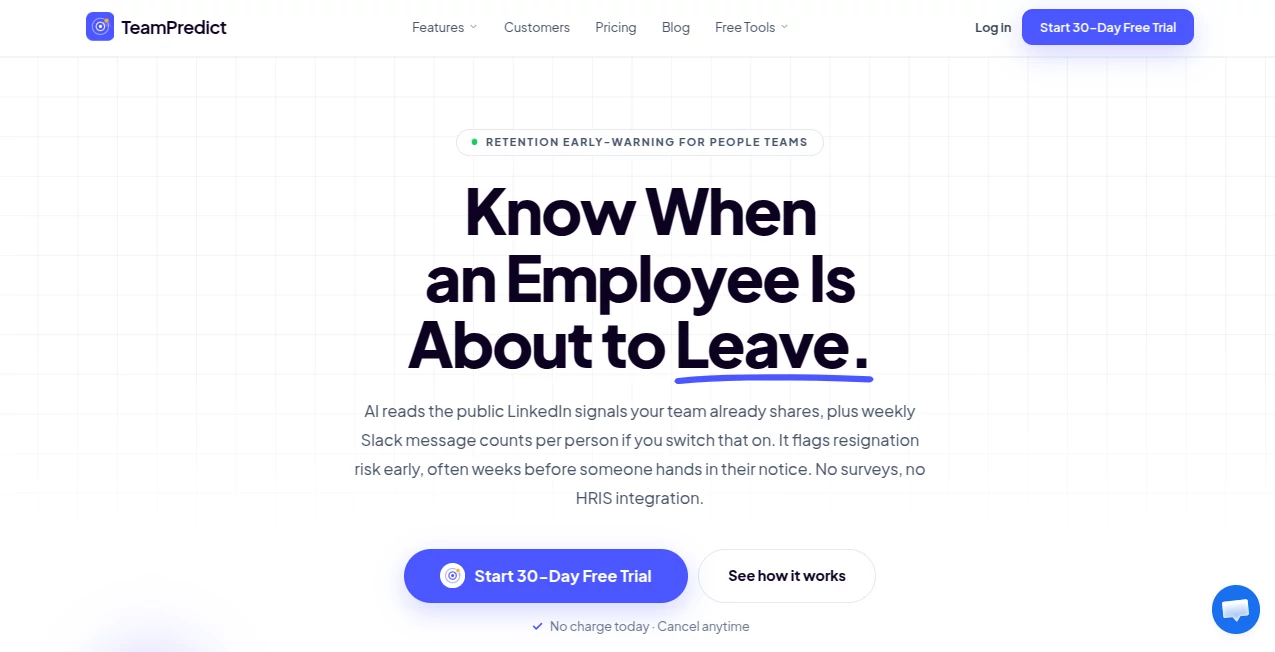
TeamPredict is an AI-powered retention early-warning platform built for HR and People teams that want to identify potential employee turnover before a resignation arrives unexpectedly. Instead of waiting for an exit interview or relying only on periodic engagement surveys, the platform looks at public LinkedIn profile signals and, when enabled, weekly Slack message counts to highlight changes that may deserve attention.
The idea is refreshingly practical. A change to someone's job title, a newly added skill, an “Open to Work” indicator, or a sudden burst of profile editing may not mean that an employee is leaving. But several changes appearing together can be worth a closer look. The platform turns those signals into understandable risk levels so managers can decide when a supportive conversation might make sense.
It is particularly suited to growing companies and lean People teams that want a lightweight retention tool without implementing a large HR analytics suite or connecting a full HRIS system.
Key Features
- Daily monitoring of tracked public LinkedIn profiles
- Employee resignation-risk scoring based on profile changes
- Visual history of LinkedIn edits, skills, headlines, and other profile signals
- Email alerts when resignation risk increases
- Recurring digest emails covering detected risk signals
- Optional Slack team-health monitoring using message counts rather than message content
- LinkedIn page engagement tracking for employees and other frequent engagers
- Competitor tracking to identify potential recruiting opportunities
- Read-only API access and webhooks for connecting retention signals with other systems
- Employee-level tracking that can be turned on or off for selected people
User Interface
The interface is designed around quick interpretation rather than complicated HR dashboards. Employee profiles can be viewed through a visual history that shows changes over time, while risk levels make it easier to identify which people may need attention first.
The workflow is also straightforward. After signing up with a company email, employee LinkedIn profiles can be fetched, specific people can be selected for tracking, and alerts can then be delivered by email when the risk level changes.
For a small HR team, this approach can save considerable time. Instead of manually checking dozens of profiles, the important changes are surfaced in one place.
Accuracy & Performance
The platform is careful to position its risk score as a prioritization signal rather than a prediction that should be treated as fact. Its analysis considers public changes such as headline or job-title updates, an “Open to Work” badge, new skills or certifications, profile photo or summary changes, location changes, and unusually high profile-edit activity.
This distinction matters. A person updating their LinkedIn profile does not automatically mean they are preparing to resign. The value comes from combining multiple signals and giving HR teams enough context to decide whether a conversation is appropriate.
Tracked profiles are checked daily, helping organizations notice changes without requiring someone on the HR team to repeatedly inspect profiles manually.
Capabilities
Employee retention is the central use case, but the platform goes beyond a simple resignation alert. HR teams can review profile history, understand which changes influenced a risk level, and receive recurring summaries of important signals.
The optional Slack feature adds another perspective. It compares each person's weekly message volume with their own historical baseline. Importantly, it uses message counts rather than reading message content, and it does not include direct messages or the text of conversations.
There is also a recruiting angle. Companies can monitor selected competitors and identify public profile changes that may indicate someone is becoming more open to a new opportunity. LinkedIn page engagement tracking can additionally show which employees interact with company posts and highlight frequent engagers who are not currently on the roster.
For technical teams, a read-only REST API can expose tracked employee data, risk changes, competitors, and profile history. Webhooks can also push warnings when relevant changes are detected, making the platform easier to incorporate into an existing internal workflow.
Security & Privacy
Privacy is particularly important for a product dealing with employee information. The platform states that it uses public LinkedIn profile signals and, when the Slack feature is enabled, message counts rather than message content. It also states that Slack monitoring does not read messages, direct messages, channels, or message timing.
Data is encrypted in transit, access follows a least-privilege approach, and billing is handled through Stripe. The customer remains the data controller for monitored employee data, while the service operates as a processor under the customer's instructions.
Organizations should still establish an appropriate lawful basis and communicate monitoring practices to employees before using employee-level tracking. The risk score should be treated as a prompt for human judgment, not as an automated employment decision.
Use Cases
Employee retention: HR teams can identify changes that may justify checking in with a valuable employee before a resignation becomes an emergency.
Succession planning: When a key employee shows elevated risk, managers can begin preparing documentation, knowledge transfer, or backup responsibilities earlier.
Lean HR teams: Smaller companies can automate daily monitoring instead of maintaining manual spreadsheets or repeatedly checking individual LinkedIn profiles.
Recruiting from competitors: Companies can use competitor tracking to identify public signals that may indicate potential candidates are becoming more receptive to new opportunities.
Remote team health: The optional Slack analysis can reveal sustained changes in an individual's communication volume compared with their normal pattern, giving managers another signal to consider.
People analytics: HR leaders can combine the individual-level signals with their existing retention and engagement processes rather than relying exclusively on annual or quarterly surveys.
Pros and Cons
Pros
- Focused specifically on early employee-retention signals
- Fast setup with a workflow designed for lean HR teams
- Daily LinkedIn monitoring reduces manual work
- Risk scores show the profile changes behind the signal
- Email alerts make important changes difficult to miss
- Optional Slack monitoring avoids reading message content
- Competitor tracking adds a recruiting use case
- API and webhook support are useful for technical teams
- No long-term contract is required
Cons
- A risk score cannot confirm that someone intends to resign
- The quality of the signal depends partly on publicly visible profile activity
- Employee monitoring requires careful privacy and communication practices
- It is more specialized than a complete HR or workforce-management platform
- Organizations looking for broad HR analytics may still need additional software
Pricing Plans
The pricing model is deliberately simple. There is one paid plan at $5 per tracked employee per month when billed monthly. An annual option costs $50 per employee per year, effectively providing two months free compared with monthly billing.
Every account starts with a 30-day free trial covering up to 100 tracked employees, with no charge at the beginning of the trial. Companies can choose which employees to monitor and can add or remove people as their needs change.
There are no separate feature tiers or setup fees, which makes the pricing easier to estimate for companies with a relatively small number of employees.
How to Use It
- Sign up using a company email address.
- Allow the platform to fetch the public LinkedIn profiles associated with your employees.
- Select the employees, departments, or roles you want to monitor.
- Let the platform check tracked profiles for relevant changes.
- Review risk levels and the specific signals that influenced them.
- Use email alerts and recurring digests to stay informed about important changes.
- If appropriate, enable the optional Slack team-health feature and communicate the monitoring policy to your team first.
- Use elevated risk as a reason for a thoughtful conversation, not as proof that someone is leaving.
Comparison with Similar Tools
Traditional employee engagement surveys are useful for understanding how teams feel, but they generally provide periodic, group-level information. They may not highlight an individual who has quietly started preparing for a move.
Larger people-analytics platforms can offer deeper analysis across internal HR data, but they can also require more implementation work and broader integrations. This solution takes a narrower approach: identify early, person-level signals and make them easy for HR teams to act on.
That makes it particularly attractive to startups, growing businesses, and companies where a single unexpected resignation can have a noticeable impact on projects, customer relationships, or team workload.
Conclusion
Employee turnover rarely feels expensive because of the resignation email itself. The real cost appears afterward: unfinished work, rushed recruiting, lost knowledge, delayed projects, and extra pressure on the people who remain.
This platform takes a proactive approach by watching public professional signals and turning meaningful changes into understandable retention alerts. Its strongest advantage is not that it claims to know exactly who will resign. Instead, it gives HR and People teams an earlier opportunity to notice something has changed and decide what to do about it.
For lean organizations that want a focused retention-monitoring layer without adopting a large HR analytics system, the combination of LinkedIn monitoring, explainable risk signals, email alerts, optional Slack health data, competitor tracking, and developer access makes it a compelling option.
Frequently Asked Questions (FAQ)
What does the platform do?
It monitors selected employees' public LinkedIn profile signals and can optionally analyze weekly Slack message counts to help HR teams identify potential resignation risk earlier.
Does it guarantee that an employee will resign?
No. The risk score is a prioritization signal rather than a definitive prediction. A high score should encourage a supportive check-in rather than trigger an automatic employment decision.
Does it read Slack messages?
No. The optional Slack team-health feature uses weekly message counts per person. It does not read message content or direct messages.
How often are LinkedIn profiles checked?
Tracked profiles are monitored daily so that relevant profile changes can be detected without requiring manual checks.
What LinkedIn changes can affect the risk signal?
Examples include headline or job-title changes, an “Open to Work” badge, newly added skills or certifications, profile photo or summary updates, location changes, and a sudden increase in profile-edit activity.
How long does setup take?
The service states that setup can take about five minutes. After connecting a company account, users can select the employees they want to track.
How much does it cost?
The paid plan costs $5 per tracked employee per month, or $50 per employee per year. A 30-day free trial covers up to 100 tracked employees.
Is there an API?
Yes. A read-only REST API provides access to tracked companies, employees, risk changes, competitors, and profile history. Webhooks can also send warnings when relevant changes are detected.
Who is it best suited for?
It is especially useful for HR and People teams, founders, startups, and growing companies that want an early-warning layer for employee retention without implementing a large enterprise people-analytics platform.
AI Analytics Assistant , AI Recruiting .
These classifications represent its core capabilities and areas of application. For related tools, explore the linked categories above.
TeamPredict details
Website unavailable — View Alternatives
Pricing
- Freemium
Apps
- Web App
Categories

TeamPredict Alternatives Product

Sparqo AI

zGEO Ranker

Website Audi…

TrackRev

Creget

UPDF AI

WRITELO

Diploria AI

Nav Ai