
Token360
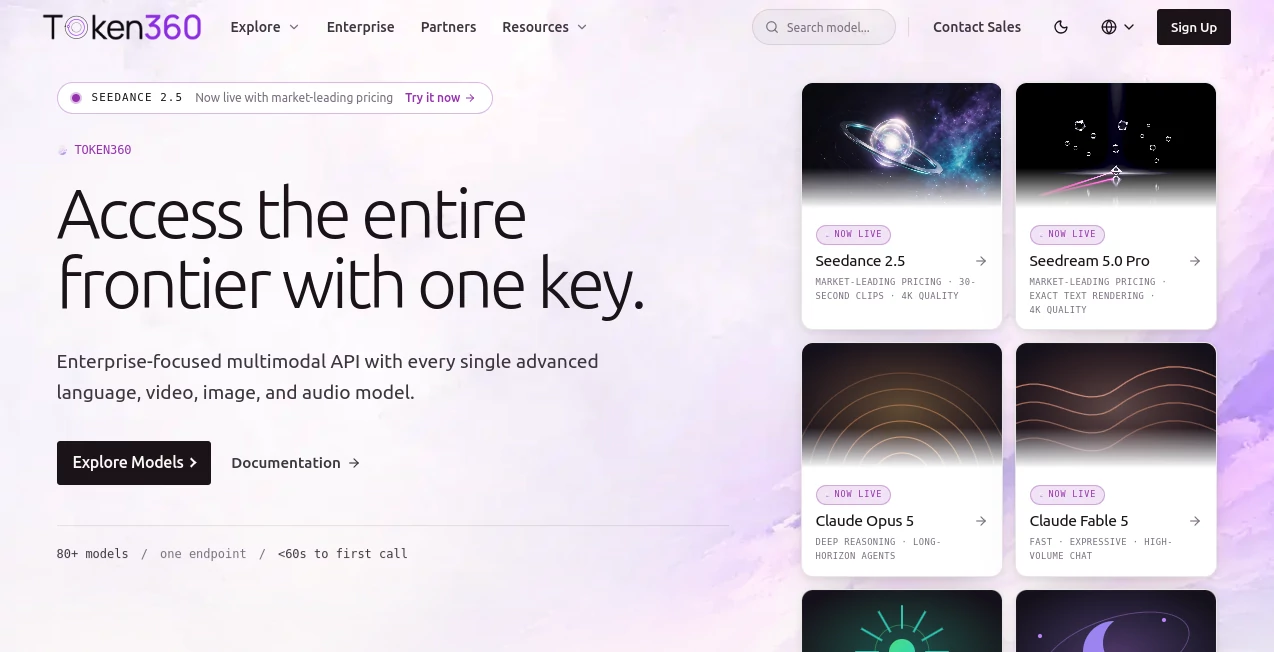
What is Token360?
Modern AI development often means juggling multiple providers, APIs, billing systems, model formats, and performance limits. Token360 takes a different approach by bringing a broad collection of advanced language, image, audio, and video models behind a single API. The platform is designed for developers, enterprises, and creators who want to experiment with leading models without building a separate integration for every provider.
The platform currently provides access to more than 80 AI models through one endpoint, covering areas such as language generation, vision, image generation, video generation, speech, and audio. Its website also emphasizes high-throughput inference, low latency, transparent usage, technical support, and pricing intended for production workloads.
For a developer building an application that may need several AI providers, this unified approach can be particularly practical. Instead of redesigning an application whenever a different model is needed, developers can select the model they want while keeping the same general API workflow.
Key Features
- Access to 80+ AI models through a unified API.
- Support for language, vision, image, video, audio, and speech models.
- OpenAI-compatible API conventions for easier integration.
- REST API access for production applications.
- A playground for testing models before integrating them into an application.
- High-throughput and low-latency inference for demanding workloads.
- Model selection without managing separate provider accounts.
- Enterprise support, account management, custom pricing, and onboarding assistance.
- Usage-based access to a wide range of current frontier models.
User Interface
The interface is focused more on practical model discovery and testing than on unnecessary visual complexity. Users can browse the model catalog, identify models by publisher and model type, and experiment through the integrated playground.
The playground is especially useful for teams that want to compare outputs before committing engineering resources. A developer can test a prompt with a selected model and then move toward an API integration when the result meets the project's requirements.
Accuracy & Performance
Performance depends heavily on the model selected and the type of workload, so it would be misleading to treat every model as having the same response characteristics. What the platform does provide is infrastructure designed around high throughput and low-latency inference.
The service states that the first successful API call can be made in under 60 seconds from obtaining an API key, while its infrastructure is designed to handle production-scale requests. Its homepage also reports potential model-cost savings of up to 30% compared with benchmarked mainstream alternatives. Actual costs and response times will naturally vary by model, resolution, request size, and workload.
Capabilities
The model catalog is one of the strongest parts of the service. Developers can work with advanced language models from providers such as OpenAI, Anthropic, Google, DeepSeek, Alibaba, Zhipu, xAI, and others. The catalog also extends beyond text, with image, video, audio, speech-to-text, and text-to-speech capabilities.
This makes the platform useful for applications that combine several forms of AI. For example, a marketing application could use a language model for copy, an image model for campaign visuals, and a video model for promotional content without requiring separate infrastructure for every component.
The API follows OpenAI-compatible conventions and supports endpoints such as chat completions and responses. Python and JavaScript workflows can also use OpenAI-compatible SDK approaches by changing the API base URL.
Security & Privacy
Security is positioned as an important part of the enterprise offering. The company describes an architecture aimed at US and EU enterprise requirements and highlights compliance monitoring, audit capabilities, region-pinned data, and GDPR alignment. Its resources also reference SOC 2 Type 2 and enterprise-oriented compliance practices.
Organizations should still review the current privacy, data retention, security, and compliance documentation before sending sensitive production information. Requirements can differ considerably between a small development project and a regulated enterprise workload.
Use Cases
The service fits a wide range of AI development scenarios. Startups can use a single integration while testing different models, which can make early product development less cumbersome. Established teams can use it when they need access to several model families without maintaining numerous individual provider integrations.
- Building AI chat and assistant applications.
- Creating multimodal applications that process text, images, audio, or video.
- Generating marketing images and video assets.
- Developing content and document-processing workflows.
- Adding speech generation or recognition to an application.
- Testing several foundation models before choosing one for production.
- Developing AI-powered SaaS products.
- Running high-volume inference workloads.
- Creating internal enterprise AI applications.
- Prototyping applications that may eventually use multiple model providers.
Pros and Cons
Pros:
- Large selection of models behind one API.
- Supports multiple AI modalities rather than focusing only on text.
- OpenAI-compatible API structure can simplify integration.
- Useful playground for testing models.
- Designed for both developers and enterprise teams.
- Dedicated technical and account support is available for enterprise customers.
- Centralized model access can reduce the complexity of managing multiple providers.
Cons:
- The large model catalog can take time for new users to understand.
- Performance and pricing vary substantially between individual models.
- Some enterprise features require contacting sales.
- Developers who only need one specific model may not benefit as much from a multi-model platform.
Pricing Plans
The platform offers different approaches depending on how it is being used. For creators, there is a free plan with 50 credits per month, short 720p clips, watermarked outputs, and access to community models. The Pro plan is listed at $19 per month with 1,500 credits, access to all video models, 1080p output without a watermark, faster generation, and a personal commercial license.
The Studio plan costs $49 per month and provides 5,000 credits, priority processing, concurrent renders, a full commercial and resale license, API access, and priority support. Annual billing is advertised as saving approximately 20%.
Enterprise customers have a separate model-access and infrastructure offering with custom pricing, dedicated technical support, account management, sub-accounts, unified billing, and organization-wide key governance. Because model costs and enterprise requirements can differ significantly, larger deployments may need a custom quotation.
How to Use the Platform
Getting started is straightforward for developers familiar with API-based AI services. First, create an account and obtain an API key. Next, choose a model from the available catalog according to the task you want to perform.
For a language application, for example, you can send a request through the chat completions endpoint using the selected model ID. The API uses standard authorization with a bearer API key and accepts JSON request bodies for common inference operations.
Developers using Python or JavaScript can also work with OpenAI-compatible SDKs by pointing the client toward the platform's API base URL. This can make the transition particularly convenient for applications that already use compatible API patterns.
For creators and non-developers, the playground provides a simpler way to experiment with supported models and evaluate outputs before building a larger workflow.
Comparison with Similar Tools
The biggest distinction is the breadth of the model-access layer. A conventional AI provider may specialize in its own model family, while a model aggregation platform gives developers the ability to select from multiple providers through a common interface.
This is particularly valuable when model quality, speed, price, or modality requirements change from one project to another. A team might prefer one model for reasoning, another for image generation, and a third for video production. Having these options available through a common platform can reduce the amount of integration work required.
On the other hand, teams that are already deeply committed to a single provider may prefer using that provider directly, especially when they need provider-specific features that are not exposed through a unified API.
Conclusion
For teams that want access to a broad selection of modern AI models without maintaining a separate integration for every provider, this platform offers a compelling proposition. Its combination of a large model catalog, multimodal capabilities, OpenAI-compatible APIs, playground access, and enterprise support makes it suitable for both experimentation and serious application development.
The most interesting benefit is flexibility. Instead of treating the choice of an AI model as a permanent architectural decision, developers can evaluate different models and select the one that makes the most sense for a particular workload. That can be especially useful as AI models continue to evolve at a rapid pace.
Frequently Asked Questions (FAQ)
What is this platform used for?
It provides unified access to a large collection of AI models for text, vision, image, video, audio, and speech applications. Developers can use its API to integrate these capabilities into their own software.
How many AI models are available?
The platform advertises access to more than 80 AI models, with the catalog covering multiple providers and model types.
Does it support an OpenAI-compatible API?
Yes. The API follows OpenAI-compatible conventions, making it easier for applications that already use compatible SDKs or request formats to integrate the service.
Can developers use multiple AI models through one API?
Yes. A central feature is the ability to select different supported models while using the same general API infrastructure.
Does it support image and video generation?
Yes. The catalog includes dedicated image and video generation models alongside language, audio, speech, and vision models.
Is there a free plan?
Yes. The creator offering includes a free plan with 50 credits per month and limited video-generation features. Paid creator plans provide higher limits and additional capabilities.
Is it suitable for enterprise applications?
Yes. Enterprise offerings include custom pricing, dedicated technical support, account management, sub-accounts, unified billing, and tenant-wide key governance.
Can I test models before integrating them?
Yes. The platform includes a playground that allows users to experiment with supported models before moving into API-based development.
Does the platform support speech generation?
Yes. Its API includes speech-generation capabilities, and the model catalog contains audio and speech models for different use cases.
What should I consider before choosing a model?
Consider the task, output quality, latency, context requirements, modality, generation speed, usage volume, and cost. Different models are optimized for different workloads, so testing several options can be worthwhile.
AI Developer Tools , AI Video Generator , Large Language Models (LLMs) , AI Image to Image .
These classifications represent its core capabilities and areas of application. For related tools, explore the linked categories above.

Token360 Alternatives Product

git-lrc

Leonardo.ai

Gemini AI vi…

Standard Com…

globalize.now

Somnio

String Art

Mage

OmniVideo