
TopAI.review
What is TopAI.review?
Choosing an AI website builder sounds simple until you start comparing the details. One platform may be easier to use, another may offer stronger design controls, while a third may be better suited to ecommerce, WordPress, or more advanced web applications. AITop AI Review brings these choices together in one focused comparison site, helping visitors understand what separates the leading options in the market.
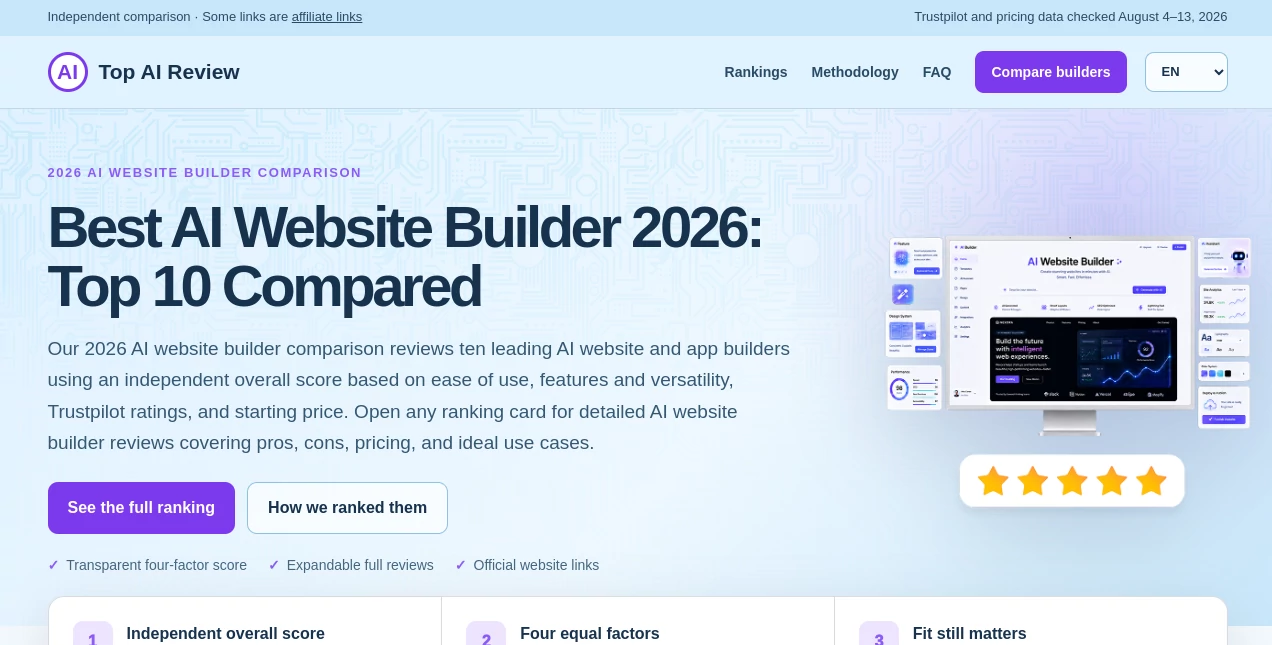
The website currently focuses on AI website builders and compares ten platforms for 2026. Instead of relying on a single opinion, its ranking combines four factors: ease of use, features and versatility, Trustpilot ratings, and starting price. Each factor contributes 25% to the overall score, creating a straightforward way to compare different products while still reminding readers that the highest-ranked option is not necessarily the best fit for every project.
This approach is particularly useful for someone who wants to move beyond marketing claims and look at practical considerations such as pricing, public customer feedback, available features, flexibility, and the type of website each platform is designed to handle.
Key Features
- Independent overall scoring: Each listed platform receives a score out of 10 based on four equally weighted factors.
- Detailed platform reviews: Individual entries explain strengths, limitations, pricing, and suitable use cases.
- Side-by-side comparison: Visitors can compare starting prices, ease-of-use scores, feature scores, Trustpilot ratings, and overall rankings.
- Practical recommendations: The comparisons are organized around real needs such as small-business websites, ecommerce, no-code development, and visual website creation.
- Transparent methodology: The ranking explains how the four scoring categories contribute to the final result.
- Current market information: Pricing and Trustpilot data are checked periodically, helping the comparison remain relevant as products and offers change.
User Interface
The interface is built around comparison rather than complicated navigation. The main page presents the ranked builders in a clear sequence, with each entry showing the platform's position, ideal use case, key characteristics, public review information, pricing, and editorial scores.
Expandable review sections add more information without forcing visitors to leave the comparison page. This is a useful touch when researching several builders at once. A visitor can quickly scan the ranking and then open a more detailed review only when a particular platform deserves closer attention.
Accuracy & Performance
The strongest part of the comparison is its transparent scoring model. Ease of use, features and versatility, Trustpilot feedback, and starting price each account for one quarter of the final score. That makes the ranking easier to understand than a vague editorial rating with no explanation behind it.
The site also distinguishes between editorial estimates and publicly available information. Trustpilot scores, review counts, and displayed prices are checked within a stated period, while monthly traffic figures are presented as directional estimates rather than exact measurements.
There is also an important practical warning for buyers: introductory prices may depend on annual or multi-year commitments and can increase at renewal. That context makes the pricing information more useful than simply displaying the lowest advertised monthly number.
Capabilities
The website is particularly useful for researching the rapidly expanding AI website-builder market. Its current comparison includes solutions aimed at very different users, from beginners building a small business website to creators developing custom websites and users experimenting with no-code applications.
The rankings also cover different approaches to AI-powered website creation. Some platforms focus on prompt-based generation, while others combine AI with visual editors, WordPress, hosting, branding tools, CMS functionality, databases, authentication, or code-level customization.
This makes the resource more than a simple list. It gives visitors a way to understand why a platform may rank well and whether its strengths actually match the project they have in mind.
Security & Privacy
Because the website functions primarily as an information and comparison resource, visitors can research products without needing to build a project directly inside the site. The comparison pages also make an effort to distinguish editorial information from third-party services and official product destinations.
For anyone choosing an AI website builder, however, privacy and security should ultimately be evaluated at the platform level. Features such as authentication, databases, hosting, backups, data handling, and integrations can differ considerably between providers. The comparison is therefore best used as a research starting point rather than a substitute for reviewing the privacy and security policies of the selected builder.
Use Cases
Small business owners: Someone launching a company website can quickly compare beginner-friendly builders, pricing, hosting options, and business features without researching dozens of providers separately.
Freelancers and agencies: Professionals building websites for clients can use the feature and flexibility comparisons to identify platforms that offer useful design controls, CMS functionality, SEO options, or code export.
Ecommerce projects: Store owners can compare builders that combine AI-assisted creation with ecommerce, analytics, SEO, hosting, and other business features.
Designers: Creatives who already have a visual direction can look for platforms capable of working with templates, images, screenshots, Figma designs, or reference websites.
No-code creators: People interested in building internal tools, portals, prototypes, or early SaaS products can identify platforms that go beyond ordinary website generation.
Beginners researching AI builders: The ranking is also useful for newcomers who simply want a shorter path from “Which builder should I choose?” to a manageable shortlist.
Pros and Cons
Pros
- Clear four-factor ranking methodology.
- Useful side-by-side comparison of leading AI website builders.
- Detailed pros, cons, pricing, and use-case information.
- Strong focus on practical buying considerations.
- Helpful distinction between editorial scores and public customer data.
- Regularly checked pricing and review information.
Cons
- The current focus is primarily on AI website builders rather than the entire AI software market.
- Some pricing and public review figures can change after the stated checking period.
- Editorial scores remain subjective, even though the methodology is clearly explained.
- A high overall ranking does not automatically mean a platform is suitable for every type of project.
Pricing Plans
There is no conventional paid subscription required to use the comparison resource itself. Visitors can access the rankings and review information while researching different AI website builders.
The prices displayed on the site belong to the individual platforms being compared. For example, the 2026 ranking includes builders with free entry options as well as services with paid plans starting at different monthly rates. Some advertised prices depend on introductory terms, annual billing, or longer prepaid periods, so visitors should always check the full pricing conditions before purchasing.
The site also identifies affiliate relationships, meaning some outgoing links may generate a commission. This is important context for readers evaluating the commercial nature of comparison websites.
How to Use It
Start by deciding what you actually need to build. A basic business website has very different requirements from an ecommerce store, a client project, or a full web application.
Next, review the overall ranking and shortlist several platforms rather than immediately choosing the number-one option. Look at ease of use, features and versatility, public customer feedback, and starting price together.
Open the detailed reviews for the platforms that match your requirements. Pay particular attention to the limitations and pricing notes. A low introductory price may require a long-term commitment, while a highly capable platform may be unnecessary for a simple website.
Finally, visit the selected provider and verify the current plan details, renewal price, domain rules, integrations, export options, and any usage limits before making a decision.
Comparison with Similar Tools
Traditional review directories often provide short descriptions and star ratings, while this resource takes a more structured approach by applying the same four-factor framework across the platforms it evaluates. That makes it easier to understand how different products compare on common criteria.
It also differs from a generic AI tools directory because its current content is concentrated on website builders. The deeper focus allows individual platforms to be discussed in terms of website creation, hosting, ecommerce, CMS capabilities, no-code workflows, design flexibility, and publishing.
Another useful distinction is the site's emphasis on fit. A platform can rank lower overall and still be the better choice for a specific project. For example, someone looking for a no-code application builder may value backend functionality more than a beginner creating a simple company website.
Conclusion
Finding a suitable AI website builder can quickly become confusing when every platform promises fast creation and intelligent design. This comparison resource makes the process more manageable by putting ten leading options into one structured ranking and explaining how each score is calculated.
Its biggest strength is not simply the ranking itself, but the context surrounding it. Pricing conditions, public customer feedback, ease of use, feature depth, limitations, and intended audiences are all part of the decision-making process.
For anyone researching an AI-powered way to create a website in 2026, it offers a practical starting point for building a shortlist before committing time or money to a particular platform.
Frequently Asked Questions (FAQ)
What does the website compare?
The current comparison focuses on ten AI website and app builders, evaluating them according to ease of use, features and versatility, Trustpilot ratings, and starting price.
How is the overall score calculated?
The overall score uses four equally weighted factors. Ease of use, features and versatility, Trustpilot, and price each contribute 25% to the final score.
Is the highest-ranked platform always the best choice?
No. The ranking provides a general comparison, but individual requirements matter. A platform with a lower overall position may be more appropriate for a specific workflow, budget, technical requirement, or type of website.
Are the prices shown on the site permanent?
No. Pricing can change, and some displayed introductory rates require annual or multi-year commitments. Renewal prices may also be higher, so current terms should be confirmed before subscribing.
Can beginners use the comparisons?
Yes. The site is particularly useful for beginners because it highlights ease of use, starting prices, practical use cases, and major differences between platforms in a relatively compact format.
Does the comparison include ecommerce website builders?
Yes. Several of the reviewed platforms include ecommerce functionality or broader business features. The comparison discusses these capabilities where they are relevant to each platform.
Are the Trustpilot ratings permanent?
No. Trustpilot ratings and review counts can change over time. The site records when its displayed data was checked so readers have useful context when interpreting those figures.
AI Website Builder , AI Website Designer , AI Design Generator , Other .
These classifications represent its core capabilities and areas of application. For related tools, explore the linked categories above.
TopAI.review details
Website unavailable — View Alternatives
Pricing
- Freemium
Apps
- Windows App
Categories

TopAI.review Alternatives Product

Image to Thr…

Nano Banana 2

Shutterstock

AI Fruit

gpt image

Meet in the …

insMind

Generador De…

AIGPTImage