
Cortana
What is Cortana?
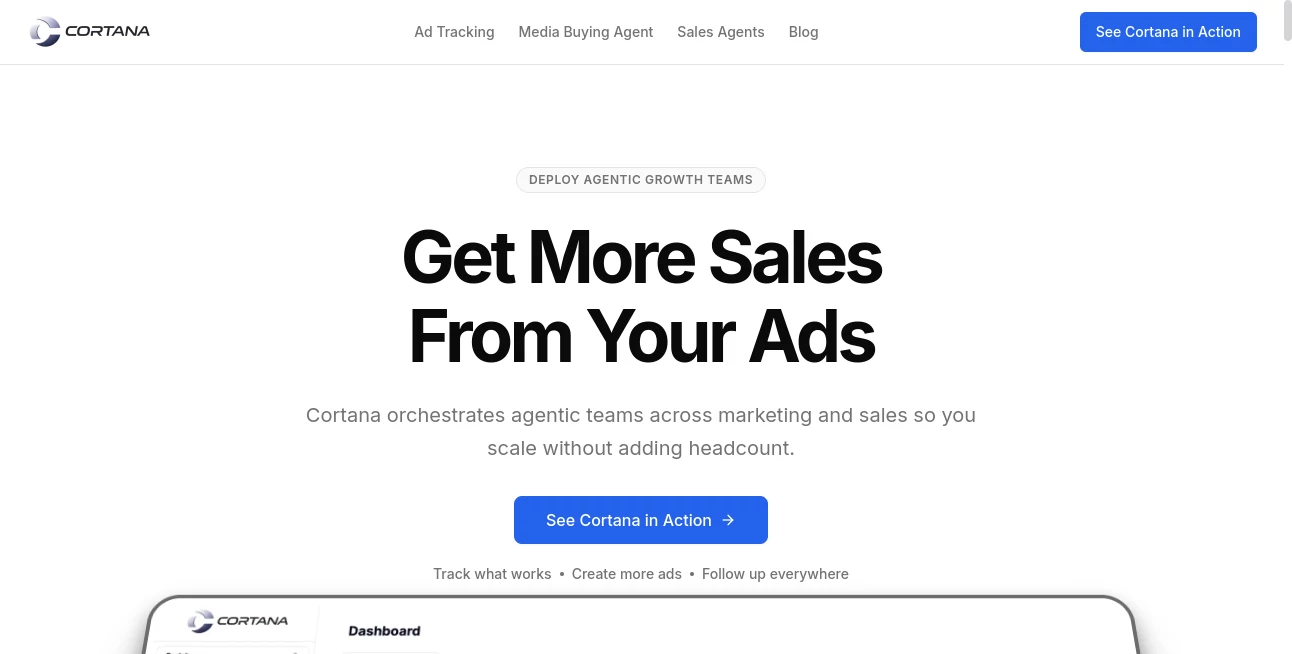
Cortana is an AI-powered growth platform built for businesses that rely on paid advertising and want a tighter connection between ad spend, customer acquisition, and sales. Instead of treating advertising, lead follow-up, and revenue tracking as separate jobs, the platform brings them together through coordinated AI teams.
The idea is straightforward: understand which campaigns are generating real revenue, create more variations around successful advertising angles, and respond to new leads quickly. This makes it particularly interesting for agencies, ecommerce companies, and businesses running sales funnels where every missed lead can become a missed sale.
What makes the approach appealing is that it focuses on the entire customer journey rather than stopping at clicks or impressions. Revenue data from platforms such as Shopify and Stripe can be connected with advertising and CRM data, giving businesses a more complete picture of what is actually working.
Key Features
- Server-side ad tracking and conversion attribution
- Profit-based advertising attribution
- Real-time conversion signals for advertising platforms
- AI-generated advertising creative variations
- Automated testing and optimization of ad creatives
- AI sales agents for lead qualification and follow-up
- Multichannel communication through voice, SMS, WhatsApp, email, and social messaging
- CRM and sales workflow integrations
- Appointment booking and follow-up automation
- Centralized marketing and revenue data
- Analytics and reporting for advertising performance
- Support for multiple advertising and business platforms
User Interface
The platform is designed around a centralized view of advertising, revenue, and sales activity. Rather than forcing users to jump between several disconnected dashboards, the system brings important signals together so teams can see which ads are producing meaningful results and where leads are moving through the funnel.
For a marketing manager, this can make everyday decision-making much easier. Instead of opening an advertising platform, CRM, payment system, and analytics dashboard separately, the relevant information can be connected into a single operating system for growth.
Accuracy & Performance
Performance depends heavily on the quality of the data connected to the account, but the platform takes an important approach by looking beyond surface-level advertising metrics. It can connect purchase and conversion information with advertising activity, helping businesses evaluate campaigns according to revenue rather than clicks alone.
Its server-side tracking and conversion synchronization are especially useful for companies that need stronger attribution across the customer journey. The creative optimization workflow also uses performance data to identify stronger advertising variations and scale successful approaches.
Another practical advantage is speed. New leads can be contacted through automated agents in a short period of time, which can be valuable for businesses where the first few minutes after a lead arrives can influence the likelihood of a response.
Capabilities
The platform combines several functions that are normally handled by different tools. Its advertising side covers tracking, attribution, creative generation, testing, and media buying workflows. On the sales side, AI agents can handle conversations, qualify prospects, schedule appointments, and continue follow-ups across multiple communication channels.
It also supports integrations with services used by modern marketing and sales teams, including Meta, Google Ads, Shopify, Stripe, HubSpot, Pipedrive, GoHighLevel, Zapier, Make, Typeform, Calendly, and TikTok.
This combination makes it more than a simple ad generator or chatbot. The bigger value is the connection between the different stages of acquisition: measuring what works, producing new creative, and making sure incoming leads receive timely attention.
Security & Privacy
Businesses connecting advertising, customer, payment, and CRM data should pay close attention to data handling. The platform states that it uses third-party AI providers to process text and voice information needed for its services and that customer data is not used to train its own AI models.
Its privacy policy also explains that information may be processed by infrastructure, payment, analytics, communication, and AI service providers when required to operate the platform. Connected third-party services may also exchange data where necessary to provide requested integrations.
Companies should therefore review the current privacy policy and integration permissions before connecting sensitive business information, particularly when customer conversations, sales records, and revenue data are involved.
Use Cases
- Advertising agencies: Manage more client campaigns while reducing the amount of manual tracking, creative testing, and lead follow-up.
- Ecommerce businesses: Connect advertising performance with actual purchases and create new creative variations based on winning campaigns.
- Sales funnels: Follow up with new leads quickly, qualify prospects, and automate appointment scheduling.
- Lead generation companies: Keep conversations moving after a form submission instead of leaving leads waiting for a sales representative.
- Performance marketers: Compare campaigns based on revenue and profitability rather than relying only on clicks and platform-reported conversions.
- Growing businesses: Add automation to marketing and sales operations without having to increase headcount at the same pace as advertising spend.
Pros and Cons
Pros
- Combines advertising, attribution, creative testing, and sales automation.
- Focuses on revenue and customer journeys rather than vanity metrics alone.
- Supports a wide range of advertising, ecommerce, CRM, and automation integrations.
- Can automate follow-up across several communication channels.
- Useful for agencies and businesses managing significant paid acquisition activity.
- Connects multiple AI roles into a coordinated workflow instead of relying on isolated agents.
Cons
- The platform is primarily aimed at businesses with established paid acquisition and sales workflows.
- Setting up multiple integrations may require planning and configuration.
- Usage-based charges can apply to certain AI agent, voice, and messaging features.
- There is currently no free trial according to the published terms.
- Businesses with very simple marketing needs may not need such a broad automation system.
Pricing Plans
Pricing is subscription-based and can vary according to the services and usage involved. The published terms explain that subscriptions are generally billed monthly in advance, while certain features such as AI agents, voice calls, and SMS can involve additional usage-based charges.
There is currently no free trial, and the published terms state that fees are generally non-refundable. Because the platform combines several services rather than offering a single simple feature, businesses should review the current pricing and discuss their expected usage before committing to a plan.
How to Use It
- Connect your revenue sources: Link relevant services such as Shopify, Stripe, advertising platforms, and your CRM.
- Set up attribution: Configure tracking so conversions and customer journeys can be connected with advertising activity.
- Review campaign performance: Identify which advertisements are producing meaningful revenue instead of looking only at traffic numbers.
- Generate and test creatives: Use conversion data to create new advertising variations and test different hooks, visuals, and messages.
- Configure sales automation: Set up AI agents to communicate with incoming leads and handle qualification or appointment workflows.
- Monitor results: Review advertising and sales performance regularly and adjust your strategy based on the resulting data.
Comparison with Similar Tools
Many marketing platforms specialize in one part of the acquisition process. An advertising analytics product may concentrate on attribution, an AI creative platform may focus on generating advertisements, and a sales automation product may concentrate on lead conversations. The main distinction here is the attempt to connect these functions within one coordinated system.
For teams that only need one specific capability, a specialized product may be simpler and more economical. However, businesses that are already managing several tools for advertising measurement, creative production, lead follow-up, and CRM automation may find greater value in consolidating those workflows.
The platform is particularly well suited to companies where paid acquisition is a major source of revenue. If advertising spend is relatively small or sales are handled manually at a low volume, many of its advanced capabilities may be unnecessary.
Conclusion
For businesses spending heavily on paid acquisition, the hardest part is often not launching another campaign. It is knowing exactly what generated the sale, producing enough new creative to prevent fatigue, and making sure promising leads receive attention before they disappear.
This platform addresses those problems from several angles at once. Its combination of revenue attribution, AI advertising workflows, creative testing, and automated sales follow-up creates a compelling option for companies looking to build a more connected growth operation.
It is not a magic replacement for a strong marketing or sales strategy. The quality of the underlying data, campaign strategy, offers, and customer experience still matters. But for teams that already have those fundamentals in place, automating the repetitive parts of acquisition can free people to focus on decisions that actually require human judgment.
Frequently Asked Questions (FAQ)
What is this platform used for?
It is designed to help businesses manage paid advertising, revenue attribution, AI-generated ad creatives, lead follow-up, and sales automation from a connected system.
Who can benefit from it?
It is particularly useful for advertising agencies, ecommerce companies, sales funnels, and businesses where paid advertising generates a significant portion of revenue.
Can it track revenue from advertising campaigns?
Yes. The system can connect revenue sources and advertising data to help businesses understand which campaigns and advertisements are contributing to real conversions and revenue.
Can AI agents contact leads?
Yes. AI sales agents can communicate with leads through channels including voice calls, SMS, WhatsApp, email, and social messaging, depending on the configured services.
Does it integrate with other business tools?
Yes. Supported integrations include platforms such as Meta, Google Ads, Shopify, Stripe, HubSpot, Pipedrive, GoHighLevel, Zapier, Make, Typeform, and Calendly.
Is there a free trial?
No. The published terms currently state that the service does not offer free trial periods and that subscriptions begin billing when activated.
Does it replace a human sales team?
It is better viewed as an automation layer that handles repetitive parts of the sales process, such as initial follow-up, qualification, scheduling, and communication. Human sales representatives can still handle complex conversations and closing.
Does it charge extra for AI usage?
Some services, including certain voice calls, SMS messages, and AI agent usage, may have additional usage-based charges depending on the features being used.
AI Sales Assistant , AI Analytics Assistant , AI CRM Assistant , AI Advertising Assistant .
These classifications represent its core capabilities and areas of application. For related tools, explore the linked categories above.

Cortana Alternatives Product

Grow Creator

Liftburst

Period Calcu…

LSGRO

Chatbots AI

Sound Level …

Toflow AI

Naxely

Embedful