
Chiplab
What is Chiplab?
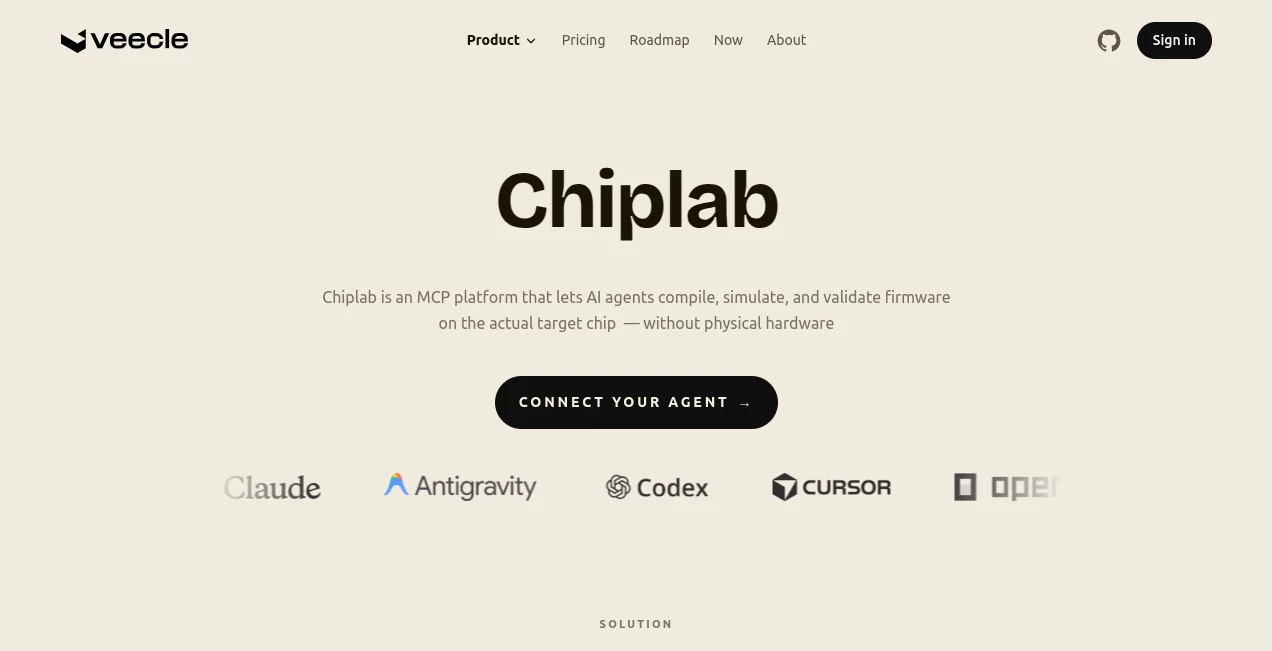
Chiplab is an innovative platform designed to connect artificial intelligence agents with the physical world of embedded systems and hardware development. It enables AI agents to interact with virtual chip environments, allowing developers to build, run, and test firmware without requiring immediate access to physical devices.
Traditional embedded development often involves long testing cycles, hardware availability challenges, and complex debugging processes. This platform changes that workflow by creating a bridge between intelligent software agents and realistic chip simulations, helping engineers experiment faster and improve firmware development efficiency.
For developers working on embedded systems, robotics, automotive technology, and connected devices, this approach opens new possibilities by allowing AI-powered workflows to participate directly in hardware-related tasks.
Key Features
- AI agent integration with virtual hardware environments
- Firmware building, execution, and testing workflows
- Virtual chip simulations without physical hardware requirements
- MCP-based connection between agents and embedded systems
- Support for automated development and testing processes
- Faster experimentation for embedded developers
- Developer-focused tools for hardware innovation
User Interface
The platform focuses on a developer-friendly experience where users can communicate with AI agents through a simple workflow. Instead of manually managing every stage of embedded testing, developers can describe tasks and allow intelligent agents to assist with building, running, and evaluating firmware operations.
The interface is designed around productivity and experimentation, making complex hardware interactions easier to understand for both experienced engineers and teams exploring AI-assisted development.
Accuracy & Performance
By using virtual chip environments, the platform provides developers with a consistent space to test firmware behavior before moving to physical devices. This helps reduce unnecessary hardware iterations and allows teams to identify potential issues earlier in the development process.
The combination of AI reasoning and embedded simulation creates a more efficient development loop where code can be created, tested, reviewed, and improved in a shorter timeframe.
Capabilities
The platform is built for developers creating firmware, embedded applications, and intelligent hardware solutions. It allows AI agents to access hardware knowledge, interact with simulated devices, and perform tasks that normally require manual engineering workflows.
- Firmware development assistance
- Embedded system experimentation
- Virtual hardware testing
- AI-assisted debugging workflows
- Automation of repetitive engineering tasks
- Support for next-generation hardware projects
Security & Privacy
Security is an important consideration for embedded development environments. By enabling testing inside controlled virtual environments, teams can experiment with firmware workflows before deploying changes to real devices.
Organizations can use this type of workflow to improve development processes while maintaining better control over testing stages and engineering operations.
Use Cases
This technology can support many industries where embedded software and hardware development are essential. Automotive companies can explore firmware improvements, robotics teams can test intelligent behaviors, and IoT developers can accelerate connected device development.
- Automotive embedded systems
- Robotics and autonomous devices
- IoT product development
- Firmware engineering teams
- Hardware prototyping
- Developer research projects
Pros and Cons
Pros
- Reduces dependency on physical hardware during early development
- Creates faster testing cycles
- Combines AI agents with embedded workflows
- Useful for modern hardware development teams
- Helps developers experiment with new ideas quickly
Cons
- Primarily designed for developers with technical knowledge
- Virtual environments may not replace every physical testing scenario
- Advanced embedded projects may still require real hardware validation
Pricing Plans
The platform uses a credit-based pricing model instead of traditional seat-based subscriptions. Users receive free credits to explore the available features, while additional usage can be purchased when larger workloads are required.
- Free Plan: Available with daily credits for testing and exploration
- Pay-As-You-Go: Purchase additional credits based on usage
- Enterprise: Custom solutions, integrations, and deployment options
How to Use Chiplab
- Create an account and access the development environment.
- Connect an AI agent workflow to the available hardware simulation tools.
- Describe firmware tasks or testing requirements.
- Allow the agent to build, run, and evaluate firmware operations.
- Review results and improve the development process.
Comparison with Similar Tools
Unlike general AI coding assistants that focus mainly on software development, this platform targets the connection between AI agents and embedded hardware. It focuses on solving a unique challenge: allowing intelligent systems to understand and interact with the hardware layer.
Developers who need assistance with traditional programming may prefer standard coding assistants, while teams building firmware and physical devices can benefit from a specialized environment that understands embedded workflows.
Conclusion
Chiplab represents a new direction in AI-assisted engineering by bringing intelligent agents closer to the physical systems they help create. By combining virtual chip environments with AI-powered workflows, it helps developers reduce development friction, test ideas faster, and explore new possibilities in embedded technology.
For engineers, startups, and organizations building the next generation of connected devices, this type of platform provides a valuable foundation for creating smarter and more efficient hardware development processes.
Frequently Asked Questions (FAQ)
What is Chiplab used for?
It helps developers connect AI agents with virtual hardware environments to build, run, and test firmware workflows.
Can it replace physical hardware testing?
It can reduce the need for early hardware testing, but real devices may still be required for final validation.
Who can benefit from this platform?
Embedded developers, robotics engineers, automotive teams, and IoT builders can use it to improve their development workflows.
Does it require advanced programming knowledge?
Because it focuses on embedded systems and firmware, basic programming and hardware development knowledge is recommended.
Is there a free plan available?
Yes, users can start with free credits and upgrade based on their usage requirements.
AI Testing & QA , AI Code Assistant , AI API Design , AI Developer Tools .
These classifications represent its core capabilities and areas of application. For related tools, explore the linked categories above.

Chiplab Alternatives Product

Lovable APP

freellm.net

Standard Com…

Empiriolabs …

Defapi
Timestamp Ro…

TruthSpine

UPDF AI

VercelAPP