















Vynaris
What is Vynaris?
Modern AI applications do not always need the largest model available for every request. A simple classification task, document summary, or structured extraction job can often be handled by a smaller model while more demanding reasoning tasks still benefit from a frontier model. The challenge is deciding which model should handle each request without rebuilding an entire application around different providers.
Vynaris is an OpenAI and Anthropic-compatible inference gateway designed to solve that problem. Instead of forcing developers to manually choose a model for every request, it can route requests toward lower-cost models when evaluation evidence shows that they are suitable, while escalating more demanding requests when necessary.
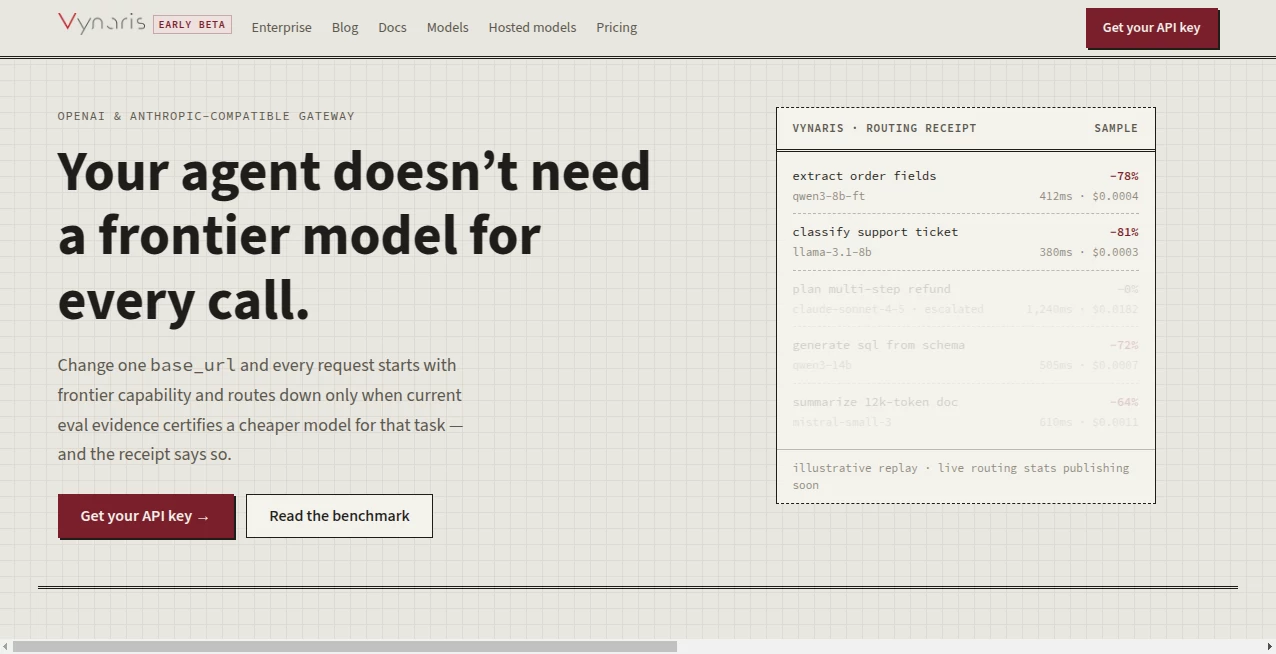
What makes the approach particularly interesting is the level of cost visibility. Each routed response can include information about the model that actually served the request, its cost, the baseline price, and the resulting saving. For teams managing large volumes of AI requests, that level of attribution can make model spending much easier to understand.
Key Features
User Interface
The product is primarily designed for developers rather than casual users, so the main experience revolves around the API, dashboard, documentation, model information, pricing and usage records.
The integration is intentionally lightweight. Developers can keep their existing OpenAI-compatible SDK, prompts and tool definitions and change the API base URL. The service also provides examples for Python, TypeScript, Claude Code and cURL, making it easier to test the integration with an existing application.
The dashboard and usage records are especially useful for teams that want to understand where their API budget is going instead of relying on a single blended usage figure.
Accuracy & Performance
The routing system starts from a quality-focused model pool and only allows a less expensive model to handle a task when the relevant evaluation evidence passes its quality gate. When a smaller model is not suitable, the request can be escalated rather than forcing an inexpensive model to handle a difficult job.
The website reports measured savings on routed requests compared with the requested model's list price, with examples showing substantial reductions for tasks such as extracting order information, classifying support tickets, generating SQL and summarizing documents. These figures are workload-dependent rather than a universal guarantee, so the receipt attached to an individual request is the more useful measure for a real application.
Latency can also vary depending on the selected model and whether hosted capacity needs to start after an idle period. This is an important consideration for applications where response time matters as much as token cost.
Capabilities
- OpenAI-compatible API integration
- Compatibility with Anthropic-oriented workflows
- Automatic model routing based on task requirements
- Escalation to a more capable model when required
- Per-request model and cost attribution
- Exportable usage ledger and CSV records
- Prepaid API credits with no overage charges on the standard plans
- Hosted reduced-refusal models for authorized security testing and model evaluation
- Support for long-context hosted models with up to 128K tokens on listed models
- Enterprise self-hosting options for higher-volume workloads
For developers building AI agents, one of the strongest advantages is the ability to keep the application architecture largely unchanged while moving model-selection logic into the gateway layer.
Security & Privacy
Privacy controls are an important part of the service. The provider states that it does not train on customer content, while also distinguishing between request metadata and full transcript storage. Standard metadata can include information such as the selected model, token counts, cost and latency.
For hosted reduced-refusal model IDs, prompt and output bodies are not persisted. The privacy policy also explains that prompts and completions pass through to the provider serving a request, so developers should still consider the data policies of the underlying provider when selecting a routing path.
Security-testing capabilities are intended for lawful and authorized red teaming, defensive engineering and model evaluation. The service explicitly prohibits abusive or illegal use cases.
Use Cases
One practical use case is AI agent development. Agents frequently make many relatively simple model calls, and sending every tool-related request to an expensive frontier model can quickly increase operating costs. Automatic routing can give routine calls access to smaller models while reserving more capable models for tasks that genuinely need them.
Customer-support automation is another good example. A lightweight model may be sufficient for ticket classification, while a complicated refund request can be escalated to a stronger model. This approach can reduce unnecessary spending without requiring developers to manually maintain a model-selection rule for every request.
Document processing is also a natural fit. Tasks such as extracting fields, summarizing long documents or generating structured information can have very different complexity levels. A routing layer can help match those tasks with an appropriate model.
Developers working with SQL generation, internal tools, automation workflows and large-scale API applications can also benefit from detailed cost attribution. Instead of asking only how many tokens were consumed, a team can see which model handled a request and how that affected the final charge.
Security researchers and authorized red teams have another option through the hosted reduced-refusal model collection. These models are intended for controlled testing, defensive research and evaluation rather than unrestricted or harmful activity.
Pros and Cons
Pros
- Simple migration for applications already using compatible APIs
- Automatic routing can reduce unnecessary frontier-model usage
- Per-request receipts provide unusually clear cost attribution
- Usage records can be exported for independent analysis
- No training on customer content according to the provider's policy
- Prepaid credit avoids unexpected overage charges on standard plans
- Hosted models provide an additional option for authorized security research
- Enterprise deployments can run on customer infrastructure
Cons
- Routing savings depend heavily on the workload and task mix
- Some requests may experience additional latency during model selection or escalation
- Self-serve usage does not come with a general uptime guarantee
- Applications with highly specialized model requirements may still need direct provider integrations
- Developers must consider the policies of third-party providers used for routed requests
Pricing Plans
The pricing model combines prepaid API usage with optional monthly plans. Router requests are charged according to the provider price of the model that actually handles the request, plus a routing fee. The published routing fee is 3% for the first $500 of monthly usage and 1% after that threshold, while prepaid top-ups start at $20 and do not expire.
The S plan costs $20 per month and provides $20 in API credit, automatic routing, the full model pool, an OpenAI-compatible API, per-request receipts, a CSV ledger, rollover of unused credit and no overage charges.
The L plan costs $45 per month and provides $45 in API credit. It adds access to privately hosted reduced-refusal models while retaining the routing, privacy and usage-accounting features.
The XL plan costs $150 per month and provides $150 in API credit. It is aimed at daily usage and lighter production workloads and includes access to the full model pool and privately hosted models.
Hosted model pricing is separate according to the selected model. Published rates include $1 per million input tokens and $5 per million output tokens for the listed Qwen3.6 35B-A3B model, while other hosted models have their own token rates.
How to Use the Gateway
Getting started is straightforward for developers already working with compatible APIs. First, create an account and obtain an API key. Next, configure the application to use the provided API endpoint instead of the existing provider endpoint.
For an OpenAI-compatible Python application, the main migration can be as simple as changing the base URL and API key while keeping the existing client structure. The model can then be set to automatic routing when the application should allow the gateway to choose an appropriate model.
After sending requests, developers can inspect the response information to see which model handled the request, what it cost and what the baseline direct price would have been. This makes it possible to compare actual application economics rather than relying on theoretical savings.
Teams using hosted models can instead specify the exact hosted model ID in the standard model field. This is useful when a particular model is preferred for authorized testing, coding or long-context evaluation.
Comparison with Similar Tools
Traditional AI API usage usually requires developers to select a provider and model directly. That approach offers control, but it also means the application team is responsible for deciding when a cheaper model is sufficient and when a stronger model is necessary.
Model aggregators can simplify access to multiple providers, but their pricing and routing visibility can differ considerably. The approach here places more emphasis on per-request attribution, showing the model used, the applicable cost and the comparison baseline instead of presenting only a blended usage number.
For teams that prefer complete control over model selection, direct provider APIs may still be the better choice. For teams running high volumes of mixed-complexity requests, however, an intelligent routing layer can reduce the amount of model-selection logic that needs to live inside the application itself.
Conclusion
For developers building AI agents, automations and API-driven applications, model selection is becoming an operational decision as much as a technical one. Sending every request to the most powerful available model can work, but it is rarely the most economical strategy.
This inference gateway takes a practical approach: start with strong model capability, route downward when evaluation evidence supports it, escalate when the task demands more intelligence, and show the financial result on the request itself.
The transparent receipt system is arguably the most compelling part of the product. Instead of asking developers to simply trust a percentage-based savings claim, it gives them information they can inspect and export against their own traffic. For teams that care about both AI quality and infrastructure costs, that makes the service worth evaluating.
Frequently Asked Questions (FAQ)
What is this service designed for?
It is designed as an inference gateway for AI applications, agents and developer workflows that need access to multiple language models while controlling cost and model-selection complexity.
Does it require rewriting an existing application?
For compatible OpenAI or Anthropic-oriented integrations, the migration is designed to be lightweight. Developers can generally keep their SDK, prompts and tool definitions while changing the API endpoint and authentication details.
How does automatic routing work?
Requests begin in a quality-focused model pool. Less expensive models become eligible when the relevant evaluation evidence meets the routing quality requirements. More difficult requests can be escalated to a stronger model.
Can developers see which model handled a request?
Yes. Response information can identify the served model and provide cost-related details. The usage ledger can also be exported for further analysis.
Does the service train models using customer data?
The published privacy policy states that the service does not train on customer content. Data handling can still differ depending on the underlying provider and the settings selected for an API key, so teams should review the applicable provider policies for sensitive workloads.
Are hosted reduced-refusal models available?
Yes. Several hosted models are available for authorized security testing, defensive engineering and model evaluation. Hosted model IDs have their own published token pricing and can be accessed through the compatible API.
Can unused monthly credit roll over?
Yes. The published monthly plans state that unused credit rolls over, while additional top-ups can be made when needed.
Is there an enterprise option?
Yes. Higher-volume customers can use a self-hosted enterprise setup on their own infrastructure, allowing their own provider accounts and data environment to remain under their control.
Large Language Models (LLMs) , AI Developer Tools .
These classifications represent its core capabilities and areas of application. For related tools, explore the linked categories above.
Vynaris details
Website unavailable — View Alternatives
Pricing
- Paid
Apps
- Web App
Categories

Vynaris Alternatives Product

You.bot

KaneAI

AI Agent Ski…
Keebye

Agent Grid

GOLANG COLLE…

NetlifyAPP

PatentFig AI

TokenCalcula…